
The Federal Government has introduced a new partnership framework involving the federal and state governments as well as private investors to accelerate the development of Nigeria’s livestock industry.
The initiative will involve the establishment of species-specific Livestock Development Centres across the country, with each centre designed around the livestock opportunities and economic strengths of its host state.

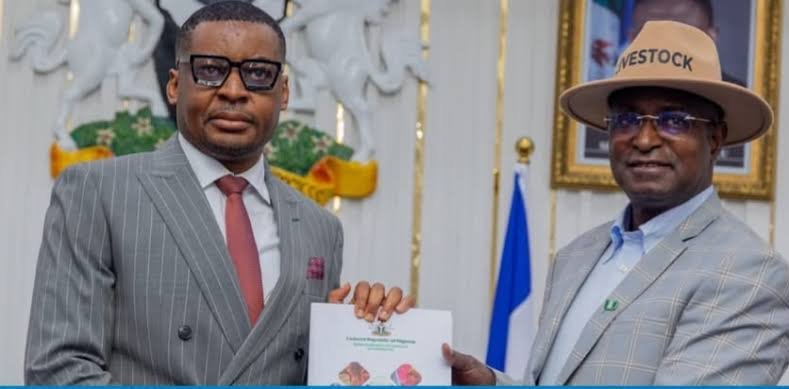
The Minister of Livestock Development, Idi Maiha, announced the initiative during a ministerial press briefing, describing it as a key part of the livestock transformation programme of President Bola Tinubu’s administration.
Maiha explained that the proposed centres would not be conventional government farms or projects driven solely by public funding. Instead, they would function as commercially oriented clusters designed to attract investment and develop different stages of livestock production.
Under the proposed model, each participating state would identify a livestock species or value chain that best suits its environment, available feed and water resources, market opportunities, community acceptance and investment prospects.
The centres could support activities ranging from animal breeding, feed and fodder production and veterinary services to aggregation, cattle finishing, dairy production, poultry, sheep and goat farming.
Other components could include meat and dairy processing, cold-chain facilities, logistics, biogas production and organic fertiliser manufacturing.
Read Also:
- FG Raises Alarm Over Vandalism Threat to Lagos-Calabar Coastal Highway
- FG, Bank Of Agriculture Partner To Create Sustainable Livelihoods For 80m Vulnerable Nigerians
- FG Begins Distribution Of Starter Packs To 18,510 TVET Beneficiaries
- Visitor Visa, Electronic Travel Authorization No Guarantee Of Employment, Canada Warns Foreigners
- Australia Announces Foreigners Eligible For Reduced Citizenship Application Fee
- Police Arrest Suspected Cultist, Recover Locally Made Pistol in Lagos
- Fire Razes Two Flats in Gombe, Destroys Property Worth N80m
- Jowizaza’s Sister Blames Social Media Image For Father’s Kidnapping Ordeal
According to the minister, the approach is intended to address some of the longstanding challenges limiting the livestock industry, including inadequate infrastructure, poor access to feed and water, weak veterinary services, insecurity and insufficient private-sector investment.
The initiative is also linked to the National Livestock Growth Acceleration Strategy (NL-GAS), which was approved by the National Economic Council.
The strategy seeks to increase the livestock sector’s contribution to Nigeria’s Gross Domestic Product from about $32 billion to at least $74 billion by 2035.
Maiha said the development of livestock value chains closer to major consumption centres could also reduce the cost and risks associated with transporting live animals over long distances.
He noted that moving livestock for more than 1,000 kilometres from production areas in the northern part of the country to markets in the south exposes farmers and traders to considerable logistical challenges and additional costs.
Rather than adopting a single model nationwide, the minister said states would be encouraged to develop livestock businesses according to their individual comparative advantages and market needs.
Under the proposed partnership, the Federal Ministry of Livestock Development will be responsible for national policy direction, technical standards, food safety, animal health protocols, traceability systems, data management, investor support and regulatory coordination.
State governments, on their part, are expected to make available suitable and properly documented land while providing local infrastructure, facilitating community engagement and coordinating security and investment activities.
Private investors and producer organisations will provide financing for the commercial components of the centres and take responsibility for their development and operations.
Maiha said the arrangement would allow livestock development policies to reflect the different realities across the country rather than impose a uniform system on all states.
He noted that livestock production varies considerably across Nigeria because of differences in climate, water and feed availability, disease patterns, land-use arrangements, production practices and consumer demand.
The minister said the programme was expected to contribute to food and nutrition security, job creation and rural economic development while also promoting greater stability within livestock-producing communities.
He added that women and young Nigerians would be encouraged to participate in livestock enterprises, processing, value addition and service provision across the various value chains.
Maiha said the broader objective was to establish a modern and commercially viable livestock industry capable of contributing significantly to food security, employment, wealth creation and rural development.
He added that the Federal Government would continue consultations with state governments, livestock producers, private investors and other stakeholders to design the development centres around the specific opportunities and requirements of participating states.