
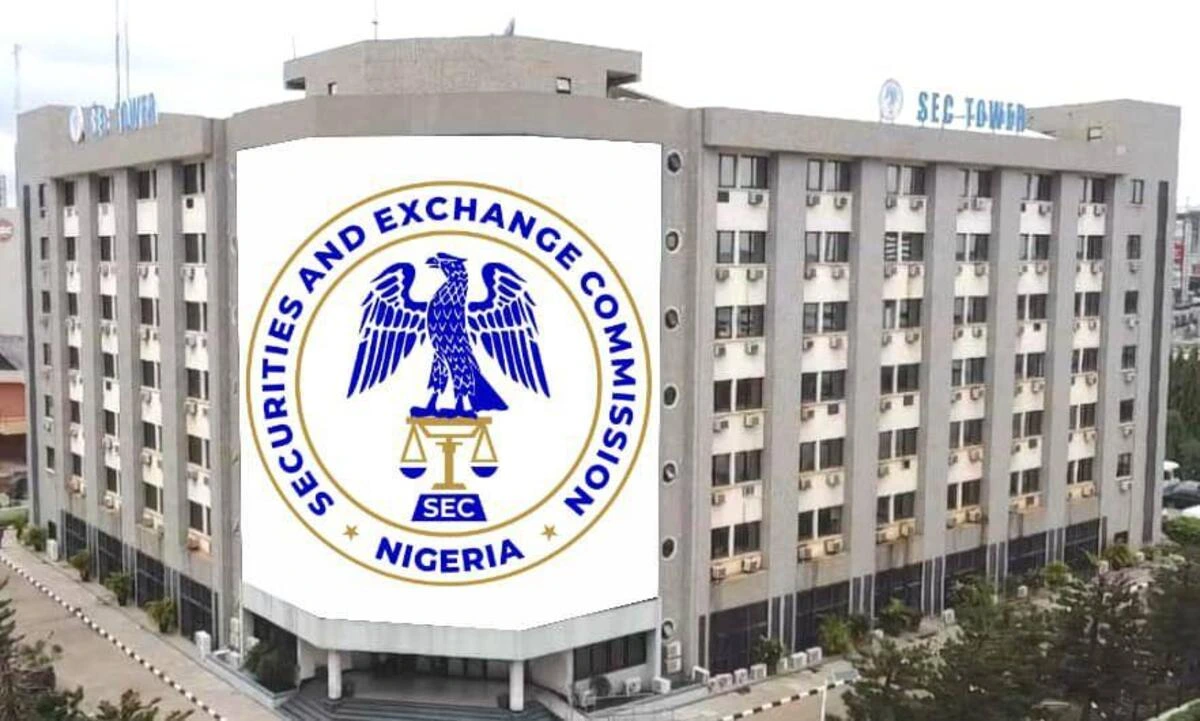
The Securities and Exchange Commission (SEC) has directed capital market operators to immediately freeze funds, assets and other economic resources linked to six individuals and three entities designated as terrorist financiers by the Nigeria Sanctions Committee.
The directive, which takes immediate effect, requires all capital market-regulated entities to identify and freeze the assets of the listed individuals and organisations without prior notice and report all actions taken to the secretariat of the Nigeria Sanctions Committee.

The SEC disclosed this in a circular signed by its management and published on its website, stating that the designations were made under the Terrorism (Prevention and Prohibition) Act (TPPA) 2022.
The commission also ordered regulated operators to stop dealing with the designated persons and entities and maintain continuous monitoring of transactions involving them.
The individuals named on the Nigeria Sanctions List are Babangida Muhammed Adamu Hammajam, Abdullahi Umar Usman, Ibrahim Abubakar, Adamu Chiroma, Muktar Muhammad Adamu and Yakubu Ogirima Ibrahim.
The three entities are Nine to Nine BDC Limited, Generation Currency BDC Limited and Abbal Bako & Sons Bureau de Change.
According to the SEC, operators must immediately identify and freeze all funds, assets and other economic resources in the possession of, owned or controlled by the designated persons and entities.
They are also required to report any attempted transactions involving the listed individuals or entities.
The commission said reports submitted to the Nigeria Sanctions Committee secretariat must detail assets frozen, measures taken to comply with the sanctions and any attempted transactions involving the designated persons.
As part of broader anti-money laundering and counter-terrorism financing measures, the SEC directed capital market operators to file suspicious transaction reports with the Nigerian Financial Intelligence Unit (NFIU) whenever a name match is identified involving any person or entity on the sanctions list.
The requirement applies to financial transactions carried out both before and after operators receive the sanctions list, underscoring the need for enhanced customer screening and continuous transaction monitoring.
“Take note that at all times, any unusual or suspicious transactions must be promptly reported to the Nigerian Financial Intelligence Unit (NFIU),” the commission stated.
The SEC said the directive is part of efforts to prevent Nigeria’s capital market from being exploited to move, conceal or facilitate funds linked to terrorism and other illicit financial activities.
The commission said Hammajam was listed on June 18, 2026, over alleged involvement in terrorism financing and support for the Islamic State West Africa Province (ISWAP).
Usman was designated over allegations that he provided material support to a designated terrorist organisation through repeated financial transactions, while Ibrahim was listed over alleged involvement in terrorism financing and membership of ISWAP.
The sanctions require capital market operators to exercise heightened vigilance when dealing with customers and counterparties and immediately escalate transactions that raise concerns under Nigeria’s anti-money laundering and counter-terrorism financing framework.
Read also:
- Interpol arrests 11 suspected terrorists in Nigeria during global crackdown on terror financing
- FG declares Simon Ekpa, 15 others as terrorists financiers
- CBN Orders Banks To Freeze Accounts Linked To Terror Financing Suspects
- Europe’s Labour Market Growth Slows as Turkey, Hungary Lead Employment Declines
- Presidency Sets Deadline for Public Input on State Police Bill
- CSDA to Provide Water, Toilets at SUMAS Teaching Hospital
- 2027: Cross River PDP Promises Local Government Financial Autonomy
- Ogbeni Adan Sparks Online Storm With Emotional Claims Against Mother
The regulator warned that failure by any regulated entity to comply with the directive would amount to a violation of the Investments and Securities Act, 2025, and the SEC’s Anti-Money Laundering and Countering Financing of Terrorism (AML/CFT) Rules and Regulations.
According to the commission, non-compliant operators could face regulatory sanctions, including fines, suspension of operations or revocation of registration.
The directive therefore places an immediate compliance responsibility on capital market operators to screen their records, identify potential matches, restrict access to affected assets where applicable and promptly report relevant transactions and compliance measures to the appropriate authorities.
The SEC said the measures are intended to strengthen Nigeria’s financial system against terrorism financing and ensure that the country’s capital market does not become a channel for illicit financial flows.