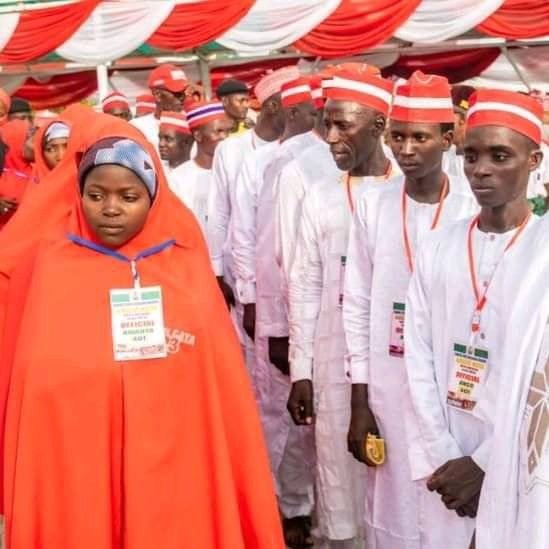
The decision of the Kano State government’s to spend ₦1.5 billion on a mass wedding involving 1,500 couples has triggered a fierce debate online, with Nigerians questioning whether sponsoring marriages is the best way to tackle poverty and unemployment in the state.
The mass wedding package reportedly covers medical screening, dowries, furniture, food supplies and other items for the couples.

At roughly ₦1 million per couple, the initiative has quickly become a subject of heated political and social debate, particularly over whether public funds should be used to encourage marriage and childbirth when many residents are struggling with unemployment, education, housing and the rising cost of living.
Rather than celebrating the initiative, several Nigerians on X have questioned the government’s priorities, with some suggesting that the money could have been channelled into job creation, education and other poverty-reduction programmes.
Reacting to the report, @Ozzmanic questioned the logic behind encouraging people who may already be struggling financially to marry and have more children.
“How does it make sense to encourage people that can’t afford a wedding to marry and continue producing more children for who to take care of?” he questioned.
The user also sarcastically raised concerns about possible misuse of public funds surrounding the programme.
Another user, @Reincarnat48772, expressed anger over the development and questioned how Nigeria is perceived internationally because of such government policies.
The comment, however, descended into an ethnic attack against people from Northern Nigeria.
Meanwhile, @OmniMyne took a political angle, alleging that the mass wedding could be connected to electoral calculations.
The user wrote that if the couples genuinely supported the initiative, they should “bring am back 2027,” suggesting that the government could be hoping to win political support from beneficiaries.
For @ifeday_o, the solution to poverty is not government-sponsored marriages, adding “provide job and watch people married by themselves without being forced by money.”
The comment struck at the heart of the controversy: whether governments should be spending millions to facilitate weddings when many young Nigerians are struggling to secure employment and build sustainable livelihoods.
Another user, @sleeks2010, took the debate further by asking “at what point will the South decide is enough and the country should just divide, at exactly what point.”
The reaction reflects the extent to which the issue has moved beyond marriage and into Nigeria’s longstanding political and regional tensions.
@Moniepawn accused the government of using development programmes and mass weddings as political tools, alleging that the initiative could be aimed at influencing voters in Northern Nigeria.
Read Also:
- FG Seeks Stronger China Partnership to Drive $1tn Economy Goal
- FG to Launch Nationwide Household Survey to Identify Out-of-School Children
- FGC Ilorin Alumni Oppose Planned Privatisation of Unity Schools, Donate Learning Facilities
Similarly, @thugcwx questioned the rationale behind the programme and made a controversial comment about population growth, while @Fresh_pumpkin alleged that mass weddings could be connected to efforts to increase the population for electoral purposes.
That claim, however, is an unverified opinion expressed by the user and should not be treated as an established fact.
One of the more straightforward criticisms came from @emmakudos, who argued that the government could have used the same ₦1.5 billion to improve education.
“Imagine the amount of money they spent in marriage and wouldn’t spend it to take their people to school. Misplaced priority,” he said.
The comment has reignited the familiar Nigerian debate over government spending versus long-term development.
While supporters may argue that mass weddings can help vulnerable couples who genuinely intend to marry but cannot afford the associated costs, critics are asking a much bigger question: Should a government be spending scarce public resources on weddings when thousands of young people are unemployed and families are struggling to survive?
At ₦1.5 billion for 1,500 couples, the controversy is not simply about weddings.
It is about what Kano State considers an urgent investment in its people marriage, household support and family formation, or jobs, schools and economic opportunities.