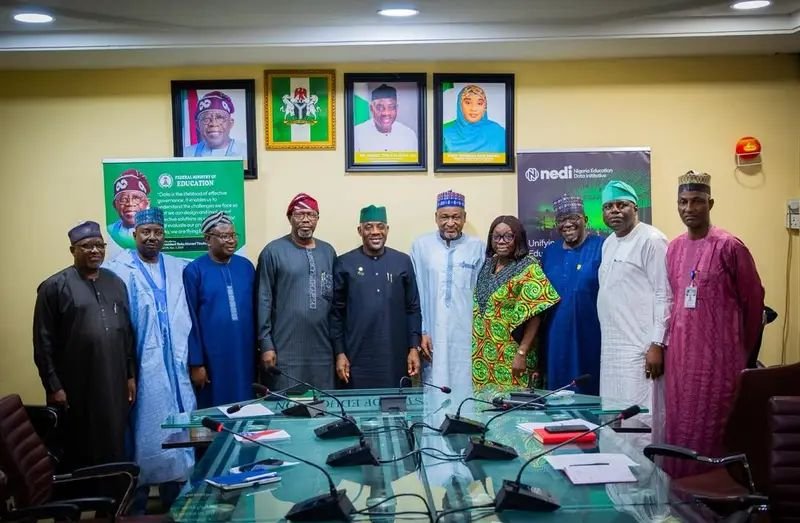
The Federal Government has inaugurated the Governing Board of the National Board for Technical Education (NBTE), ending more than five years without a governing board and unveiling an ambitious reform agenda aimed at transforming Technical and Vocational Education and Training (TVET) into a major engine of industrialisation, job creation and economic growth.
The inauguration marks a significant milestone in the Federal Government’s broader education reform programme, which seeks to reposition technical education as a critical pillar of Nigeria’s drive towards a knowledge-based and skills-driven economy.

Speaking at the ceremony, the Minister of Education, Dr. Tunji Alausa, charged the newly constituted board to accelerate reforms that will strengthen technical education, align training with industry demands and equip young Nigerians with skills needed for the modern labour market.
He described the inauguration as a major step in implementing President Bola Ahmed Tinubu’s Renewed Hope Agenda, which places education and human capital development at the centre of national economic transformation.
According to Alausa, Nigeria must move beyond an education system that places excessive emphasis on academic certificates and instead prioritise practical skills capable of driving innovation, entrepreneurship and industrial productivity.
He expressed confidence that the new board would provide the strategic direction required to reposition NBTE and strengthen technical and vocational education across the country.
The minister stressed that TVET should no longer be viewed as an alternative for students unable to pursue university education.
Rather, he said, it should be recognised as a strategic pathway for producing technicians, technologists, engineers, artisans, automation specialists, machine operators and other skilled professionals essential for national development.
“No country has achieved sustainable industrialisation without investing heavily in technical skills development,” Alausa said.
He noted that the Federal Government has already begun implementing policies designed to bridge the gap between education and industry while ensuring that graduates possess practical competencies demanded by employers.
To accelerate the transformation, the minister outlined four priority areas for the board.
The first, he said, is to provide effective governance and strategic oversight capable of repositioning NBTE as a globally competitive regulatory institution.
Secondly, he directed the board to accelerate the implementation of the Recognition of Prior Learning (RPL) programme, an initiative designed to formally assess and certify artisans and skilled workers who acquired their competencies outside the formal education system.
According to him, certification under the National Skills Qualification Framework will improve employability, increase access to financing opportunities, facilitate participation in government procurement processes and enhance labour mobility across ECOWAS member states.
The minister also urged the board to collaborate closely with the Industrial Training Fund (ITF), employers and other industry stakeholders to expand the programme nationwide.
Alausa’s third priority centres on comprehensive curriculum reform.
He directed NBTE to review technical education curricula using the Outcome-Based Education (OBE) model, ensuring that programmes reflect the realities of the Fourth Industrial Revolution.
The revised curricula, he said, should integrate emerging fields such as artificial intelligence, robotics, automation, advanced manufacturing, renewable energy, digital technology and green economy skills.
He also encouraged polytechnics to gradually discontinue programmes outside their technical mandate while strengthening engineering, technology and applied science disciplines.
The fourth priority focuses on transparency, accountability and measurable outcomes.
Read also:
- FG releases lists trade areas for technical education
- Provost pushes for ICT-driven reforms in Technical Education
- Enugu Government trains 1,000 science, technical, vocational teachers for improved learning
The minister emphasised that every public investment in technical education must deliver tangible improvements in institutional performance, skills acquisition, youth employment and national productivity.
Responding on behalf of the board, its Chairman, Prof. Babatunde L. Salako, thanked President Tinubu and the Minister of Education for the confidence reposed in the members.
He pledged that the board would work to expand opportunities for young Nigerians to acquire industry-relevant technical skills while promoting innovation and entrepreneurship.
Salako said changing public perception of technical education would be one of the board’s immediate priorities.
According to him, technical and vocational education should be seen as a respected career pathway capable of producing wealth creators, innovators and globally competitive professionals.
Also speaking, the Executive Secretary of NBTE, Prof. Idris M. Bugaje, described the inauguration as historic, noting that the regulatory agency had operated without a governing board for more than five years.
He commended the Minister of Education for driving reforms within the sector and assured that the board would work closely with the Federal Ministry of Education to implement the administration’s ambitious TVET transformation agenda.
The inauguration comes as the Federal Government intensifies efforts to reposition technical education as a cornerstone of its education reforms.
Recent interventions include the revitalisation of technical colleges, expansion of skills acquisition programmes, industry-led curriculum reforms, increased investment in vocational training and plans to certify millions of Nigerian artisans through the Recognition of Prior Learning framework.
The reforms form part of the government’s broader strategy to close Nigeria’s widening skills gap, improve workforce productivity and build the technical capacity required to support industrial growth, manufacturing expansion and the country’s ambition of becoming a $1 trillion economy.