The Federal Government has unveiled plans to establish a dedicated medical institution that will train doctors, nurses and other healthcare professionals exclusively for the Nigerian Armed Forces, with the first intake of military medical cadets scheduled for the 2026 academic session.
Key Highlights
- The Federal Government will establish the Armed Forces College of Medicine and Health Sciences to train healthcare professionals exclusively for the Nigerian Armed Forces.
- The college is expected to admit its first batch of military medical cadets in the 2026 academic session.
- Education Minister Dr. Olatunji Alausa said the initiative will reduce the military’s reliance on civilian universities for training doctors, nurses and allied health professionals.
- A Technical Working Group has been inaugurated to oversee curriculum development, accreditation and the institution’s take-off.
- The college will offer integrated academic and military training, including battlefield medicine and Tactical Combat Casualty Care.
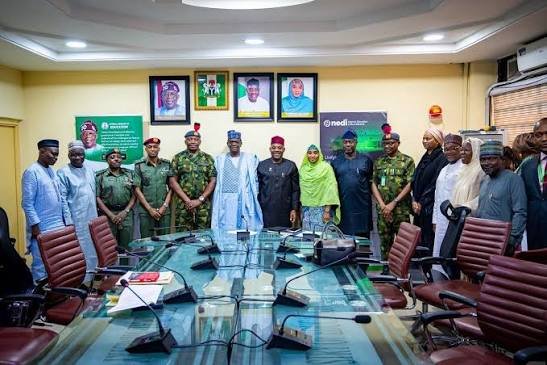
Minister of Education, Dr. Olatunji Alausa, announced the initiative on Friday in Abuja during the inauguration of a Technical Working Group established to fast-track the creation of the Armed Forces College of Medicine and Health Sciences.

According to a statement issued by the Minister’s Special Adviser on Media and Communications, Ikharo Attah, the proposed college is aimed at ending the military’s long-standing reliance on civilian universities for the training of medical personnel by creating a specialised institution dedicated to military healthcare education.
Alausa described the project as a major investment in national security and human capital development, saying the inauguration of the Technical Working Group marked the transition from policy formulation to implementation.
“We cannot continue to leave the brave men and women who defend our nation without a sustainable system for training the healthcare professionals they require.
Neither can we continue to expect the Armed Forces to compete with the rest of the country for the limited number of doctors graduating from our universities,” the minister said.
He explained that the institution would produce healthcare professionals specifically trained to meet the operational and emergency medical needs of the Armed Forces, both during combat and in peacetime.
The minister noted that the initiative complements the Federal Government’s broader reforms to expand medical education across Nigeria.
He disclosed that annual admissions into Medicine and Dentistry have increased from about 5,000 before the current administration to 10,405 students, while the government aims to raise admissions to at least 20,000 within the next two years through the accreditation of additional medical colleges.
Alausa also revealed that annual enrolment into nursing programmes has grown from about 28,000 to nearly 120,000 nationwide, exceeding the administration’s target.
While commending the Nursing and Midwifery Council of Nigeria for maintaining high professional standards, he stressed that the military requires a dedicated institution capable of producing healthcare personnel with specialised military training.
Read also:
- Defense Chief Reaffirms Commitment to Strengthening Local Defence Manufacturing During DICON Visit
- Why Is Israel Skeptical of Peace Deals? Inside the Security Calculations Driving the Conflict
- Makinde Imposes 16-Hour Curfew on 10 Oyo LGAs as Insecurity Deepens Around Old Oyo National Park
- 20 Militants Killed As US-Saudi Airstrikes Hit Iran-Backed Groups
“This institution is not being established to compete with conventional universities. It is being established to make the Armed Forces self-sufficient in producing the healthcare professionals they require.
“Every programme should answer one simple question: Does the Armed Forces need it? If the answer is yes, then it should be prioritised,” he stated.
Alausa directed the Technical Working Group to prioritise programmes such as Occupational Therapy, Speech Therapy and other specialised disciplines that would support the treatment and rehabilitation of personnel recovering from combat-related injuries.
The committee, comprising representatives from the Federal Ministry of Education, Ministry of Defence, National Universities Commission, Medical and Dental Council of Nigeria, Nursing and Midwifery Council of Nigeria, the Nigerian Defence Academy and other key institutions, has been mandated to develop the academic curriculum, integrate military and academic training, coordinate accreditation, facilitate appointments of key academic personnel and work with the Joint Admissions and Matriculation Board (JAMB) to ensure the institution commences academic activities during the 2026 academic session.
The minister further disclosed that discussions had already been held with the JAMB Registrar to include the college on the admissions portal, while the National Universities Commission had been directed to fast-track resource verification and accreditation processes.
Providing an update on preparations, the Director-General of the Ministry of Defence Health Implementation Programme and Chairman of the Technical Working Group, Major General Idris Babatunde Solebo, said the college is being developed using the model of the Uniformed Services University in the United States.
According to Solebo, medical cadets will undergo integrated academic and military training throughout their education, acquiring expertise in battlefield medicine, Tactical Combat Casualty Care and other specialised military medical competencies.
He disclosed that the institution will be located at the Nigerian Army Reference Hospital in Kaduna, where existing infrastructure will support its immediate take-off.
Solebo also revealed that the Armed Forces currently face an estimated 93 per cent shortage of medical personnel, making the establishment of the college essential to ensuring a sustainable supply of doctors, nurses and allied health professionals for military operations.
Alausa thanked the Minister of Defence and the Minister of State for Defence for supporting the initiative, expressing confidence that the Technical Working Group would complete its assignment in time for the admission of the pioneer military medical cadets.
The proposed Armed Forces College of Medicine and Health Sciences forms part of the Tinubu administration’s broader efforts to strengthen medical education, address the country’s healthcare workforce shortage and build a self-sustaining defence medical system capable of meeting the operational, emergency and rehabilitation needs of Nigeria’s Armed Forces.