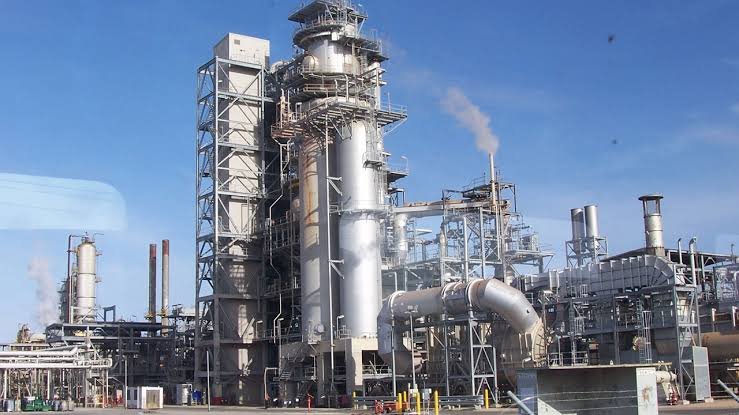
The Federal Government has described the Dangote Petroleum Refinery and Petrochemicals complex as a critical pillar of Nigeria’s ambition to build a $1 trillion economy, saying large-scale industrialisation remains essential to creating jobs and driving sustainable growth.
Minister of State for Industry, Senator John Owan Enoh, stated this on Wednesday during a high-level inspection of the 700,000-barrel-per-day Dangote Refinery, petrochemicals complex and Dangote Fertiliser facility in Lagos.

Enoh said the integrated complex represents the scale of industrial investment needed to transform Nigeria’s economy and strengthen the country’s manufacturing capacity.
According to him, the refinery has become a symbol of value addition, industrial competitiveness and Nigeria’s expanding capacity to produce and export refined petroleum products.
“This facility matters because of what it represents for Nigerian industry, for our people and for the realisation of President Bola Tinubu’s vision of a one trillion-dollar economy,” Enoh said.
He added that the refinery had helped change international perceptions of Nigeria by reducing the country’s dependence on imported refined petroleum products and enabling it to supply international markets.
Read Also:
- Dangote Refinery Secures $2.5 Billion Equity Raise in Africa’s Largest Private Placement
- Dangote Refinery Becomes Europe’s Biggest Jet Fuel Supplier, Overtakes US
- Dangote Refinery IPO: Investors Required to Commit $350,000 Minimum as NGX Courts Middle East Capital
The minister also said the Federal Government would deepen engagement with private-sector manufacturers through ministerial roundtables and the Industrial Revolution Work Group, particularly to address challenges such as access to affordable long-term financing.
Enoh commended Aliko Dangote, describing him as Nigeria’s foremost industrialist, and stressed that the success of the government’s Nigeria Industrial Policy would depend on strong collaboration between the public and private sectors.
The policy seeks to raise manufacturing’s contribution to Nigeria’s Gross Domestic Product to about 20 per cent by 2030 and 25 per cent by 2035.
Speaking during the visit, Dangote Industries Limited President and Chief Executive, Aliko Dangote, said industrialisation must remain at the centre of Nigeria’s economic strategy if the country is to achieve sustainable prosperity.
He argued that strong domestic investors are crucial to attracting foreign capital because their success demonstrates that Nigeria offers a viable environment for investment.
Dangote disclosed that his company recently raised an unsecured and unrated bond at rates below Nigeria’s sovereign benchmark, describing the development as evidence of growing investor confidence in credible Nigerian businesses.
He urged the government to maintain consistent economic policies, warning that frequent policy reversals can undermine investor confidence more than the absence of incentives.
Reflecting on the refinery project, Dangote described its construction as the biggest business risk of his life, citing challenges including the COVID-19 pandemic, foreign exchange volatility and scepticism from financiers.
He said the successful completion of the project demonstrated that Nigerian entrepreneurs could execute projects of global significance.
Dangote further disclosed that when operating at full capacity, the refinery would represent the equivalent of about 10 per cent of US refining capacity and consume approximately 2.5 per cent of globally traded crude oil.
He called for continued government support for indigenous investors, describing them as major drivers of employment, foreign exchange earnings and long-term economic resilience.
“If Nigeria is to achieve sustainable growth and become a trillion-dollar economy, industrialisation must be the foundation,” Dangote said.