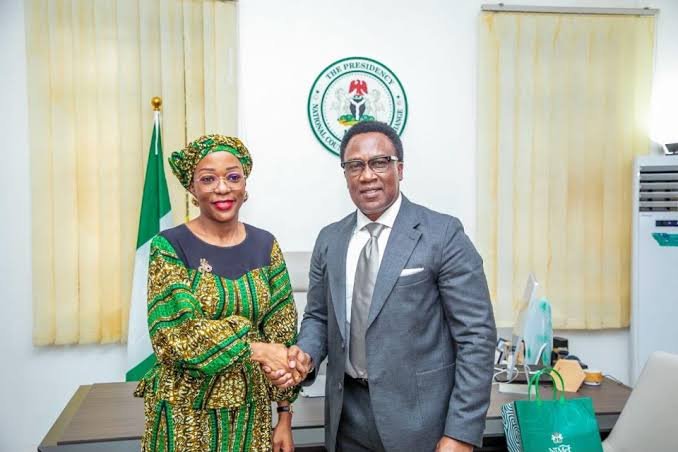
The Nigerian Meteorological Agency (NiMet) and the National Council on Climate Change (NCCC) have concluded plans to formalise a strategic partnership aimed at strengthening Nigeria’s climate services, improving climate data management and enhancing the country’s resilience to climate change.
The proposed agreement emerged from a courtesy visit by the Director-General and Chief Executive Officer of NiMet, Prof. Charles Anosike, to the Director-General of the NCCC Secretariat, Nkiruka Majekodunmi, according to a statement issued by NiMet on Wednesday.
During the meeting, Prof. Anosike reaffirmed NiMet’s role as Nigeria’s primary repository of long-term meteorological records, explaining that the agency’s extensive weather and atmospheric datasets provide the scientific foundation for climate trend analysis, risk assessments and the development of reliable climate projections.

He stressed that closer cooperation between both organisations would improve the production of localised climate forecasts, enhance early warning systems, standardise climate information and promote collaborative research capable of supporting evidence-based policymaking.
According to him, stronger institutional collaboration would enable governments and other stakeholders to access accurate, science-driven information needed to design effective climate adaptation and mitigation strategies while translating global climate projections into practical guidance for communities and sectors vulnerable to climate change.
Prof. Anosike also highlighted the importance of reliable climate information in attracting international climate financing, noting that high-quality meteorological data is often a key requirement for securing global funding targeted at climate resilience and environmental sustainability.
He said both institutions could jointly pursue funding opportunities to support projects focused on climate infrastructure, early warning systems and other resilience-building initiatives capable of strengthening Nigeria’s response to climate-related challenges.
Responding, the Director-General of the National Council on Climate Change, Nkiruka Majekodunm, commended NiMet for its continued contributions to weather forecasting and climate services, expressing support for stronger collaboration between the two agencies.
Both organisations subsequently agreed to institutionalise their relationship through a memorandum of understanding that will provide a framework for sustained cooperation in climate services, climate research, data management, early warning systems, capacity building and other areas of mutual interest.
NiMet noted that the planned agreement reflects the shared commitment of both agencies to advancing Nigeria’s climate policy objectives, improving institutional coordination and safeguarding lives, livelihoods and the environment through more effective climate information and evidence-based interventions.
Read also:
- NiMet Raises Flash Flood Alert For 27 States As Peak Rainy Season Begins
- NiMet issues nationwide thunderstorm alert as Lagos, Abuja, Rivers, Kano, other states face heavy rainfall
- NiMet, Singapore Meteorological Service explore AI, aviation research collaboration
The proposed partnership builds on an existing relationship between the two organisations.
In August 2024, NiMet and the National Council on Climate Change agreed to strengthen cooperation on national climate action, with the meteorological agency highlighting its stewardship of more than a century of weather and climate records essential for adaptation, mitigation and the implementation of the United Nations’ Early Warnings for All initiative.
NiMet has also expanded similar collaborations with universities, state governments and development partners in recent months to improve climate services and weather information across the country.
In March 2026, the agency entered into a separate Memorandum of Understanding with the University of Agriculture and Environmental Sciences to promote climate research, improve local weather observation systems and support climate-smart agriculture and national food security initiatives.
Related Stories: