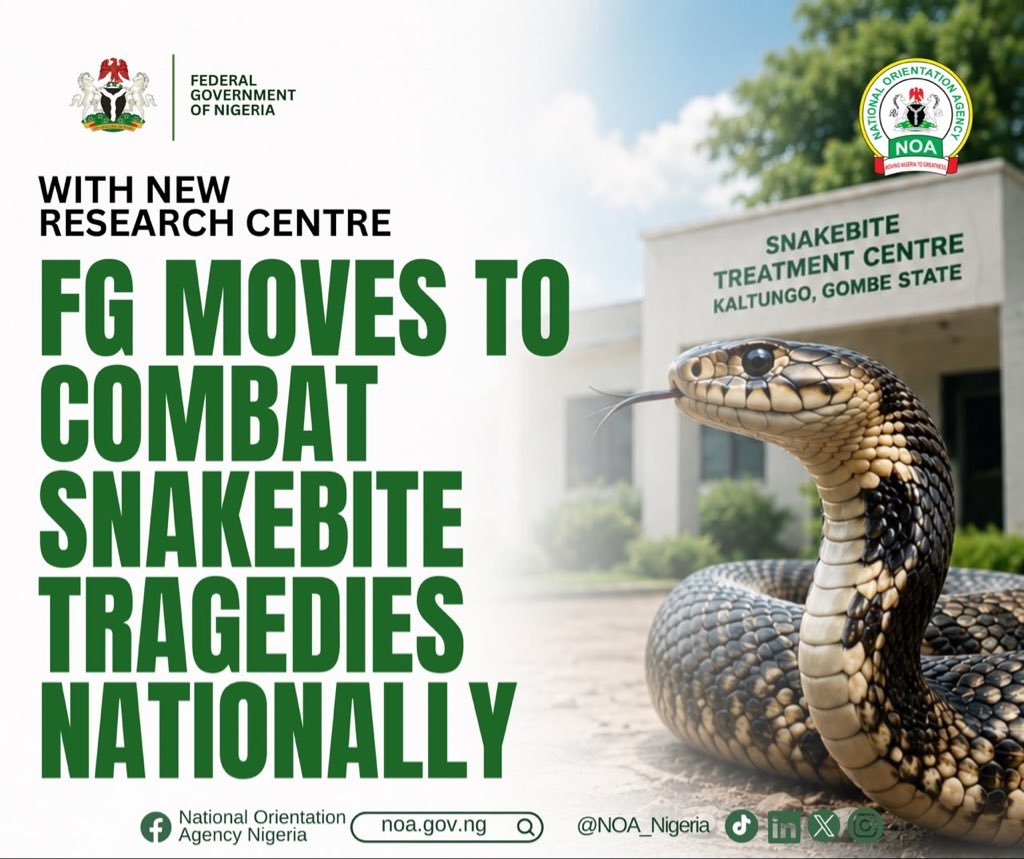
The Federal Government has approved the upgrade of the Gombe Snakebite Centre in Kaltungo into the National Snakebite Research and Medical Centre, a landmark intervention aimed at tackling Nigeria’s growing snakebite burden through specialised treatment, research, training and improved access to life-saving anti-snake venom.

Key Highlights:
- Federal Government upgrades Gombe Snakebite Centre to a National Snakebite Research and Medical Centre.
- Centre to become Nigeria’s leading institution for snakebite treatment, research and training.
- Nigeria records an estimated 43,000 snakebite cases annually.
- New centre will expand access to anti-snake venom and specialised clinical services.
- Healthcare workers nationwide will receive specialised training in snakebite management.
- FEC also approved major investments in tuberculosis, reproductive health and blood donation services.
The approval was granted during the Federal Executive Council (FEC) meeting presided over by President Bola Tinubu, marking a major step towards addressing one of Nigeria’s most neglected public health challenges.
Located in Kaltungo, Gombe State, the facility has served as one of Nigeria’s foremost snakebite treatment centres for decades. Originally established as a missionary hospital ward in 1958, it has treated thousands of snakebite victims, particularly from rural communities across Northern Nigeria.
With its new national status, the centre will now serve as Nigeria’s premier institution for snakebite prevention, treatment, research and policy development.
Read Also:
- Gombe To Investigate Collapse Of State House Of Assembly Complex Under Construction
- Gombe joins states regulating electricity as NERC hands over market oversight
- Federal Government, ANOCA Seal Hosting Agreement For Abuja 2027 African School Games
According to the Coordinating Minister of Health and Social Welfare, Professor Muhammad Ali Pate, the upgraded institution will provide specialised clinical services for snakebite and other envenomation cases, conduct research into snakebite epidemiology, diagnosis and treatment, ensure sustainable access to quality anti-snake venom, train healthcare professionals, and collaborate with international institutions to advance innovation in snakebite management.
Professor Pate described the initiative as the first institution of its kind in Nigeria and the West African sub-region, noting that it would significantly reduce deaths, disabilities and other long-term complications associated with snakebites.
Nigeria is estimated to record about 43,000 snakebite cases annually, with many victims suffering amputations, permanent disabilities, psychological trauma and death. Rural communities in the North-East, North-West and North-Central zones remain the most affected due to farming, herding, hunting and other outdoor occupations that increase exposure to venomous snakes.
The approval of the National Snakebite Research and Medical Centre formed part of a broader package of health sector interventions approved by the Federal Executive Council, valued at approximately ₦128.29 billion.
The approvals include ₦62 billion for tuberculosis commodities to strengthen local production and reduce dependence on donor funding, ₦25 billion for reproductive health and family planning commodities, and ₦6.9 billion for the procurement of 10 compressed natural gas (CNG)-powered blood donation vehicles to improve the national blood supply system.
Health experts and stakeholders have welcomed the elevation of the Kaltungo facility but urged the Federal Government to ensure prompt implementation, adequate funding and affordable access to treatment for rural residents who bear the highest burden of snakebite cases.
They also stressed the need for sustained research, local production of anti-snake venom, stronger partnerships with international institutions and closer integration of snakebite management into Nigeria’s primary healthcare system.
The World Health Organization classifies snakebite envenoming as a neglected tropical disease. The upgraded National Snakebite Research and Medical Centre is expected to play a critical role in reducing preventable deaths and disabilities while strengthening Nigeria’s public health response and serving as a regional centre of excellence for West Africa.