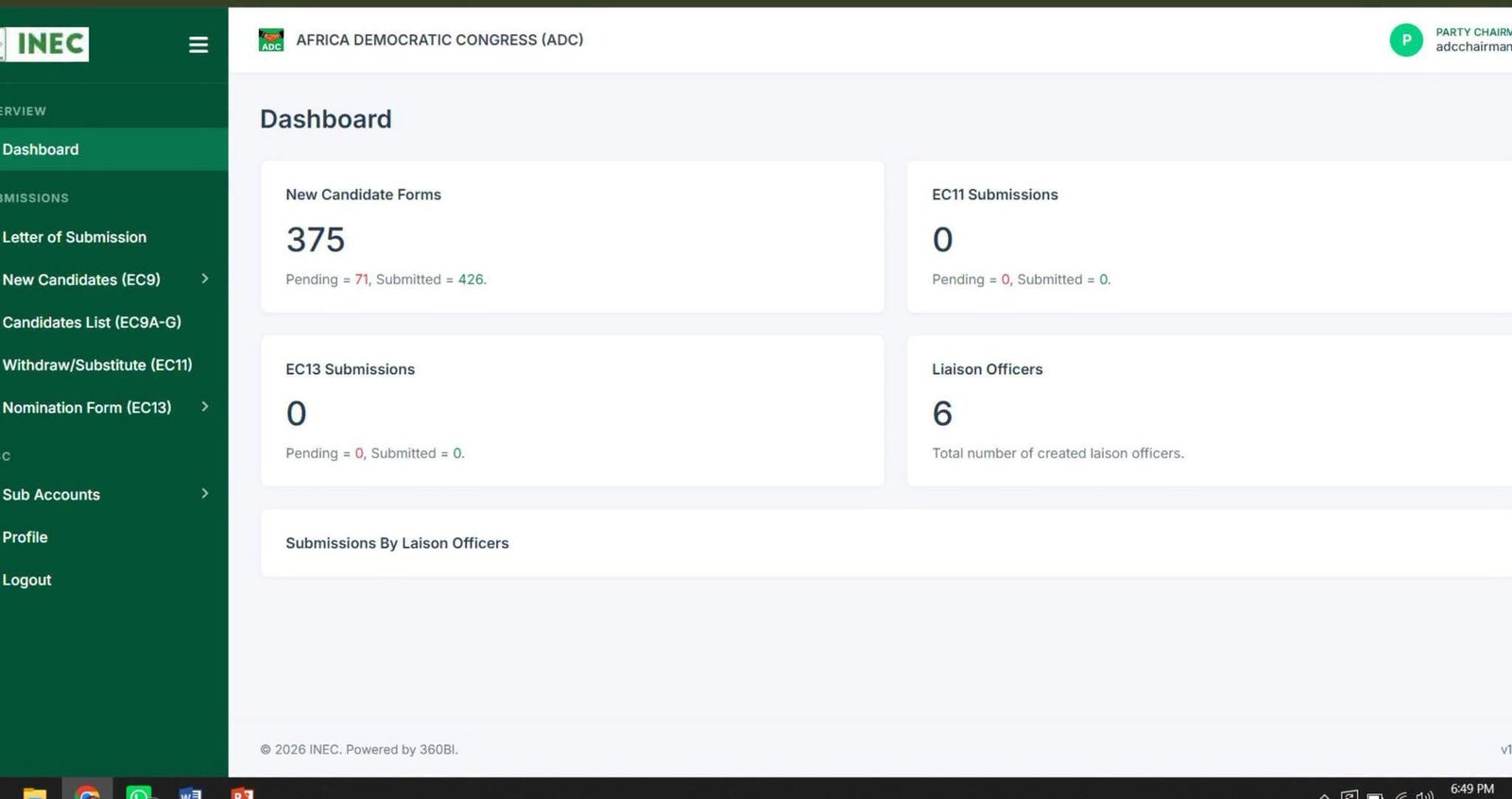
In a significant development that deepens the crisis within the African Democratic Congress (ADC), the faction led by Hon. Nafiu Bala Gombe has successfully uploaded its Presidential, Vice-Presidential, and National Assembly candidates onto the Independent National Electoral Commission (INEC) portal for the 2027 general elections.

The official statement issued today by Hon. Nafiu Bala Gombe, National Chairman of the ADC under his leadership, reads:
“The African Democratic Congress, ADC, under my leadership, has successfully completed the upload of our Presidential, Vice-Presidential, and National Assembly candidates on the INEC portal for the 2027 General Elections.
“This achievement demonstrates our Party’s firm commitment to safeguarding the interests of our founding and legacy members in the face of anti-democratic tendencies.
“As a Party, the ADC remains resolute in its mission to field credible, competent, and people-centered candidates who will provide purposeful leadership, promote good governance, and bring hope to the Nigerian people.”
Read Also:
- FIPC Scandal: Wike’s Political Bullying Cannot Replace Transparency, Accountability, says ADC Chieftain, Eze
- ADC Inaugurates Kano Caretaker Committee
- ADC Chieftain Questions Establishment, Operations Of Alleged FIPC
This move comes amid ongoing leadership tussles in the ADC and represents what many observers describe as fresh trouble for the Atiku Abubakar-aligned faction.
Background to the ADC Crisis
The ADC has been plagued by parallel leadership structures. One faction, often associated with former Senate President David Mark, has positioned former Vice President Atiku Abubakar as its presidential candidate, reportedly pairing him with former Rivers State Governor Rotimi Amaechi. This group claims legitimacy through certain court outcomes and party processes.
Conversely, the Nafiu Bala Gombe-led faction has consistently rejected Atiku’s candidacy. Earlier statements from this group declared that Atiku “is not, and has never been,” the party’s presidential candidate, nominating Professor Chris Uba instead and warning Atiku against parading himself as the ADC flag bearer. They have described the opposing structure as lacking constitutional standing.
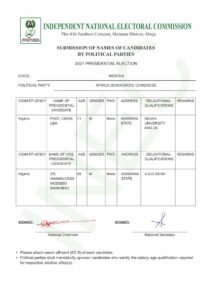
Today’s upload of candidates by Bala’s group intensifies the legal and administrative complications. With INEC deadlines approaching (recently extended in some cases), competing submissions from rival factions could lead to disputes over which list the commission recognizes, potential court interventions, and delays in publishing final candidate lists.
Implications for Atiku Abubakar
For Atiku Abubakar, a perennial contender with a strong northern base and national name recognition, this development poses strategic and logistical challenges:
Platform Uncertainty: Atiku’s political machinery has invested heavily in the ADC as a vehicle for 2027. A rival faction successfully submitting candidates risks diluting or invalidating that effort if INEC or the courts side with Bala’s group on legitimacy.
Legal Battles Ahead: Nigeria’s electoral history is replete with intra-party crises resolved (or prolonged) in court. Multiple suits over ADC leadership are already in play, and this latest action is likely to trigger more.
Time Pressure: With primaries concluded in some narratives and submissions underway, the window for consolidation is narrowing. Confusion could weaken opposition coordination against the ruling APC.
Perception Risk: Prolonged factional fights portray the opposition as fragmented, potentially eroding public confidence and donor support.
However, Atiku’s camp may draw hope from past experiences where favorable court rulings or INEC recognitions have validated their processes. Reports indicate that Atiku and Amaechi’s particulars were also uploaded under the ADC banner by aligned structures, setting up a direct contest for official recognition.
Broader Opposition Dynamics
This ADC imbroglio reflects wider challenges in Nigeria’s opposition ahead of 2027. Fragmentation in parties like the ADC could benefit the incumbent if not resolved swiftly. Key questions remain:
Which faction will INEC ultimately recognize for the ADC symbol?
Can the factions reconcile, or will one prevail decisively?
How will this affect potential alliances involving Atiku, Peter Obi’s aligned groups, and other opposition figures?
Hon. Nafiu Bala Gombe’s statement emphasizes safeguarding “founding and legacy members” against “anti-democratic tendencies,” signaling that his faction views itself as the authentic guardian of the party’s identity. Whether this resonates legally and politically will shape the coming weeks.
As the dust settles on today’s submission, Atiku’s path to the 2027 ballot via the ADC has become more uncertain. His supporters will be watching closely for INEC’s response, court developments, and any signs of strategic repositioning. In Nigerian politics, factional crises are common—but their resolution often determines who carries the party flag into the real battle.
The coming days promise more drama as stakeholders jostle for supremacy in what has become one of the most contested opposition platforms.