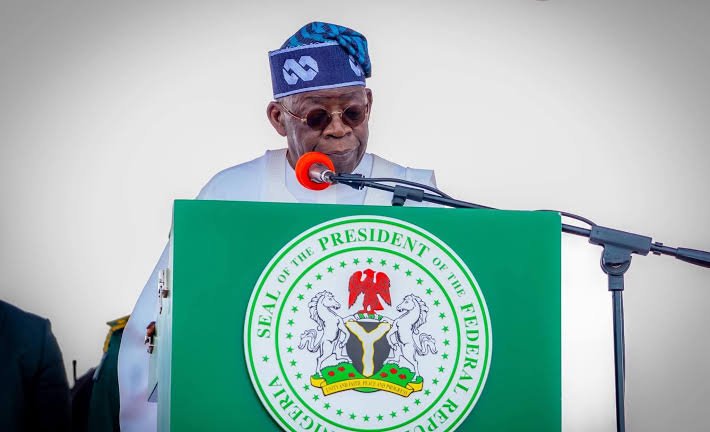
President Bola Tinubu has inaugurated the Presidential Working Group on the NATIONAL POLICING BILL, a major step towards establishing the legal framework for the implementation of state police across Nigeria following the passage of the Constitution Alteration (State Police) Bill, 2026.

Key Highlights:
- President Tinubu inaugurates Presidential Working Group on the NATIONAL POLICING BILL.
- Bill will provide the legal framework for implementing state police nationwide.
- Committee chaired by Chief of Staff, Femi Gbajabiamila.
- Proposed law to address policing standards, accountability and human rights safeguards.
- Nigeria Governors’ Forum pledges support for speedy implementation.
- NBA backs state police but calls for strong legal safeguards against abuse.
- Federal Government seeks implementation-ready bill before constitutional amendment process is concluded.
Represented by his Chief of Staff, Femi Gbajabiamila, at the inauguration held on Tuesday at the Presidential Villa, Abuja, President Tinubu said the NATIONAL POLICING BILL would translate the constitutional provisions for state police into an operational legal framework.
According to the President, while the Constitution Alteration (State Police) Bill establishes the legal basis for a dual policing structure comprising the Federal Police Service and 36 State Police Services, the NATIONAL POLICING BILL will provide the detailed legal architecture required for its implementation.
“The Constitution Amendment Bill establishes the framework for dual policing, but it does not operationalise it. That work is left to the National Policing Bill,” the President said.
Read Also:
- Tinubu Orders Probe into Nigeria Content Exploitation By Meta, Google, X, AI Platforms
- Tinubu Urges Team Nigeria To Compete With Integrity At Commonwealth Games
- Tinubu Unveils New ECOWAS Headquarters, Calls For Industrialised West Africa
Tinubu explained that the proposed legislation would address critical operational issues, including minimum policing standards, state readiness certification, federal and state coordination mechanisms, accountability measures, fiscal requirements and human rights safeguards.
He noted that the Presidential Working Group had been constituted to produce a technically sound and implementation-ready draft bill for transmission to the National Assembly immediately after the constitutional amendment process is completed.
The President stressed that work on the legislation must begin immediately rather than waiting for the constitutional amendment to be fully concluded.
“We must not wait until the constitutional process is concluded before beginning this important assignment,” he stated.
The committee is chaired by Gbajabiamila and includes the Attorney-General of the Federation, the President of the Nigerian Bar Association (NBA), the Chairman of the Nigeria Governors’ Forum (NGF), the National Security Adviser, the Inspector-General of Police, the Chairman of the NGF Committee on State Police and other key stakeholders. A secretariat will provide administrative support to the panel.
Speaking on behalf of the Nigeria Governors’ Forum, Ogun State Governor Dapo Abiodun pledged the commitment of governors to ensuring the swift implementation of the proposed reforms.
He disclosed that governors would work closely with their respective State Houses of Assembly to facilitate speedy ratification of the constitutional amendment and subsequent implementation of the NATIONAL POLICING BILL.
Abiodun described the state police initiative as a response to Nigerians’ long-standing demand for community-based policing and decentralised security management.
“This bill has answered the cries of Nigerians about cascading policing and removing it from the Exclusive Legislative List,” he said.
The governor also pointed to the success of regional security outfits such as Amotekun, saying the establishment of state police would significantly improve internal security.
According to him, if each of the 36 states recruits about 6,000 officers, Nigeria would gain nearly 200,000 additional security personnel to complement the existing Federal Police Force.
The Attorney-General of the Federation and Minister of Justice, Lateef Fagbemi (SAN), described the initiative as timely, given Nigeria’s current security challenges.
“There is no denying the fact that we are in a critical moment security-wise, and all hands must be on deck,” he said.
Fagbemi also urged governors to ensure the speedy passage of the constitutional amendment by their respective State Houses of Assembly.
President of the Nigerian Bar Association, Afam Osigwe, reaffirmed the association’s support for state police, saying Nigeria can no longer rely solely on a centralised policing system.
He, however, stressed the need for adequate legal safeguards to prevent abuse of the proposed state police system.
“We must ensure we do not create a monster. The right legal framework must guarantee accountability and prevent oppression,” Osigwe said.
He pledged the NBA’s support in assisting the committee to produce legislation that strengthens national security while protecting the constitutional rights of Nigerians.
Also present at the inauguration were Attorneys-General and Commissioners for Justice from Plateau, Lagos and Ondo States, representatives of the Inspector-General of Police and the National Security Adviser, alongside other senior government officials.