Two powerful earthquakes struck northwestern Venezuela on Wednesday evening, June 24, within seconds of each other, triggering massive infrastructural damage across the country, particularly in the capital Caracas. The stronger quake registered a magnitude of 7.5, following a 7.2 foreshock, leaving at least 32 people dead and more than 700 injured as rescue operations continue amid fears that the death toll could rise significantly.
Key highlight:

5 Key Highlights
- Twin earthquakes devastate Venezuela – Two powerful earthquakes measuring 7.2 and 7.5 magnitude struck northwestern Venezuela within 39 seconds, causing widespread destruction.
- Dozens killed and hundreds injured – At least 32 people were confirmed dead, while more than 700 others sustained injuries, with officials warning that the casualty figure could rise.
- Major infrastructure damage reported – Several buildings collapsed in Caracas and Yaracuy State, while roads, power supply, communication networks, and airport facilities suffered significant damage.
- Government declares state of emergency – Acting President Delcy Rodríguez declared a national state of emergency and mobilized rescue and emergency response teams.
- Rescue operations and international support ongoing – Search and rescue efforts are continuing amid fears of strong aftershocks, while neighbouring countries and international organizations have offered assistance.
According to the U.S. Geological Survey (USGS), the first earthquake, a magnitude 7.2 event, struck at approximately 6:04 p.m. local time (22:04 UTC) near San Felipe in Yaracuy state, about 160 km (100 miles) west of Caracas. Just 39 seconds later, a more powerful 7.5 magnitude quake hit nearby, centered close to Yumare in the same region, at shallower depths of around 10-20 km.
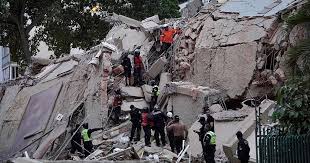
The rapid succession of the high-magnitude strikes — described as a doublet earthquake — amplified the destruction. Buildings swayed violently in Caracas, with multiple structures collapsing in the capital and surrounding areas. Videos from the scene showed panicked residents fleeing into streets, dust clouds rising from ruined buildings, and rescue teams searching rubble for survivors. Damage was also reported at Simon Bolivar International Airport and in coastal regions.
Scale of Destruction
Preliminary reports indicate severe infrastructural damage:
Collapsed buildings in Caracas and Yaracuy state, trapping residents under debris.
Widespread power outages, disrupted communications, and damaged roads hindering rescue efforts.
Impacts extending to La Guaira and other central and northern areas.
A brief tsunami warning was issued for parts of the Caribbean coast, though no major waves were reported.
Acting President Delcy Rodríguez declared a national state of emergency and addressed the nation on state television, confirming the initial casualty figures and mobilizing emergency services. Experts and officials have warned that the toll could climb into the thousands due to the vulnerability of older infrastructure and densely populated urban areas.
Read also:
- Lagosians Call Out Government As Lekki Flooding Worsens
- Saudi Humanitarian Centre Supports Vulnerable Nigerians With 24,302 Food baskets
- ADC Chieftain Blasts Bwala Over Prediction Of Atiku Coming 4th In 2027 Presidential Election
- DESOPADEC Took Early Action To Mitigate Flood Impact This Year – Nani
Search and rescue operations are underway, with teams working through the night to locate trapped individuals. Hospitals are overwhelmed with the injured, and international aid is expected as the full extent of the damage becomes clearer.
Geological Context
Venezuela lies near the boundary of the Caribbean and South American tectonic plates, making it prone to seismic activity, though major quakes of this intensity are relatively infrequent in recent decades. The 7.2 and 7.5 events were strike-slip quakes at intermediate depths. The USGS has noted a high likelihood of strong aftershocks, including potential magnitude 5+ events, which could exacerbate damage.
This disaster comes at a challenging time for Venezuela, already grappling with economic and humanitarian issues. The earthquakes have further strained resources and infrastructure.
International Response
Condolences and offers of assistance have begun to pour in from neighbouring countries and global organisations. Colombia, which also felt the tremors, has expressed solidarity. As of early Thursday, the focus remains on saving lives and stabilizing affected regions. The situation remains fluid. Authorities urge residents to stay away from damaged structures and heed official advisories. Further updates on casualties and recovery efforts will be released as more information emerges. This is a developing story.
Related Stories: