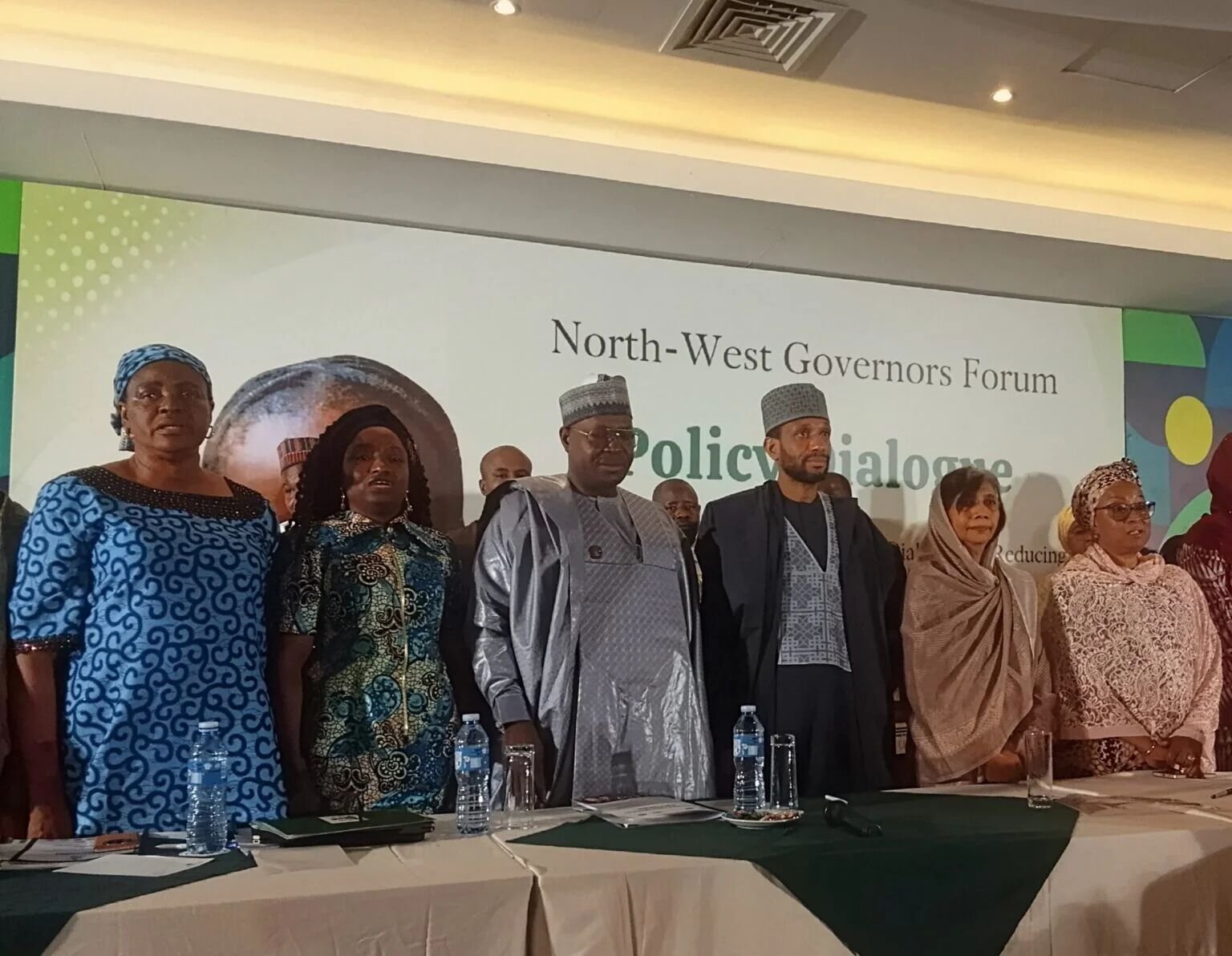
The Northwest Governors Forum (NWGF) has intensified efforts to tackle multidimensional poverty across the region with the inauguration of a high-level policy dialogue aimed at translating existing commitments into actionable programmes through scaled social protection systems and innovative financing mechanisms.
The two-day dialogue, held in Kano on Tuesday, was organised by the forum in collaboration with the Federal Government, with support from the European Union (EU) and the United Nations Children’s Fund (UNICEF).

Speaking at the opening ceremony, Director-General of the Northwest Governors Forum Secretariat, Maryam Yahaya, said the dialogue was designed to move regional poverty reduction initiatives from policy commitments to practical implementation.
She noted that despite the Northwest’s vast human and economic potential, the region continues to grapple with high levels of multidimensional poverty, out-of-school children, poor health outcomes, insecurity, climate-related challenges and growing fiscal pressures.
According to her, the challenges are interconnected and require coordinated regional responses beyond individual state boundaries.
Yahaya explained that the dialogue forms part of the implementation framework of the Northwest Peace, Security and Development Framework earlier adopted by governors in the region.
She said the forum would work with governments, development partners, private sector organisations, philanthropic institutions and traditional leaders to identify sustainable financing pathways capable of accelerating poverty reduction and strengthening social protection systems.
“At a time of fiscal constraints, governments alone cannot shoulder the burden of financing poverty reduction programmes. We must broaden the financing ecosystem through partnerships with the private sector, philanthropic institutions, Islamic finance mechanisms and community-based structures,” she said.
Head of Human Development at the European Union, Dr. Leila Ben Amor, commended the Northwest Governors Forum for providing leadership on one of the most pressing development challenges confronting Nigeria.
She said the EU remained committed to supporting social protection initiatives, education, healthcare, social cohesion and resilience programmes across the region.
“Poverty does not stop at borders, just as insecurity does not. Only coordinated regional and national actions can effectively address these challenges,” she stated.
Also speaking, UNICEF Deputy Representative in Nigeria, Dr. Rownak Khan, described the dialogue as a major milestone in the region’s efforts to address multidimensional poverty.
He disclosed that the seven Northwest states account for nearly one-quarter of Nigeria’s population, estimated at about 60 million people, while also recording some of the country’s poorest child development indicators.
Khan noted that maternal mortality in the region exceeds 1,000 deaths per 100,000 live births, under-five mortality stands at 140 per 1,000 live births, while nearly 60 per cent of children suffer from stunting.
Read also:
- FG disburses N2.25bn grant to boost student-led innovations
- Police launch 2026 National Police Day with sanitation drive, free medical outreach in FCT
- Isoko Monitoring Group hails Prof. Aghalino’s appointment as vice chancellor of DDU, Asaba
He advocated the introduction of a universal child benefit programme, describing it as a proven global strategy for reducing child deprivation, improving school enrolment and strengthening household resilience against insecurity and economic shocks.
Declaring the dialogue open on behalf of Governor Abba Kabir Yusuf, Kano State Deputy Governor, Alhaji Aminu Abdulsalam Gwarzo, represented by Alhaji Murtala Sule Garo, said social protection remains a strategic investment in human capital development, social stability and economic growth.
He highlighted Kano State’s enactment of the Social Protection Policy Law in 2025 and the establishment of a Social Protection Directorate as part of efforts to institutionalise support for vulnerable groups.
Garo urged stakeholders to strengthen partnerships, embrace innovative financing models and ensure that outcomes from the dialogue translate into tangible improvements in the lives of citizens across the Northwest.