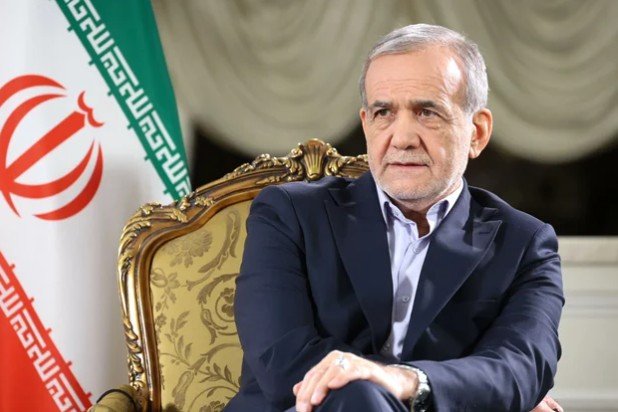
The reported resignation of Iranian President Masoud Pezeshkian has opened a new chapter of uncertainty in Iran’s political crisis, intensifying concerns that the country’s wartime decision-making structure may be fracturing under the pressure of months of conflict with the United States and its allies.
Key Highlights:
- Reports claim Masoud Pezeshkian may have resigned, but officials deny it.
- The story highlights tensions between civilian leaders and the military (IRGC).
- Analysts say the war has increased military influence in Iran.
- Possible instability could affect diplomacy and regional security.
- Iran insists its government remains stable and in control.
Although Iranian officials have publicly denied reports that Pezeshkian submitted a resignation letter, multiple reports from sources close to Iran’s leadership claim the president sought to step down after complaining that elected civilian institutions had effectively lost control to the powerful Islamic Revolutionary Guard Corps (IRGC).

If eventually confirmed, the resignation would represent one of the most significant political ruptures inside Iran since the beginning of the 2026 war. It could become a defining moment in the struggle between Iran’s civilian government and its military-security establishment.
Reports surrounding the resignation center on claims that Pezeshkian believed major decisions were increasingly being made by military commanders rather than civilian officials. Iranian authorities have rejected those reports and insist the president remains in office.
Yet even the emergence of such reports highlights a reality acknowledged by many analysts: the war has significantly altered Iran’s internal power structure.
The conflict has already reshaped Iran’s leadership landscape following the death of Supreme Leader Ali Khamenei and the subsequent elevation of Mojtaba Khamenei.
Reports have described decision-making inside Tehran as increasingly centralized around security institutions and military commanders.
Should Pezeshkian’s resignation be accepted, it could further reinforce perceptions that Iran’s civilian leadership has become secondary to wartime military structures.
History offers several examples where leadership crises emerged during major conflicts.
During the final phase of the Vietnam War, South Vietnamese President Nguyen Van Thieu resigned as military defeat became imminent.
In Iraq, the collapse of political authority under Saddam Hussein accelerated following military setbacks in 2003.
More recently, leadership upheavals during conflicts in Afghanistan, Libya and Sudan exposed how internal divisions can become as damaging as external military pressure.
While Iran’s situation differs significantly from those cases, the common thread is that wartime resignations often signal deeper institutional stress rather than merely personal disagreements.
Read also:
- Trump says he ‘wasn’t worried’ during shooting at Correspondents’ Dinner
- Rubio says ‘solid’ Iran deal likely on Monday
- U.S targets Iran-linked militia leader with $10m reward
Military experts generally agree that political instability during wartime can complicate command structures.
If Iran’s president were removed or sidelined amid ongoing hostilities, several consequences could emerge:
Delays in strategic decision-making.
Increased competition between political factions.
Greater influence of military commanders over state policy.
Reduced confidence among foreign partners and mediators.
Harder coordination between economic and military institutions.
Iran is already navigating ceasefire negotiations, sanctions pressure, economic challenges and intermittent military exchanges with the United States. Any perception of political disunity could weaken Tehran’s negotiating position.
From a strategic perspective, any internal disagreement among Iran’s leaders could provide advantages to Washington.
A divided leadership often struggles to project a coherent negotiating position.
American officials could potentially exploit differences between moderates, hardliners and military leaders during diplomatic talks.
Furthermore, uncertainty inside Tehran may:
Increase pressure on Iran to pursue negotiations.
Complicate military planning.
Reduce the effectiveness of coordinated responses.
Encourage further defections or dissent within state institutions.
President Donald Trump recently said Iran wants an agreement with the United States and suggested that Tehran is under significant pressure.
For Washington, a politically distracted Iran may be easier to contain than a unified one.
Trump and several supporters have repeatedly argued that the Iranian system is approaching collapse. Since the outbreak of war, American and Israeli officials have pointed to leadership losses, economic disruption and anti-government unrest as evidence that the Islamic Republic is weakening.
However, political scientists caution that reports of internal power struggles do not automatically indicate regime collapse.
History shows that authoritarian systems can survive major crises if security institutions remain cohesive.
In Iran’s case, the IRGC remains one of the country’s most powerful organizations. Even if tensions exist between civilian leaders and military commanders, the broader state structure remains intact.
Therefore, while the resignation reports may support arguments that Iran is under extraordinary strain, they do not by themselves prove that the government is on the verge of collapse.
The war has unquestionably inflicted significant losses on Iran’s military and security establishment.
Numerous senior commanders and officials have reportedly been killed since the conflict began, including top military and security figures. Major military facilities, command centers and infrastructure have also reportedly been targeted.
Despite suffering losses, Iran has continued missile launches, drone operations and retaliatory actions against U.S. interests and regional targets. Recent incidents involving attacks and counterattacks indicate that Tehran retains substantial military capabilities.
The more accurate assessment may be that Iran’s military has been weakened and disrupted rather than eliminated.
The potential resignation carries consequences beyond Iran.
Markets have closely monitored every development in the conflict because of Iran’s strategic position near the Strait of Hormuz, one of the world’s most important energy corridors.
A deeper power struggle in Tehran could affect:
Global oil prices.
Maritime security.
Regional stability across the Middle East.
Nuclear negotiations.
Relations between Iran, Russia and China.
Western security calculations.
Investors and governments alike are watching for signs that political instability could either accelerate peace talks or trigger a new phase of confrontation.
Whether Pezeshkian actually resigns may ultimately prove less important than what the reports reveal about Iran’s internal dynamics.
The central question emerging from Tehran is no longer simply whether Iran can withstand external military pressure. It is whether its political institutions can maintain unity while navigating war, sanctions, leadership succession and growing international isolation.
For now, Iran’s government insists the president remains in office. But the mere appearance of resignation reports during an active conflict has exposed what may be the most consequential battlefield of all: the struggle for power inside the Iranian state itself.
Related Stories: