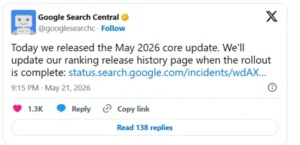
Google has officially begun rolling out the May Google Core Update, its second broad core algorithm update of 2026, marking another significant step in the evolution of AI-driven search rankings and content evaluation.
Key Highlights:
- May Google Core Update launched on May 21, 2026
- Full rollout expected to take approximately two weeks
- Update focuses on content quality, authority, and user experience
- Google continues integrating Gemini-powered AI models into search rankings
- Experts advise website owners against making drastic changes during rollout
- New Ahrefs study questions the impact of schema markup on AI citations
According to Google’s official Search Status Dashboard, the May Google Core Update commenced at 08:40 AM US/Pacific Daylight Time (PDT) on May 21, 2026. The company expects the rollout to be completed within two weeks. Released the May 2026 core update. The rollout may take up to 2 weeks to complete.

Google Continues AI Search Transformation
The May Google Core Update follows the highly volatile March 2026 Core Update, which triggered major ranking fluctuations across industries.
Industry analysts believe the latest update reflects Google’s ongoing efforts to integrate advanced Gemini-powered quality assessment systems directly into its ranking algorithms. The objective remains clear: reward original, helpful, and people-first content while reducing the visibility of low-quality, automated, or ad-heavy pages that offer poor user experiences.
The update also comes amid Google’s broader push toward conversational search experiences powered by Gemini 3.5 Flash and the company’s expanding AI ecosystem.
What Makes the May Google Core Update Different?
Unlike earlier algorithm updates that focused primarily on keyword relevance and backlinks, modern core updates increasingly evaluate:
Overall website authority
Content originality and usefulness
Technical performance
Accessibility for AI systems
User experience signals
Real-world expertise and trustworthiness
It is widely believed that the May Google Core Update may also lay the foundation for deeper integration of Google’s upcoming AI technologies, including Google Spark and Universal Cart, both showcased during Google I/O 2026.
Experts note that search engines are now assessing whether content can be effectively understood not only by human users but also by autonomous AI agents that retrieve and process information.
Read Also:
- Google expands AI search to Yorùbá, Hausa, boosting access for Millions of Nigerian users
- Google names Nigeria as a global frontrunner in adopting AI for education, entrepreneurship
- Minitap raises $4.1M to revolutionize mobile development with AI, outpacing Google DeepMind in just 40 days
Website Owners Advised to Remain Patient
SEO professionals caution website owners against making major structural changes while the rollout remains active.
As with previous broad core updates, ranking volatility is expected throughout the rollout period. Experts recommend monitoring performance trends and waiting until the update is fully completed, likely around June 4, 2026, before implementing significant changes.
Ahrefs Study Challenges Schema Markup Assumptions
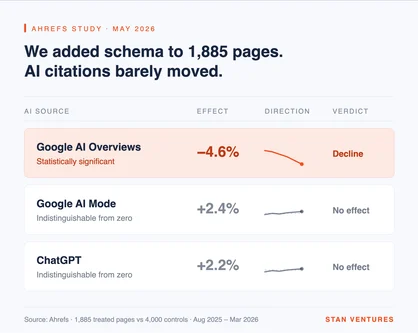
The rollout coincides with a new study published by Ahrefs on May 11, 2026, which examined whether adding JSON-LD schema markup improves visibility in AI-generated search experiences.
Researchers Louise Linehan and Xibeijia Guan analysed 1,885 pages that added schema markup between August 2025 and March 2026 and compared them with 4,000 similar control pages.
The study found little evidence that schema markup directly increases citations in Google AI Overviews, Google AI Mode, or ChatGPT.
Researchers concluded that while pages cited by AI systems are often more likely to use schema markup, the relationship appears correlational rather than causal.
According to the findings, AI systems tend to favour authoritative, well-maintained websites that also happen to implement structured data correctly.
AI Systems Prioritise Visible Content
The Ahrefs report also referenced findings from searchVIU, which tested whether major AI platforms including ChatGPT, Claude, Perplexity, Gemini, and Google AI Mode actively use schema markup when retrieving web content.
The results suggested that these systems primarily extract visible HTML content while largely ignoring hidden schema formats such as JSON-LD, Microdata, and RDFa during real-time retrieval.
However, experts note that structured data continues to play an important role in search ecosystems through rich results, knowledge graphs, voice assistants, and entity recognition systems.
Key Takeaways for Publishers and SEO Professionals
The May Google Core Update reinforces Google’s continued emphasis on quality content, technical excellence, and user-focused experiences.
While schema markup remains valuable for traditional SEO purposes, emerging evidence suggests that publishers seeking stronger AI visibility should prioritise high-quality content, authority building, and superior user experience rather than relying solely on technical markup.
As the rollout progresses, website owners are encouraged to monitor traffic patterns carefully and focus on long-term content quality improvements rather than short-term ranking fluctuations.