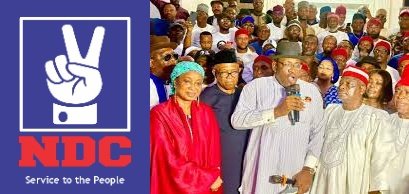
In the fluid, often unpredictable theatre of Nigerian politics, moments of rupture tend to arrive without warning—but rarely without consequence. The emergence of the Nigeria Democratic Congress (NDC) as a magnet for political realignment in early May 2026 is one such moment. What began as a relatively obscure addition to Nigeria’s crowded party register has, within days, transformed into the most talked-about opposition platform ahead of the 2027 general elections.
At the centre of this political acceleration is a claim as startling as it is consequential: that the NDC recorded over 9.3 million registered members in less than 48 hours following the defection of Peter Obi and Rabiu Musa Kwankwaso. Whether treated as a precise statistic or a symbolic indicator of momentum, the figure captures something deeper—a surge of political energy searching for structure.

But numbers alone do not build parties. Nor do defections, however high-profile, automatically translate into electoral viability. What is unfolding around the NDC is more complex: a convergence of elite recalibration, grassroots sentiment, institutional ambiguity, and historical repetition. The question is not simply whether the NDC is rising. It is whether it can survive its own ascent.
A Political Vacuum Waiting to Be Filled
To understand the NDC’s rapid growth, one must first examine the vacuum it has stepped into. Nigeria’s opposition ecosystem, long fragmented and often self-sabotaging, has struggled to present a coherent alternative to the ruling All Progressives Congress (APC). The traditional opposition pillars—the Peoples Democratic Party (PDP), Labour Party, and smaller third-force platforms—have each faced internal crises, leadership disputes, or strategic incoherence.
The African Democratic Congress (ADC), which had briefly positioned itself as a potential coalition vehicle, effectively collapsed under the weight of its own contradictions. Court cases, factional leadership battles, and mutual accusations among stakeholders rendered it structurally unreliable at precisely the moment unity was most needed.
Into this space stepped the NDC—a party that did not emerge organically from grassroots agitation, but rather through a combination of administrative process and judicial intervention. Its registration, compelled by a Federal High Court order after initial rejection, already marked it as atypical. Yet in Nigerian politics, legality is often only one dimension of legitimacy. Perception, timing, and elite endorsement matter just as much.
The NDC arrived at a moment when the opposition was not merely weak, but disoriented.
The Obi–Kwankwaso Effect
The catalytic moment came on May 3, 2026. In a coordinated move that signalled more than routine defection, Peter Obi and Rabiu Kwankwaso formally exited the ADC and aligned with the NDC. The symbolism was immediate. These were not peripheral actors; they were two of the most recognisable opposition figures in Nigeria, each commanding distinct political constituencies.
Obi brought with him the remnants—and perhaps the future—of the “Obidient” movement, a loosely structured but highly mobilised base of largely urban, youth-driven supporters who had disrupted traditional voting patterns in 2023. Kwankwaso, by contrast, carried the disciplined, regionally anchored Kwankwasiyya movement, particularly influential in Kano and parts of the North-West.
Their convergence within a single party structure altered the political calculus overnight. The NDC was no longer just another registered party. It became a potential coalition nucleus.
Within hours, social media platforms were saturated with registration links, mobilisation calls, and declarations of allegiance. Party officials, including Seriake Dickson, framed the moment as the birth of a “pan-Nigerian ideological movement”—a deliberate attempt to transcend the ethnic and regional fragmentation that has historically defined Nigerian politics.
The reported 9.3 million registrations, whether fully verified or not, reflect this surge of enthusiasm. But enthusiasm, as Nigerian political history repeatedly demonstrates, is volatile.
The Architecture of Rapid Growth
What makes the NDC’s rise particularly striking is not just its speed, but its structure. Unlike traditional party expansion—which relies on ward-level organisation, physical registration drives, and gradual network building—the NDC’s growth appears heavily digitised and centralised.
Online registration platforms, viral messaging, and elite endorsements have replaced the slower, more laborious processes of grassroots consolidation. This creates both opportunity and risk.
On one hand, digital mobilisation allows for unprecedented scale. Nigerians disillusioned with existing parties can affiliate with a new platform almost instantly. On the other hand, digital membership does not automatically translate into electoral machinery. Votes are not cast online; they are mobilised through physical structures—polling agents, local coordinators, logistics networks.
The NDC’s challenge, therefore, is to convert numerical enthusiasm into operational capacity.
A party can claim millions of members. But without verifiable registers aligned with the requirements of the Independent National Electoral Commission (INEC), those numbers may have limited procedural value. Under the Electoral Act 2026, participation in primaries—and ultimately, candidate legitimacy—depends on compliance with strict membership documentation timelines.
This is not a trivial constraint. It is a structural bottleneck that could determine whether the NDC’s surge translates into actual political power.
The Illusion of Unity
For now, the NDC presents an image of cohesion. There are no visible factional splits, no competing national executives, no parallel conventions. Compared to the chaos that consumed the ADC, this alone makes it attractive. But this unity is, at best, provisional.
The entry of Obi and Kwankwaso introduces multiple centres of power into a party that was originally structured around its founding leadership. Each brings not just followers, but expectations—about candidate selection, party hierarchy, and strategic direction.
Nigerian political history offers a cautionary template. When the APC was formed in 2013, it successfully integrated diverse blocs—but only after extensive negotiation, compromise, and the establishment of clear power-sharing arrangements. Even then, internal tensions persisted.
The NDC has not yet undergone that level of institutional negotiation. Its current cohesion may simply reflect the early phase of convergence, before the harder questions are asked.
Who gets the presidential ticket? How are party offices distributed? What happens when regional interests collide? These are not hypothetical issues. They are inevitable.
The Legal Shadow
Complicating matters further is the legal environment surrounding the NDC’s formation. While the party is now officially recognised by INEC, its registration remains contested in certain quarters. Competing political associations have raised questions about procedural irregularities, arguing that the NDC’s approval did not follow standard processes.
At the same time, the NDC itself is engaged in litigation challenging aspects of the Electoral Act 2026—particularly provisions related to membership registers and primary elections.
This dual legal posture—defending its own legitimacy while contesting the rules of the system—places the party in a complex position. Legal battles can shape political outcomes, but they can also create uncertainty. Investors, donors, and even potential candidates may hesitate to fully commit to a platform whose regulatory status is still under scrutiny.
In Nigerian politics, perception often matters as much as legality. A party seen as “legally vulnerable” may struggle to project stability, regardless of its formal recognition.
The Collapse of ADC: A Case Study in Political Self-Sabotage
The NDC’s rise cannot be separated from the ADC’s collapse. The latter serves as a textbook example of how internal dysfunction can destroy political opportunity.
At its peak, the ADC had positioned itself as a potential coalition platform for opposition figures dissatisfied with both the APC and the PDP. It hosted negotiations, attracted high-profile entrants, and generated cautious optimism. But it failed where many Nigerian parties fail: internal management.
Power-sharing agreements were reportedly breached. Leadership positions became contested. Litigation replaced negotiation. By the time Obi and Kwankwaso exited, the party was already structurally weakened.
The lesson is clear. Political parties do not collapse solely because of external pressure. They collapse because they cannot manage internal complexity.
The NDC, in inheriting the ADC’s displaced actors, also inherits its risks.
The “Noah’s Ark” Strategy
NDC leaders have consciously framed the party as a “Noah’s Ark”—a refuge for politicians across ideological, regional, and partisan lines. The metaphor is revealing. It suggests not just inclusivity, but urgency: a gathering before a political storm.
This strategy has immediate advantages. It allows the party to grow بسرعة, attracting defectors from the APC, PDP, and smaller parties. It creates momentum, visibility, and a sense of inevitability.
But it also raises a fundamental question: what binds the coalition together?
A party defined primarily by opposition to the ruling government risks becoming a coalition of grievances rather than a platform of ideas. Without a clear ideological framework, internal contradictions can quickly surface.
The NDC has articulated broad principles—fairness, equity, justice, economic reform. These are necessary, but not sufficient. Voters increasingly demand specificity: policy positions, governance strategies, measurable commitments. The transition from movement to institution requires more than rhetoric.
The Membership Surge: Signal or Mirage?
The claim of 9.3 million members in 48 hours is extraordinary. If accurate, it would represent one of the fastest political mobilisations in Nigeria’s history.
But scale demands scrutiny. How many of these registrations are verified? How many represent unique individuals? How many are politically active versus passively affiliated?
These questions matter because political capital is not just about numbers; it is about deployable numbers. A million inactive members are less valuable than a hundred thousand organised, motivated voters.
There is also the issue of sustainability. Rapid growth can create administrative strain. Membership databases must be managed, validated, and integrated into INEC-compliant systems. Communication channels must be established. Local structures must be built. Without this backend infrastructure, the initial surge risks dissipating.
The Road to 2027: Compression and Pressure
Time is not on the NDC’s side. The electoral calendar imposes hard deadlines—party primaries, candidate submissions, compliance requirements. These processes cannot be improvised.
The party must, within a compressed timeframe: Consolidate its membership register; Establish functional structures across all states; Resolve internal power arrangements; Develop a coherent policy platform; Select credible candidates.
Read also:
- NDC disowns fake X account linking Peter Obi, Kwankwaso to 2027 bid, reaffirms open-door policy
- How low ADC membership registration in South East could jeopardize Peter Obi’s 2027 ambitions
- Peter Obi meets Bala Mohammed in Bauchi as defection speculation deepens
Each of these tasks is complex. Combined, they constitute a formidable organisational challenge.
The entry of high-profile figures accelerates expectations. The public will not judge the NDC as a new party; it will judge it as a potential governing alternative. That is a higher standard.
A Familiar Pattern, A Different Outcome?
There is a temptation to draw parallels with 2013–2015, when opposition forces coalesced to form the APC and eventually unseat the incumbent government. The comparison is instructive, but incomplete.
The APC’s success was not inevitable. It was the product of sustained negotiation, strategic compromise, and a clear electoral objective. Even then, it required a unifying candidate—Muhammadu Buhari—and a coherent campaign narrative.
The NDC has yet to reach that stage. It is still in the phase of aggregation, not consolidation.
Whether it can transition from one to the other will determine its fate.
Between Momentum and Maturity
The rise of the NDC is real. It reflects genuine dissatisfaction with the current political order, as well as a renewed search for alternatives. It demonstrates that Nigerian voters—and politicians—are willing to realign when given a credible platform.
But momentum is not maturity.
The NDC’s greatest strength—its rapid expansion—may also be its greatest vulnerability. Growth without structure leads to fragmentation. Inclusion without rules leads to conflict. Enthusiasm without organisation leads to disappointment.
The coming months will test whether the party can institutionalise its gains.
The Unfinished Story
For now, the NDC exists in a state of political possibility. It is neither a fully formed alternative nor a transient experiment. It is a work in progress, shaped by forces both internal and external.
The 9.3 million figure, whether literal or symbolic, captures a moment—but not an outcome.
What happens next will depend less on how many Nigerians have joined the NDC, and more on how effectively the party can organise them, represent them, and ultimately, convince them.
In Nigerian politics, the distance between surge and fall is often shorter than it appears. The NDC has crossed the first threshold: relevance. The harder task lies ahead—proving that relevance can be sustained, structured, and translated into power.