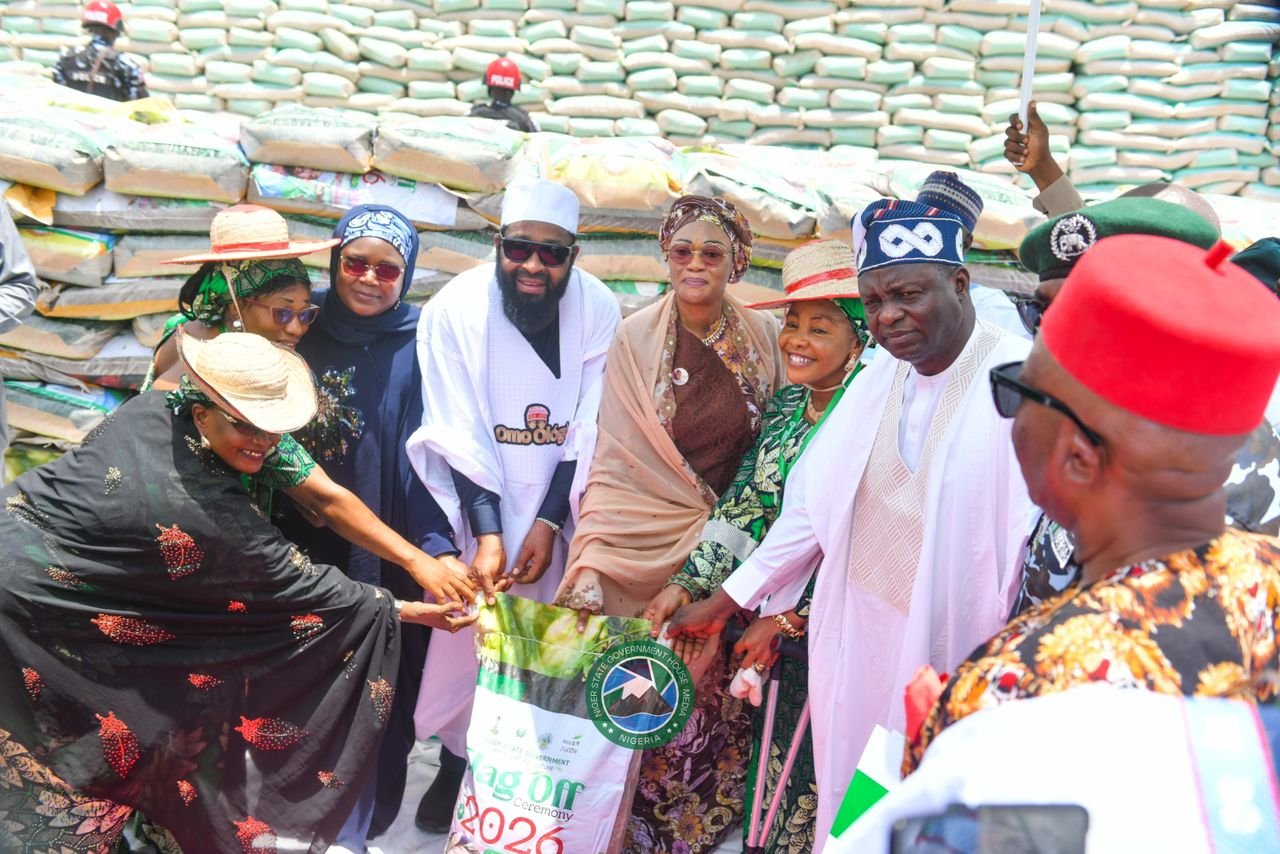
Nigeria’s First Lady, Oluremi Tinubu, has called for an urgent shift from subsistence farming to mechanised agriculture, warning that traditional farming methods can no longer meet the country’s growing food demands.
She made the declaration on Saturday in Niger State, during the official flag-off of the 2026 farming season and the rollout of mechanisation support equipment aimed at boosting food production.

The event, held at the Bola Ahmed Tinubu International Airport, formed part of broader efforts to tackle food insecurity and modernise Nigeria’s agricultural sector.
Tinubu criticised the continued reliance on rudimentary tools such as hoes and cutlasses, insisting that Nigeria must embrace mechanisation, innovation, and improved inputs to guarantee food security.
“We must move beyond subsistence farming. Mechanisation and modern practices are no longer optional—they are necessary for sustainable food security,” she said.
She described the distribution of tractors, harvesters, and other inputs as a strong indication that Nigeria is ready to transition to large-scale commercial agriculture.
Governor Mohammed Umaru Bago said the state government’s intervention includes the deployment of 250 tractors, 50 multi-crop harvesters, 1,500 farming implements, and 150,000 bags of fertiliser.
According to him, each of the state’s 25 local government areas will receive 10 tractors to deepen mechanisation at the grassroots level.
Gov. Bago said the initiative is part of a broader plan to position Niger as a leading food production hub, noting that post-harvest losses—estimated to be as high as 90 per cent depending on the crop—would be significantly reduced with the introduction of harvesters.
The governor projected that the programme would cover about 120,000 hectares of farmland, generate 2,000 direct jobs, and create up to 100,000 indirect employment opportunities.
Read also:
- Tinubu approves appointment of 65 Nigerian Ambassadors to international missions
- Oborevwori appoints Prof. Samuel Aghalino as Vice Chancellor of Dennis Osadebay University, Asaba
- FG sets up committee to develop funding structure for nutrition interventions
He added that the state is targeting an annual output of about 500,000 metric tonnes of assorted food crops per farming season.
To address price instability and protect farmers from post-harvest losses, Bago disclosed that the government is developing a structured off-take system in partnership with Niger Food Security and Logistics Limited.
The governor also revealed plans to complete a 10,000-hectare solar-powered irrigation scheme to enable year-round farming across the state.
He said the initiative aligns with the “Renewed Hope Agenda” of President Bola Tinubu, which prioritises food security and economic diversification.
The state Commissioner for Agriculture, Isah Sidi Rijau, described the intervention as a practical step towards agricultural transformation.
Similarly, the Minister of State for Agriculture and Food Security, Aliyu Sabu Abdullahi, said the programme reflects ongoing national efforts to reposition agriculture as a major driver of economic growth.
He commended the Niger State government for what he described as a model initiative capable of boosting productivity across Nigeria.