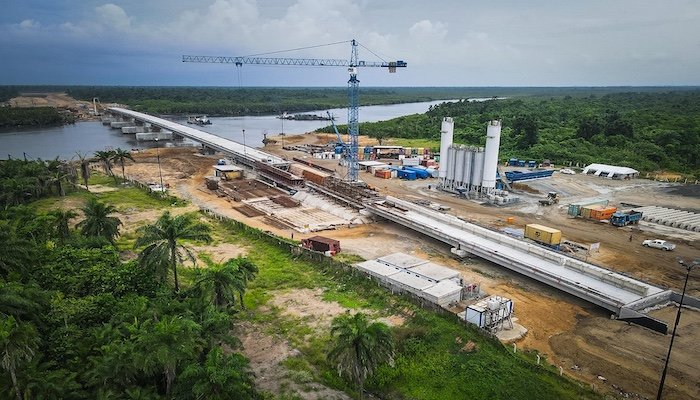
The federal government has approved a fresh N150 billion extension of the Bodo-Bonny Road project in Rivers State, signalling what officials describe as a shift toward “smart, durable and economically impactful infrastructure” under a Public-Private Partnership (PPP) arrangement.
Minister of Works, David Umahi, disclosed this during a meeting with the management of Nigeria LNG Limited, stating that the project reflects a deliberate move away from conventional road construction to long-lasting, technology-driven systems.
According to a statement issued on Thursday by the ministry’s Director of Information and Public Relations, Mohammed Ahmed, the project has already received presidential approval and is expected to be presented before the Federal Executive Council for final ratification.

Umahi said the extension would be constructed using reinforced concrete technology designed to last between 50 and 100 years, a move he claimed would drastically reduce maintenance costs.
“This project is not just about building a road. It is about delivering infrastructure that will stand the test of time, reduce maintenance burden, and provide lasting economic value to Nigerians,” the statement read.
The minister insisted that the Tinubu administration remains committed to transparency, adding that the project would undergo all necessary approval processes.
Beyond the road expansion, Umahi unveiled broader plans to convert Nigeria’s highways into “smart economic corridors,” incorporating digital surveillance, environmental sustainability, and safety infrastructure.
He disclosed that the government has approved the installation of solar-powered street lighting and large-scale tree planting along major highways to improve visibility and security while stimulating economic activity.
The government also plans to deploy Closed-Circuit Television cameras along key routes, supported by monitoring centres aimed at improving emergency response time.
“We are introducing CCTV surveillance systems along key highways with strategically located monitoring centres. This will enable us to respond to emergencies in less than 10 minutes,” Umahi said.
He added that the new design framework would include rest areas, service stations, and operational hubs, while contractors have been directed to reinvest cost savings into value-enhancing components such as solar lighting and landscaping.
In a bid to tackle congestion, the government also announced plans to integrate truck parking facilities along the corridor, with ongoing negotiations with host communities for land acquisition.
Umahi further stated that the project has been given a strict 12-month completion timeline, warning that there would be no room for cost variations.
Read also:
- Umahi opens completed sections of Enugu–Onitsha Expressway
- Umahi warns against Tanker parking on new Roads, raises alarm over infrastructure damage
- Section 1 of Lagos- Calabar Coastal Highway to be commissioned in May -Umahi
“This administration is serious about efficiency and accountability. There will be no cost overruns,” he said.
Meanwhile, the Managing Director of NLNG, Adeleye Falade, highlighted the company’s push toward cleaner energy, presenting a model of a Compressed Natural Gas-powered ship as part of efforts to promote low-carbon transport solutions.
The Bodo-Bonny Road has long been considered a critical infrastructure linking Bonny Island, home to major oil and gas assets, to the mainland in Rivers State.
For decades, the absence of a functional road network forced residents and businesses to rely heavily on water transportation.