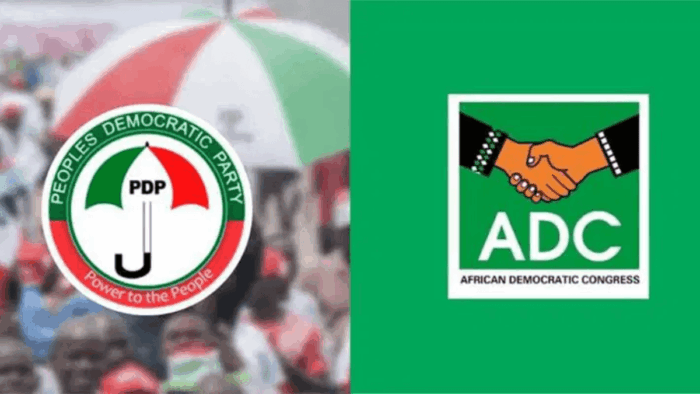
Nigeria’s opposition landscape hangs in the balance as the Supreme Court is set to deliver judgment today, on the protracted leadership disputes rocking the African Democratic Congress (ADC) and the Peoples Democratic Party (PDP), in a ruling that could reshape the political trajectory of the country, ahead of the 2027 general elections.
The verdict, scheduled for 2pm, follows weeks of heightened legal tension and political maneuvering, with both parties scrambling to retain legitimacy and control amid deep internal fractures.

Sources within the opposition coalition confirmed that key stakeholders held an emergency strategy meeting late Wednesday to map out possible responses to the court’s decision.
Notably absent from the high-level talks were Peter Obi and Rabiu Musa Kwankwaso, two figures central to ongoing coalition negotiations.
Hours before the Supreme Court ruling, the crisis within the ADC worsened after a Federal High Court in Abuja, barred the Independent National Electoral Commission (INEC) from recognising congresses organised by a faction loyal to former Senate President David Mark.
The court also restrained Mark and his allies from interfering with the tenure of elected state executives, declaring that only constitutionally recognised party structures can organise congresses.
The ruling effectively invalidated moves by a caretaker leadership to restructure the party, an intervention the court said breached both statutory provisions and the party’s constitution.
Read Also:
- Court halts INEC from recognising ADC congresses
- ADC chieftain blasts Tinubu over failure to fulfill promise of steady power
- How low ADC membership registration in South East could jeopardize Peter Obi’s 2027 ambitions
Despite the setback, Mark struck a defiant tone, insisting the ADC would weather the legal storm and appear on the 2027 ballot.
“We shall triumph in all the cases,” he said, vowing to lead the legal battle despite not being a lawyer.
But dissent within the ADC remains fierce. The party’s 2023 presidential candidate, Dumebi Kachikwu, backed the court ruling, accusing unnamed political actors of attempting to hijack the party.
Similarly, state party leaders described the judgment as a necessary intervention to preserve internal democracy and prevent collapse.
Meanwhile, the faction loyal to Mark has moved swiftly to appeal the ruling and seek a stay of execution, underscoring the high-stakes legal chess game unfolding within the party.
The Supreme Court is also expected to rule on a parallel leadership dispute within the PDP, where rival factions aligned with Oyo State Governor, Seyi Makinde and the Federal Capital Territory (FCT) Minister, Nyesom Wike, continue to battle for control of party structures.
Heavyweights from both camps are expected in court, reflecting the significance of the ruling for the party’s survival and its role in the opposition coalition.
The urgency surrounding the cases is driven by a tightening electoral timetable released by INEC, which sets strict deadlines for party primaries, submission of membership registers, and campaign activities.
Legal representatives for the ADC had earlier warned the apex court that any delay in judgment could expose the party to “grave and irreversible risk” of exclusion from the 2027 elections.
They argued that the party’s ability to comply with statutory requirements hinges entirely on the court’s decision.
Beyond the courtroom, today’s ruling is widely seen as a referendum on the viability of Nigeria’s opposition ahead of 2027.
With coalition talks ongoing and defections reportedly in play, the outcome could either consolidate a unified front against the ruling party—or deepen fragmentation within opposition ranks.
For now, all eyes remain on the Supreme Court, where a single judgment may determine whether key opposition platforms survive long enough to contest power—or implode under the weight of their own internal contradictions.