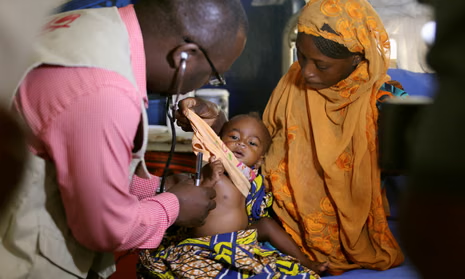
UN Deputy Secretary-General, Amina Mohammed, made the commitment following a high-level visit to conflict-affected communities in Zamfara State and Benue State, where she engaged displaced persons and assessed ongoing interventions.
According to UN spokesperson Stéphane Dujarric, Mohammed witnessed firsthand the scale of devastation caused by insecurity, describing the humanitarian situation as severe but not beyond response if local efforts receive sustained international backing.

“She saw both the urgent needs on ground and the resilience of communities, as well as the work already being done by authorities and humanitarian partners,” Dujarric said.
The visit comes amid growing reliance on digital systems to manage Nigeria’s complex displacement crisis.
At the ongoing 59th Session of the Commission on Population and Development in New York, UN officials highlighted how data-driven tools are reshaping humanitarian coordination.
- United Nations intervention in the Sahel crisis: what implications
- Former United Nations Consultant Becomes 15th Odio-Ologbo of Delta Community
- Trump tells the UK, other nations to get their oil from Strait of Hormuz
Nigeria, grappling with nearly two million internally displaced persons due largely to insurgency in the North-East, has adopted the Displacement Tracking Matrix developed by the International Organization for Migration (IOM) to improve real-time data collection and response planning.
UN officials say the system, currently deployed in over 90 countries, has strengthened evidence-based decision-making, enabling authorities to better map population movements and allocate scarce resources.
However, the organisation warned that the gains are being undermined by structural challenges, including digital inequality, weak infrastructure, data privacy risks, and the spread of misinformation, factors that disproportionately impact already vulnerable communities.
Meanwhile, the UN Secretary-General, António Guterres, has raised alarm over declining global financing for development programmes, warning that current funding levels fall far short of what is required to meet sustainable development targets.
Guterres called for more predictable and sustained financial commitments, particularly for countries like Nigeria facing overlapping security and humanitarian pressures.