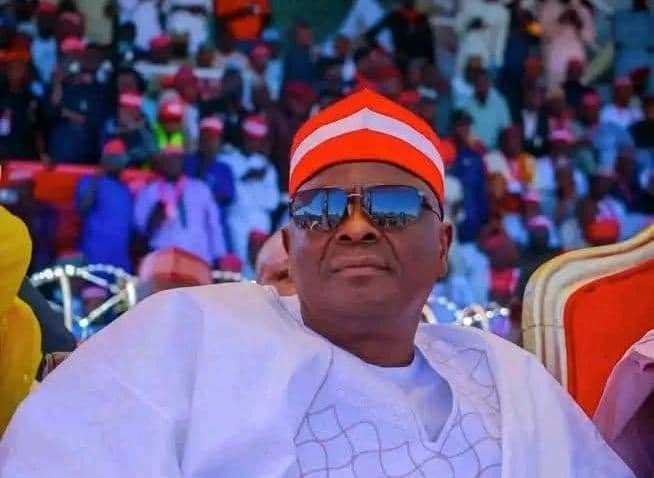
In Nigeria’s political theatre, symbolism often precedes substance. Gatherings framed as cultural or religious homage routinely double as staging grounds for strategic recalibration. That duality was on full display in Kano on Sunday, where Rabiu Musa Kwankwaso hosted an array of opposition heavyweights under the banner of a Sallah celebration. Yet beneath the festive veneer of the annual Dandalin Kwankwasiyya lay the unmistakable architecture of a political realignment—one that could reshape the trajectory of the 2027 presidential election.

The presence of Peter Obi, Seyi Makinde, and Seriake Dickson alongside Kwankwaso was not incidental. It was calculated. For a political class still grappling with the consequences of fragmentation in 2023, the optics of unity—however preliminary—carry significant weight.
A Gathering That Signals More Than It Says
Officially, the meeting was framed as a routine Eid-el-Fitr homage. Unofficially, it functioned as a convergence point for some of the most consequential actors in Nigeria’s opposition politics. The choice of Kano was strategic. As the political and demographic anchor of the North-West, Kano remains one of the most critical battlegrounds in national elections. Any coalition aspiring to national viability must command influence there.
Kwankwaso’s residence on Miller Road transformed into a political arena where symbolism did the heavy lifting. The sea of red caps—emblematic of the Kwankwasiyya movement—was more than a show of loyalty; it was a demonstration of enduring grassroots capacity. Despite internal fractures, the movement retains a mobilization structure that most political platforms envy.
For Obi, whose 2023 campaign drew unprecedented urban and youth support, the Kano appearance was a deliberate outreach to northern constituencies where his acceptance remains uneven. For Makinde, it was an implicit declaration that his political calculations now extend beyond the confines of the Peoples Democratic Party (PDP). For Dickson, it reinforced his role as a bridge figure within the evolving opposition bloc.
The Strategic Imperative of Unity
The arithmetic of the 2023 election remains the most compelling argument for opposition convergence. The combined votes secured by Obi, Kwankwaso, and Atiku Abubakar significantly exceeded those of Bola Tinubu. Yet that numerical advantage was neutralized by disunity.
This is the paradox the opposition now seeks to resolve: how to convert latent electoral strength into a coherent political vehicle.
The emergence of the African Democratic Congress (ADC) as a potential coalition platform reflects a pragmatic shift. Rather than attempting to rehabilitate legacy parties weakened by internal crises, opposition actors are experimenting with a relatively neutral platform capable of accommodating competing ambitions.
Obi’s reported alignment with the ADC—and the quiet repositioning of Atiku within the same orbit—suggests that the party is being engineered as a convergence hub. The Kano meeting, therefore, represents an extension of that process, bringing Kwankwaso—previously a holdout—into closer proximity with the emerging coalition.
Kwankwaso’s Calculated Positioning
Kwankwaso occupies a unique position in this evolving equation. Unlike Obi and Atiku, whose political networks are national but diffused, Kwankwaso commands a highly concentrated and disciplined base in Kano and parts of the North-West. This makes him both indispensable and difficult to accommodate.
His insistence on being considered for either the presidential or vice-presidential slot is not mere ambition; it reflects the leverage conferred by his grassroots machinery. Any coalition that sidelines him risks forfeiting a critical electoral bloc.
Recent developments within the New Nigeria Peoples Party (NNPP), including signals that its 2027 ticket is open, have effectively loosened Kwankwaso’s institutional anchor. This creates both opportunity and risk. While it frees him to negotiate within a broader coalition, it also raises questions about the durability of his political platform outside Kano.
The Obasanjo Mediation Factor
Behind the scenes, the hand of Olusegun Obasanjo is widely believed to be shaping the contours of the emerging alliance. Obasanjo’s influence derives not from formal authority but from his enduring role as a political broker with cross-regional credibility.
His relationship with both Obi and Kwankwaso positions him as a natural mediator. For Obi, Obasanjo’s backing provides elite validation that complements his grassroots appeal. For Kwankwaso, it offers a pathway to negotiate a dignified role within a coalition that might otherwise marginalize him.
The reported proposal of an Obi-Kwankwaso ticket reflects a strategic logic: combine regional strengths to create a nationally competitive pairing. Obi brings consolidation in the South-East and significant traction among urban voters nationwide. Kwankwaso delivers depth in the North-West, particularly in Kano.
However, this configuration is not without complications. It implicitly sidelines other aspirants, most notably Atiku, whose political machinery remains formidable.
The PDP’s Fragmentation and Its Implications
No analysis of the opposition’s trajectory can ignore the implosion of the PDP. Once Nigeria’s dominant political force, the party is now embroiled in a factional struggle that threatens its viability as a national platform.
The split between the governors’ bloc—aligned with figures like Makinde—and the faction associated with Nyesom Wike has evolved into a structural crisis. Legal disputes, competing conventions, and mutual accusations of sabotage have eroded the party’s coherence.
Makinde’s presence in Kano is therefore significant. It signals not just dissatisfaction with the PDP’s internal dynamics but a willingness to explore alternatives. His public assertion that alignment with Wike equates to indirect support for Tinubu underscores the depth of mistrust within the party.
For the broader opposition, the PDP’s fragmentation presents both an opportunity and a challenge. On one hand, it weakens a potential rival within the opposition space. On the other, it complicates efforts to consolidate anti-APC forces under a single platform.
APC’s Strategic Calculus
The ruling All Progressives Congress (APC) has responded to the Kano meeting with a mix of public dismissal and private caution. Official statements downplaying the significance of the gathering are consistent with a strategy aimed at projecting confidence.
Read also:
- Kwankwaso hosts Obi, Gov. Makinde, Sen. Dickson in Kano
- Shettima welcomes Gov. Fintiri to APC, declares him party leader in Adamawa
- Gov. Yusuf appreciates Tinubu’s visit to Kano, late business mogu’s family
However, internal assessments reportedly acknowledge the threat posed by a united opposition. The APC’s victory in 2023 was facilitated not just by its own strengths but by the opposition’s divisions. A repeat of that fragmentation is far from guaranteed.
The party’s likely response will involve a combination of defensive and offensive strategies: consolidating its existing base, exploiting divisions within the opposition, and potentially co-opting key figures from rival camps.
The Atiku Variable
Any discussion of opposition unity must grapple with the role of Atiku Abubakar. His political résumé, financial resources, and national network make him a central figure in any coalition calculus.
Yet his relationships with both Obi and Kwankwaso are fraught. Obi’s departure from the PDP in 2022—where he had been Atiku’s running mate—introduced a layer of personal and political tension. Kwankwaso, meanwhile, has his own history of rivalry with Atiku in northern politics.
The challenge for the ADC, if it becomes the coalition platform, will be to manage these competing ambitions without triggering a rupture. A transparent and credible primary process could provide legitimacy, but it also carries the risk of producing losers who may defect or undermine the eventual ticket.
Grassroots Versus Elite Politics
One of the defining tensions within the emerging coalition is the balance between grassroots mobilization and elite negotiation. Kwankwaso’s strength lies in his ability to command a loyal base. Obi’s appeal is rooted in a movement that blends grassroots enthusiasm with digital mobilization. Atiku’s influence is anchored in elite networks and institutional experience.
Reconciling these different modes of political engagement will be critical. A coalition that is perceived as purely elite-driven risks alienating the very voters it seeks to mobilize. Conversely, a movement that lacks elite coordination may struggle to navigate the complexities of national elections.
Regional Balancing and Electoral Math
Nigeria’s electoral dynamics are deeply influenced by regional considerations. Any viable presidential ticket must navigate the delicate balance of geography, religion, and ethnicity.
An Obi-Kwankwaso ticket offers a North-South configuration that aligns with established political norms. However, it also raises questions about broader inclusivity. How will the South-West—Tinubu’s stronghold—factor into the coalition’s strategy? What role will the North-East, Atiku’s base, play?
These are not merely theoretical concerns. They will shape the coalition’s ability to build a truly national platform.
The Role of Political Timing
Timing will be a decisive factor in determining the coalition’s success. Electoral regulations, party primaries, and campaign timelines impose constraints that limit the window for negotiation.
The Kano meeting suggests that opposition actors are acutely aware of these constraints. Early engagement increases the likelihood of building consensus before formal processes begin. It also allows time to test the durability of alliances under pressure.
Risks of Implosion
Despite the momentum generated by the Kano convergence, the risks of failure remain substantial. Nigerian political history is replete with alliances that collapsed under the weight of personal ambition and mutual distrust.
Key risk factors include: Leadership disputes: Competing claims to the presidential ticket could fracture the coalition.
Ideological incoherence: A coalition driven solely by the goal of unseating the incumbent may struggle to articulate a coherent policy agenda.
External interference: The ruling party may exploit divisions through strategic co-optation or political maneuvering.
The Kwankwasiyya Factor
For the Kwankwasiyya movement, the stakes are particularly high. The defection of key figures, including Kano’s governor, exposed vulnerabilities within the movement’s structure. The Kano gathering was therefore as much about internal consolidation as it was about external alliance-building.
The enthusiastic reception of Obi by Kwankwasiyya supporters suggests a willingness to embrace broader coalitions. However, sustaining that openness will depend on how the movement’s interests are represented in any final arrangement.
The Road to 2027
The Kano meeting marks the beginning of a process rather than its culmination. In the months ahead, several critical developments will shape the trajectory of the opposition: The resolution—or escalation—of the PDP crisis; The formal structuring of the ADC as a coalition platform; The emergence of a consensus—or contested—presidential ticket; The response of the APC to a potentially unified opposition.
Each of these variables carries significant implications. Together, they will determine whether the opposition can translate its current momentum into a credible electoral challenge.
A Fragile but Significant Shift
What happened in Kano is best understood as a signal rather than a settlement. It reflects a growing recognition among opposition actors that fragmentation is a losing strategy. It also demonstrates a willingness—however tentative—to explore new configurations of power.
The presence of figures like Rabiu Musa Kwankwaso, Peter Obi, and Seyi Makinde on the same platform is not, in itself, transformative. What matters is whether that convergence can be institutionalized into a durable political arrangement.
For now, the opposition appears to have internalized the central lesson of 2023: unity is not optional. Whether it can operationalize that lesson—amid competing ambitions, regional complexities, and external pressures—remains the defining question of Nigeria’s political future.
The road to 2027 has begun. Kano may well be remembered as the point where the conversation shifted from possibility to intent. Whether it ultimately leads to a coherent alternative or another cycle of fragmentation will depend on decisions yet to be made—and compromises yet to be accepted.