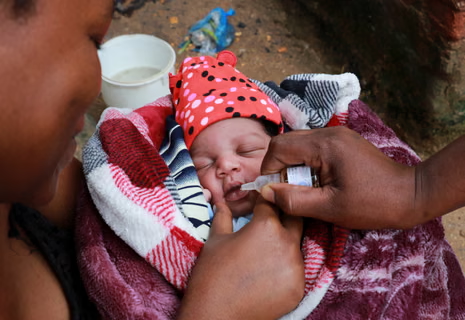
The Adamawa State Government has unveiled plans to vaccinate more than one million children between the ages of 0 and 59 months as part of a major campaign aimed at preventing childhood diseases.
The announcement was made during the first-quarter meeting of the State Task Force on Primary Healthcare held in Yola.

Speaking at the event, Deputy Governor Kaletapwa Farauta explained that the meeting was organised to evaluate the state’s readiness and enhance coordination for key public health programmes. She also acknowledged the contributions of development partners and stakeholders supporting healthcare services across the state.
Farauta reiterated the administration’s commitment to improving primary healthcare facilities and protecting the well-being of residents. She assured that adequate measures are in place to ensure the success of the upcoming Sub-National Immunization Plus Days (SNIPDs), scheduled to begin on March 28.
Read Also:
- Police arrest 2 suspects over kidnap of four-year-old in Adamawa
- Adamawa Assembly confirms 3 commissioner nominees
- Atiku’s son resigns as Adamawa works commissioner
She noted that the vaccination drive became necessary following reports of circulating variant poliovirus type 2 (cVPV2) in Gombi Local Government Area and nearby states.
The deputy governor urged parents, caregivers, and community leaders to actively support the campaign by ensuring that eligible children receive the vaccine.
She also raised concerns about a reported meningitis case in Maiha Local Government Area, calling for swift and coordinated action to prevent a potential outbreak.
In addition, Farauta revealed that preparations are ongoing for the integrated Seasonal Malaria Chemoprevention (SMC) programme and the distribution of Long-Lasting Insecticide-Treated Nets (LLINs), both scheduled to commence in June 2026 across selected wards.
She stressed the importance of strengthening emergency response systems, particularly with the rainy season approaching, to reduce the risk of flooding.
Earlier, the Commissioner for Health and Human Services, Felix Tangwami, alongside the Executive Chairman of the Primary Healthcare Development Agency, Suleiman Saidu Bashir, noted that the quarterly meeting served as a platform to review ongoing health programmes, evaluate performance, identify gaps, and develop strategies for improvement.
However, stakeholders at the meeting identified insecurity as a significant challenge affecting healthcare delivery, particularly in Lamurde and Hong Local Government Areas.