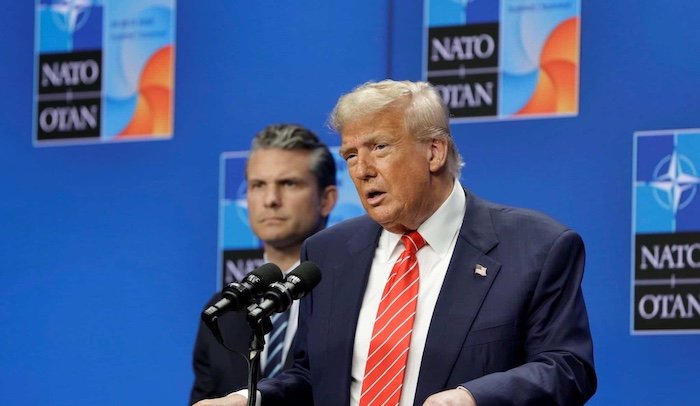
Donald Trump has issued a strong warning to the North Atlantic Treaty Organization, cautioning that the alliance could face serious consequences if member states fail to assist in securing the strategically important Strait of Hormuz amid rising tensions across the Middle East.
In an interview with the Financial Times, the U.S. president said the alliance could face a “very bad future” if its members decline to take part in efforts to protect the narrow maritime corridor, one of the most vital routes for global oil transportation.

The Strait of Hormuz, located between Iran and Oman, handles a large share of the world’s crude oil shipments. Any disruption to commercial traffic in the passage could trigger major shocks in international energy markets and global trade.
Trump disclosed that the United States is currently holding discussions with about seven countries regarding a possible joint operation to police the waterway and guarantee safe passage for commercial vessels navigating the strait.
Read Also:
- Asia Stocks slide, Oil prices surge as Donald Trump warns Iran over nuclear deal
- Breaking News: Donald Trump captures Venezuelan President Nicolás Maduro after massive U.S. strike
- Donald Trump is president because of me, Elon Musk boasts
Speaking to reporters aboard Air Force One, the president stressed that Washington expects NATO allies and other global powers to share the burden of maintaining maritime security in the region.
He also warned that the United States would take note of countries that refuse to participate in the proposed security initiative, suggesting that their response could influence future diplomatic and military cooperation with Washington.
Trump further indicated that China should play a role in safeguarding shipping lanes, citing Beijing’s heavy dependence on energy imports that pass through the Strait of Hormuz.
According to the president, the level of cooperation from China could influence the timing of a proposed meeting with Chinese leader Xi Jinping. Trump hinted that the summit could be delayed if Beijing does not contribute to efforts aimed at stabilising the critical shipping route.
China remains one of the world’s largest crude oil importers, with a significant portion of its energy supply transported through the Gulf region.
Trump’s warning comes as tensions intensify across the Middle East. The Israel Defence Forces recently announced the start of “limited and targeted ground operations” against the Iran-backed militant group Hezbollah in southern Lebanon.
The development follows a fresh escalation between Israel and forces aligned with Iran. Reports from Tehran indicate heavy bombing in the Iranian capital, while Iran and Hezbollah have reportedly launched missile attacks toward Israeli territory.
Elsewhere in the region, authorities in Saudi Arabia said air defence systems intercepted and destroyed dozens of drones overnight, highlighting the growing security risks in the Gulf.
In the Dubai area of the United Arab Emirates, a drone strike reportedly hit a fuel tank facility close to Dubai International Airport, one of the world’s busiest aviation hubs. Airport officials confirmed that flights were temporarily disrupted but said operations would gradually resume after safety checks.
Security analysts warn that prolonged instability around the Strait of Hormuz could have far-reaching implications for global energy supply and international shipping.
A substantial share of the world’s crude oil passes through the narrow maritime corridor each day, meaning that any sustained conflict, blockade, or disruption could send oil prices sharply higher and create ripple effects across global markets.
Diplomatic engagement continues as military activity unfolds across several fronts in the region, leaving the security of one of the world’s most important energy routes under close international scrutiny.