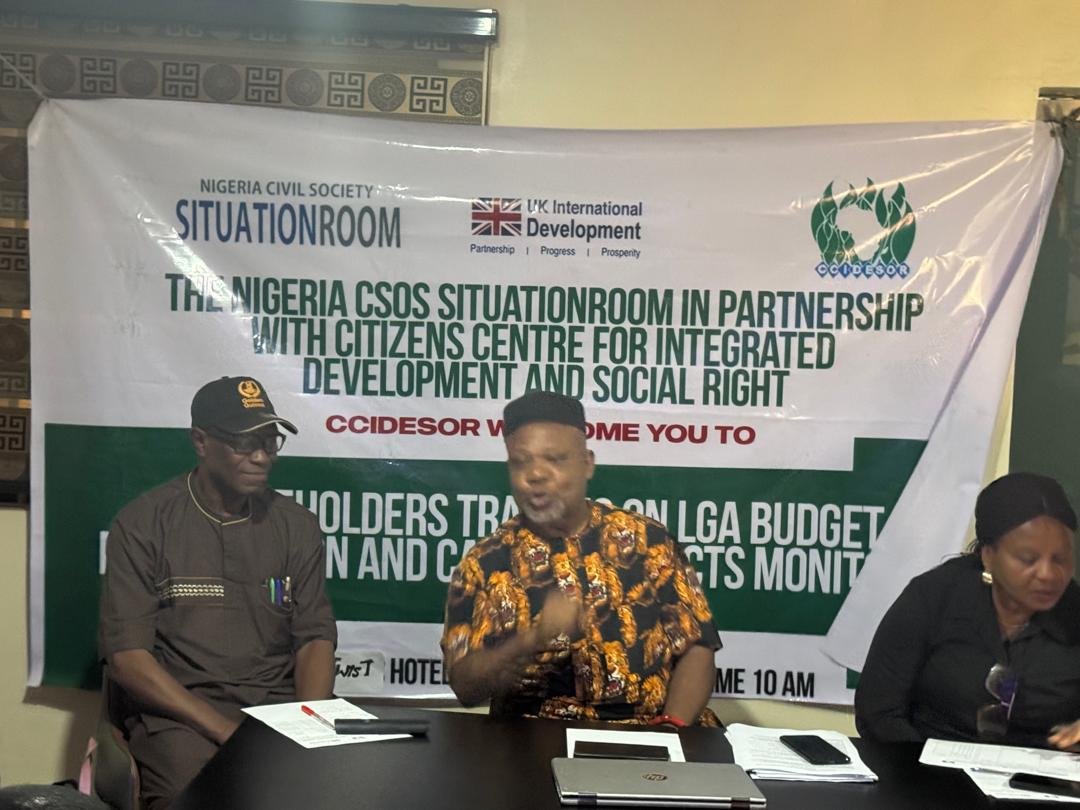
A civil society group has called on Nigerians to take an active role in the preparation and monitoring of local government budgets in order to promote transparency and accountability at the grassroots level.
The appeal was made by the Executive Director of the Citizens Centre for Integrated Development and Social Rights (CCIDESOR), Dr. Emeka Ononamadu, during a Budget Participation and Capital Budget Monitoring Training held on Sunday in Enugu.

The training was organised by the Citizens Centre for Integrated Development and Social Rights in partnership with the Nigeria Civil Society Organisations Situation Room to encourage citizens to engage more closely with the budgeting process in their local councils.
Speaking at the event, Ononamadu said that many Nigerians, particularly those living in rural and suburban communities, have been deprived of the benefits of local government budgets because of limited public participation and oversight.
Read Also:
- CSOs Situation Room, CCIDESOR task Tinubu, NASS on political will to ensure LG autonomy
- CSOs raise alarm over alleged boundary manipulation, warn of erosion of Nigeria’s territorial integrity
- Journalists, CSOs urged to deploy FOI Act against corruption
He observed that many citizens rarely question how funds allocated to their local councils are spent, allowing political actors and their associates to manipulate the system without proper scrutiny.
According to him, active participation in budget preparation and monitoring enables communities to verify whether projects listed in council budgets actually exist and whether due process is followed during project awards. He added that citizen oversight also helps determine the true cost and value of projects, assess the quality of implementation, and evaluate whether the projects meet the real needs of the communities.
Ononamadu explained that budget monitoring also makes it possible to track project timelines, examine how resources are utilised, measure the impact of completed projects, and ensure fair distribution of development initiatives across different wards within a council area.
He further disclosed that the training programme will include field exercises in Abia State, Imo State, and Enugu State, where participants will apply the knowledge gained during the workshop to monitor projects within their local government areas.
One of the participants, Mr. Samuel Ani, commended the organisers for creating a platform that encourages grassroots participation in development efforts. Ani, who serves as Chairman of the Youth Wing of the Christian Association of Nigeria (YOWICAN), pledged that young people would be mobilised to engage more actively in the affairs of their local councils in order to reduce waste and improve governance at the community level.
Another participant, Mrs. Onyinye Mamah, Executive Director of the Heroine Women Foundation, said an effective and transparent local government system would significantly improve the economic and social conditions of women in rural communities.
Mamah, who also serves as President of the Women Support Women for Human Empowerment and Mentorship Initiative, noted that women’s groups strongly support the training and its planned field survey, describing it as a step toward ensuring that the local government system works for all citizens.
About 30 participants drawn from civil society organisations, youth and women groups, as well as media practitioners, attended the training programme. The initiative was organised by the Citizens Centre for Integrated Development and Social Rights and the Nigeria Civil Society Organisations Situation Room with support from UK International Development.