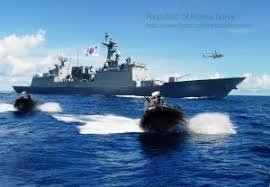
South Korea has indicated it will carefully review a request from the United States to deploy naval forces to help secure the strategic Strait of Hormuz as tensions continue to rise in the Middle East.
The appeal was made by U.S. President Donald Trump, who called on allied nations to support international efforts aimed at protecting the vital maritime corridor that carries a significant share of the world’s oil supply.

In a statement released on Sunday, the presidential office in Seoul said the government would remain in close communication with Washington while it evaluates the request and the broader security implications of any potential deployment.
South Korean officials said developments in the Middle East are being closely monitored as the situation continues to evolve, adding that any decision would take into account both national security interests and regional stability.
Read Also:
- South Korea Court sentences Former President Yoon Suk Yeol to life imprisonment for insurrection over martial law declaration
- Prosecutors seek death penalty for ex-South Korean president Yoon
- South Korean woman sentenced to 4 years in jail for blackmailing Son
Meanwhile, officials in Japan also responded cautiously to the proposal. Japanese lawmaker Takayuki Kobayashi noted that although the deployment of Japanese naval vessels could be legally possible under certain conditions, the threshold for such a move remains extremely high.
Speaking during an interview with the Japanese public broadcaster NHK, Kobayashi explained that the escalating tensions in the region mean any decision to dispatch warships must be considered carefully due to the potential risks involved.
The cautious responses from both countries come at a time of heightened geopolitical strain following the recent escalation involving Iran, Israel and the United States.
Security analysts warn that further instability could disrupt maritime traffic through the Strait of Hormuz, a narrow waterway located between Iran and Oman that serves as one of the world’s most critical oil transit routes.
The strait is widely regarded as a strategic chokepoint for global energy markets, with a large percentage of the world’s crude oil shipments passing through the corridor each day. Any disruption to traffic in the area could therefore have significant consequences for international energy supplies and global economic stability.