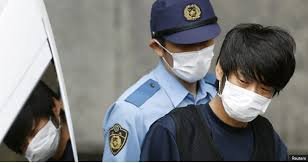
The man who killed Japan’s Former Prime Minister, Shinzo Abe, has been sentenced to life in prison, three and a half years after he shot him dead at a rally in the city of Nara in 2022.
Tetsuya Yamagami had pleaded guilty to murder charges at the trial’s opening last year, but how he should be punished has divided public opinion in Japan.

While many see the 45-year-old as a cold-blooded murderer, some sympathise with his troubled upbringing.
Prosecutors said Yamagami deserved life imprisonment for his “grave act”. Abe’s assassination stunned the country, where there is virtually no gun crime.
Seeking leniency, Yamagami’s defence team said he was a victim of “religious abuse”.
His mother’s devotion to the Unification Church bankrupted the family, and Yamagami bore a grudge against Abe after realising the ex-leader’s ties to the controversial church, the court heard.
On Wednesday, Judge Shinichi Tanaka from the Nara District Court said the fact that Yamagami “shot (Abe) from behind… when he was least expecting it” showed how “despicable and extremely malicious” his actions were, AFP news agency reported.
Yamagami sat quietly with his hands clasped and eyes downcast as the sentence was handed down.
Nearly 700 people had lined up outside the courtroom to attend the hearing.
Read Also:
- Museveni wins Uganda’s presidential vote, secures 7th term in office
- 2 Russian doctors arrested after 9 babies die in maternity hospital
- Trump vows ‘very strong action’ if Iran executes protesters
Abe’s shocking death in broad daylight prompted investigations into the Unification Church and its questionable practices, including soliciting financially ruinous donations from its followers.
The case also exposed links with politicians from Japan’s ruling Liberal Democratic Party and resulted in the resignations of several cabinet ministers.
Journalist Eito Suzuki, who covered all but one of Yamagami’s court hearings, said Yamagami and his family seemed “overwhelmed with despair” throughout the trial.
Yamagami “exuded a sense of world-weariness and resignation,” recounts Suzuki, who began looking into the Unification Church long before Abe’s shocking murder.
“Everything is true. There is no doubt that I did this,” Yamagami said solemnly on the first day of his trial in October 2025.
Armed with a homemade gun assembled using two metal pipes and duct tape, he fired two shots at Abe during a political campaign event in the western city of Nara on July 8, 2022.
The murder of Japan’s most recognisable public figure at the time, Abe, remains the longest-serving prime minister in Japanese history, sent shockwaves around the world.
Calling for a jail term of no more than 20 years, Yamagami’s lawyers argued that he was a victim of “religious abuse.”
He resented the church because his mother donated to it his late father’s life insurance and other assets, amounting to 100 million yen ($633,000, £471,000), the court heard.
Yamagami spoke of his grievance against Abe, who was 67 when shot, after seeing his video message at a church-related event in 2021, but said he had initially planned to attack church executives, not Abe.
Suzuki recalls Abe’s widow, Akie’s look of disbelief when Yamagami said the ex-leader was not his main target.
Her expression “remains vividly etched in my mind”, Suzuki says.
“It conveyed a sense of shock, like she was asking: Was my husband merely a tool used to settle a grudge against the religious organisation? Is that all it was?”
In an emotional statement read to the court, Akie Abe said the sorrow of losing her husband “will never be relieved. I just wanted him to stay alive.”