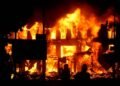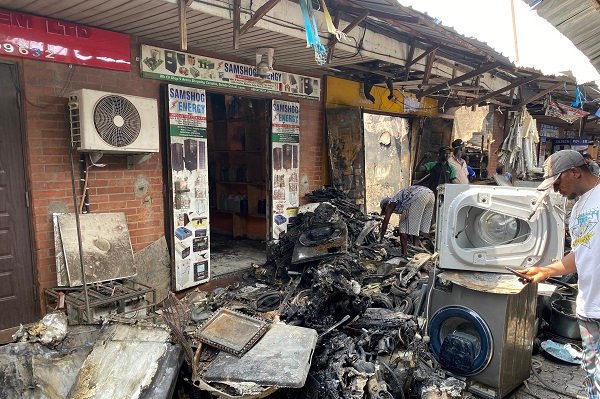
A devastating early-morning fire has destroyed no fewer than 48 shops at the Elegushi Model Market complex in the Lekki area of Lagos State, causing significant losses to traders.
The incident occurred in the early hours of Sunday, with the Lagos State Emergency Management Agency (LASEMA) confirming that it received a distress call at about 2:00 a.m.

In a statement, the agency’s Permanent Secretary, Olufemi Oke-Osanyintolu, said emergency responders arrived at the scene to find the market complex already engulfed in flames.
He explained that coordinated efforts by emergency agencies helped to contain the blaze and prevent it from spreading to adjoining buildings within the densely populated area.
“Preliminary investigations conducted by the Shark Response Team revealed that the fire started from one of the makeshift stalls within the market complex and quickly spread to the main building,” Oke-Osanyintolu said, adding that the exact cause of the fire had yet to be determined as of the time of reporting.
He confirmed that no lives were lost and no injuries were recorded during the incident.
Read also:
- TETFund to set up fire stations, installs hydrants, sprinklers, smoke detectors in public universities
- Fire destroys goods worth millions at Nnewi Market
- Fire destroys goods worth millions in Lagos market
A post-disaster assessment carried out by the agency showed that 48 shops were completely affected, dealing a heavy blow to traders who lost goods and property worth millions of naira.
Oke-Osanyintolu noted that market union executives and traders were immediately sensitised on fire safety measures to prevent future occurrences.
“Market leaders were advised to install fire extinguishers at strategic points to enable prompt response to minor outbreaks before they escalate,” he said. “Shop owners were also urged to be more conscious of fire prevention measures, including the installation of smoke detectors and fire alarms within the market premises.”
Fire outbreaks remain a recurring challenge in Lagos markets, often linked to overcrowding, makeshift electrical connections, and inadequate fire management infrastructure, raising renewed concerns about safety standards in commercial hubs across the state.