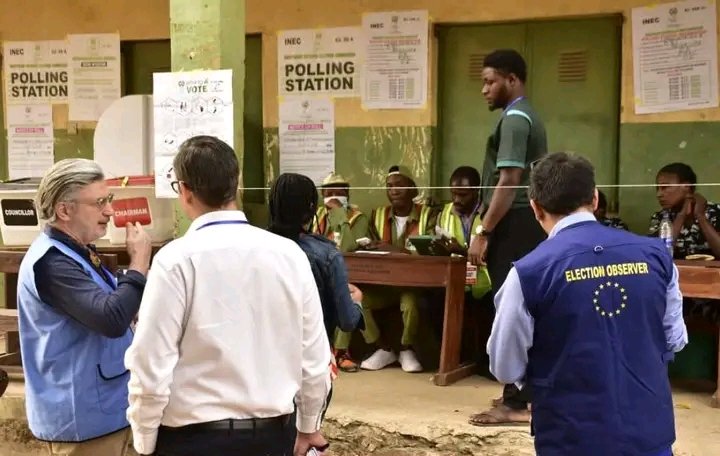
A civil society organisation, Yiaga Africa, has criticised the conduct of the Federal Capital Territory (FCT) area council elections, citing low voter turnout, vote-buying and widespread logistical lapses
In a preliminary statement issued on Saturday after the polls conducted by the Independent National Electoral Commission (INEC), the group said although the elections were largely peaceful, significant administrative shortcomings undermined the integrity of the process.

The elections were held to fill six chairmanship seats and 62 councillorship positions across the six area councils of the FCT.
Executive Director of Yiaga Africa, Samson Itodo, disclosed that the organisation deployed trained and accredited roving observers across the 62 wards to monitor opening procedures, accreditation, voting and counting.
“Overall, the election was conducted in a largely peaceful atmosphere. Voters who presented themselves at polling units were afforded the opportunity to exercise their franchise without widespread disruption,” Itodo said.
He, however, noted that voter turnout was generally poor across most polling units observed.
According to the group, late commencement of voting was recorded in several locations, particularly in the Abuja Municipal Area Council, where as of 9:00 a.m., polling units were still being set up, with accreditation and voting starting around 10:00 a.m. in many centres.
Yiaga also reported missing materials in some polling units, including the absence of a voter register in a polling unit in Wuse Ward until concerns were raised. In parts of Abaji Area Council, observers noted the non-availability of voting cubicles and ink pads.
Read also:
- FCT Polls: Confusion as Supreme Court Nullifies Gwagwa, Upholds Karshi’s Nomination as APC AMAC Candidate
- Osun denies not paying salaries of LG workers amid federal allocation dispute
- Election materials arrive early at Peyi polling unit as FCT residents vote in area council polls
The organisation further criticised the redistribution of voters to newly created polling units without adequate notice.
Although INEC reportedly sent SMS notifications, many were delivered on election day, causing confusion and congestion at polling centres.
“The lack of timely and effective communication generated confusion at several polling locations, as numerous voters spent over an hour attempting to ascertain their designated polling units,” Itodo said, adding that the situation undermined queue management and may have discouraged participation.
Yiaga also alleged that some polling units closed before the official 2:30 p.m. deadline, contrary to guidelines requiring officials to remain until all voters on queue had cast their ballots.
On security deployment, the group said there was heavy presence of personnel in certain areas, which in some instances impeded the movement of accredited observers and restricted voter access to polling units.
It further flagged incidents of vote-buying, describing the practice as a persistent problem despite prior assurances by INEC and security agencies to curb it.
Yiaga urged INEC to ensure that Form EC 60E, the People’s Results Sheet, is pasted at polling units and that results are promptly uploaded to the IReV portal and transmitted to ward collation centres to enhance transparency.
The organisation said it would continue monitoring the collation process and the results portal, insisting that strict compliance with laid-down procedures is critical to the credibility of the final outcome.