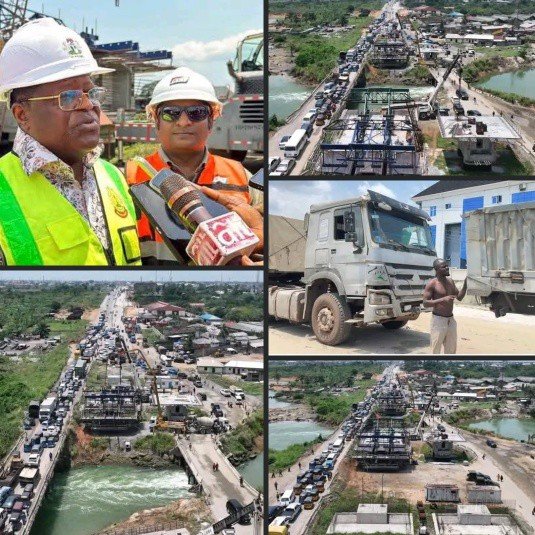
The Minister of Works, David Umahi, has issued a strong warning against the growing practice of parking fuel tankers and other heavy-duty vehicles on newly constructed roads, describing it as a major threat to the durability of Nigeria’s critical infrastructure.
Umahi raised the concern during an inspection of the Aleto Bridge project in Rivers State, where he expressed dismay over the obstruction of a completed section of the road by stationary fuel tankers. He noted that such behaviour not only disrupts traffic flow but also accelerates the deterioration of expensive public assets.

According to the minister, no road anywhere in the world is designed to withstand prolonged static pressure from heavy-duty vehicles. He stressed that allowing tankers to remain parked on finished road surfaces would inevitably lead to structural damage and reduce the lifespan of the infrastructure.
He pointed out that the Aleto Bridge project, valued at over ₦230 billion, represents a significant national investment that must be protected. The minister questioned the rationale behind allowing misuse of such projects, insisting that the government would not stand by while critical infrastructure is damaged.
Read Also:
- Umahi bags Silverbird Extraordinary Personality of the Year award
- Tinubu’s administration has favoured South-East – Umahi
- Umahi denies using the police to harass businesswoman
Umahi, however, commended the contractor, Reynolds Construction Company, for maintaining high construction standards and praised Bola Ahmed Tinubu for ensuring continuity of the project through alternative funding after support from the Nigerian National Petroleum Company Limited ceased in 2025.
He described the Aleto Bridge as a landmark engineering project, highlighting its use of concrete pavement technology, solar-powered lighting, and reinforced structural design aimed at improving long-term performance.
The minister also revealed plans to integrate young Nigerian engineers into the project through a mentorship initiative backed by the presidency, noting that such exposure would help build local technical capacity.
Providing an update on timelines, Umahi disclosed that one carriageway of the project is expected to be completed before May 25, 2026, while the first phase is projected for completion by August. He added that the second phase, which includes multiple flyovers and bridges, is expected to be delivered within the year.
He reiterated that the decision to redesign the project from asphalt to concrete was driven by the need for durability and sustainability, adding that the results of that shift are already visible.
Calling for collective responsibility, the minister urged road users, transport operators, and stakeholders to safeguard public infrastructure, stressing that government efforts alone would not be sufficient to preserve national assets.