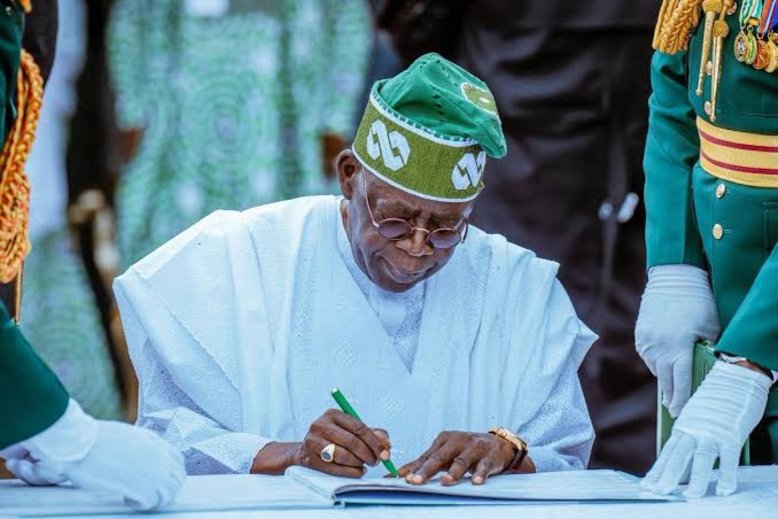
In a bold move aimed at curbing revenue leakages and enhancing fiscal transparency, Nigerian President Bola Ahmed Tinubu signed Executive Order 9 on February 13, 2026. Officially titled the “Presidential Executive Order to Safeguard Federation Oil and Gas Revenues and Provide Regulatory Clarity, 2026,” the directive mandates the direct remittance of all oil and gas revenues, including royalty oil, tax oil, profit oil, and profit gas, straight into the Federation Account.
This bypasses previous retention mechanisms held by the Nigerian National Petroleum Company Limited (NNPCL), such as the 30% management fee on profit oil and gas from production sharing contracts (PSCs) and the 30% Frontier Exploration Fund deduction.
While proponents hail it as a step toward accountability and increased revenue for federal, state, and local governments-potentially boosting allocations by up to N15 trillion-the order has sparked fierce opposition from labor unions, who warn of devastating job losses in the oil and gas industry.

At its heart, Executive Order 9 seeks to eliminate what President Tinubu described as “excessive deductions, overlapping funds, and structural distortions” that have historically reduced remittances to the Federation Account.
Under the Petroleum Industry Act (PIA) of 2021, NNPCL, a state-owned but commercially oriented entity, was allowed to retain portions of oil revenues for operational costs, frontier exploration, and management fees.
The new order suspends these retentions, requiring all operators and contractors under PSCs, profit-sharing contracts, and risk service contracts to pay government entitlements directly to the central account.
This includes scrapping the 30% management fee and redirecting funds previously allocated to NNPCL’s discretionary use.
Supporters, including the Petroleum Products Retail Outlets Owners Association of Nigeria (PETROAN) and the Revenue Mobilization Allocation and Fiscal Commission (RMAFC), argue that this will block leakages, promote transparency, and ensure revenues benefit the broader Nigerian populace.
However, critics contend that this abrupt fiscal recalibration could starve NNPCL of necessary funds, forcing operational cutbacks that ripple into widespread job losses.
PENGASSAN President, Festus Osifo, said the union is “troubled” by the development and has called for its immediate withdrawal.
While acknowledging the president’s constitutional powers, Mr Osifo argued that an executive order cannot set aside statutory provisions.
“Executive orders cannot supersede the law of the land. Executive orders cannot override the provisions of a law. What the president has done is to use an executive order to set aside a law of the Federal Republic of Nigeria,” he said.
He cited Sections 8, 9 and 64 of the PIA, noting that the law took over a decade to pass.
“It took Nigeria over 10 years to enact the PIA. You cannot wake up one day and, by executive order, set aside key provisions of that law. This is an aberration. It should never have happened,” he added.
Mr Osifo also disputed the presidency’s claim that 30 per cent of revenue from production sharing contracts accrues to NNPCL.
“It was stated that 30 per cent of the revenue from production sharing contracts goes to NNPC. That is not correct in any way. The actual percentage that gets to NNPC eventually is somewhere below two per cent. The calculations are there,” he said.
He further clarified that funds earmarked for frontier exploration do not go directly to NNPCL.
“There is a Frontier Exploration Account where the money goes. It does not go to NNPC as a company,” he said.
The union warned that the directive could reverse gains recorded since the PIA was enacted in 2021 by sending negative signals to the international investment community.
“What are we telling investors? What signal are we sending out there that, just with an executive order, you can set aside a law of the land?” Mr Osifo asked.
“If this sails through, the international community will lose faith in the PIA. Investors will lose faith in the PIA. Tomorrow, they will think that any provision safeguarding their investment can be set aside by executive order. The signalling is troubling.”
He recalled that prolonged uncertainty before the PIA’s passage had led to declining rig counts and reduced capital inflows into the sector.
“For about 10 years before the PIA was enacted, investment in the industry went down. The rig count declined sharply due to uncertainty. When the PIA came, we started seeing some investments trickling in,” he said.
“We acknowledge that no law is 100 per cent perfect. The PIA had its limitations. But we believed it would provide stability and certainty. You cannot use one single executive order to set aside all the good work that has been done since August 2021.”
PENGASSAN also expressed concern that the directive could jeopardise about 4,000 jobs within NNPCL.
“Today, we have close to 4,000 of our members working in NNPC. If this is allowed to stand the way it is, in the next few months, our members are in danger of being declared redundant because the company may not be able to meet its obligations,” Mr Osifo said.
“This will bring about a lot of industrial challenges in the industry. We are worried because this has direct implications for job security and the survival of the industry.”
Responding to suggestions that the union was prioritising members’ interests over national revenue concerns, Mr Osifo maintained that PENGASSAN’s position was driven by the need to protect Nigeria’s economic backbone.
“This industry has sustained our economy for over 50 years. Our interest is that the industry survives and continues to grow. When the industry grows, jobs are protected. When there are investments, Nigerians benefit,” he said.
He warned that declining investment could reduce oil production and foreign exchange earnings, ultimately weakening the naira and having ripple effects across the broader economy.
Mr Osifo said the union had initially been informed that the government intended to sponsor an executive bill to amend aspects of the PIA, but was surprised that the changes were introduced through an executive order.
“We are calling on the president, with immediate effect, to recall this executive order and have a second look at it. We know the president has been travelling around the world to attract investment into the oil and gas sector. We cannot use one single executive order to jeopardise the gains we have made,” he said.
He also expressed concern over what he described as the silence of the National Assembly and the Office of the Attorney-General of the Federation on the matter.
The union said it would continue consultations with stakeholders, including its sister union, the Nigeria Union of Petroleum and Natural Gas Workers (NUPENG), and other industry bodies, with further steps to be announced in due course.
However, in a statement released by the Director-General, Budget Office of the Federation, Secretary, Tanimu Yakubu, Implementation Committee on Executive Order 9 said the commentary suggesting that the president was making law through the order misrepresents reality, saying the claim “misstates both the Constitution and the fiscal question at issue”.
Yakubu states that the president did not create new laws, but reinforced existing constitutional provisions.
The statement reads, “Section 80(1) of the Constitution (1999, as amended) is mandatory: all revenues or other moneys raised or received by the Federation shall be paid into and form one Consolidated Revenue Fund of the Federation. Public revenue cannot lawfully be retained, applied, or warehoused outside constitutional funds.
“Section 162 complements this rule by requiring revenues accruing to the Federation to be paid into the Federation Account for distribution in accordance with constitutional allocation principles. The order of legality is clear: revenue must first enter constitutionally recognised accounts before it can be appropriated, shared, or spent.
Read also:
- Exclusive: Tinubu’s Executive Order 9 – A bold move to flood FAAC with Trillions, at what cost?
- Exclusive: What Tinubu’s Executive Order 9 means for NNPC, Nigerians
- Tinubu assures Nigerians of stronger democratic process, signs Electoral Act
“EO9 operationalises these provisions in the oil and gas sector by directing direct remittance of petroleum revenues – including royalties, taxes, profit oil and gas, penalties, and related receipts – into constitutionally recognised accounts, and by tightening reconciliation and transparency across collection, custody, and reporting.
“EO9 does not intrude into legislative competence. Section 60(1) preserves the procedural autonomy of the National Assembly; EO9 does not regulate legislative procedure, amend the Petroleum Industry Act (PIA), or repeal any statute. It is an executive instrument issued under Section 5 to ensure faithful execution of the Constitution and applicable laws.
Urging those contesting the constitutional validity of EO9 to seek legal redress through appropriate judicial channels.
“Pending any judicial pronouncement, the Executive is duty-bound to protect Federation revenues, uphold constitutional supremacy, and strengthen fiscal integrity for FAAC distributions, budget credibility, and macroeconomic stability.” The statement added.
In conclusion, Will Executive Order 9’s push for transparency, or inadvertently trigger massive job losses by financially hamstringing NNPCL and forcing painful restructurings.