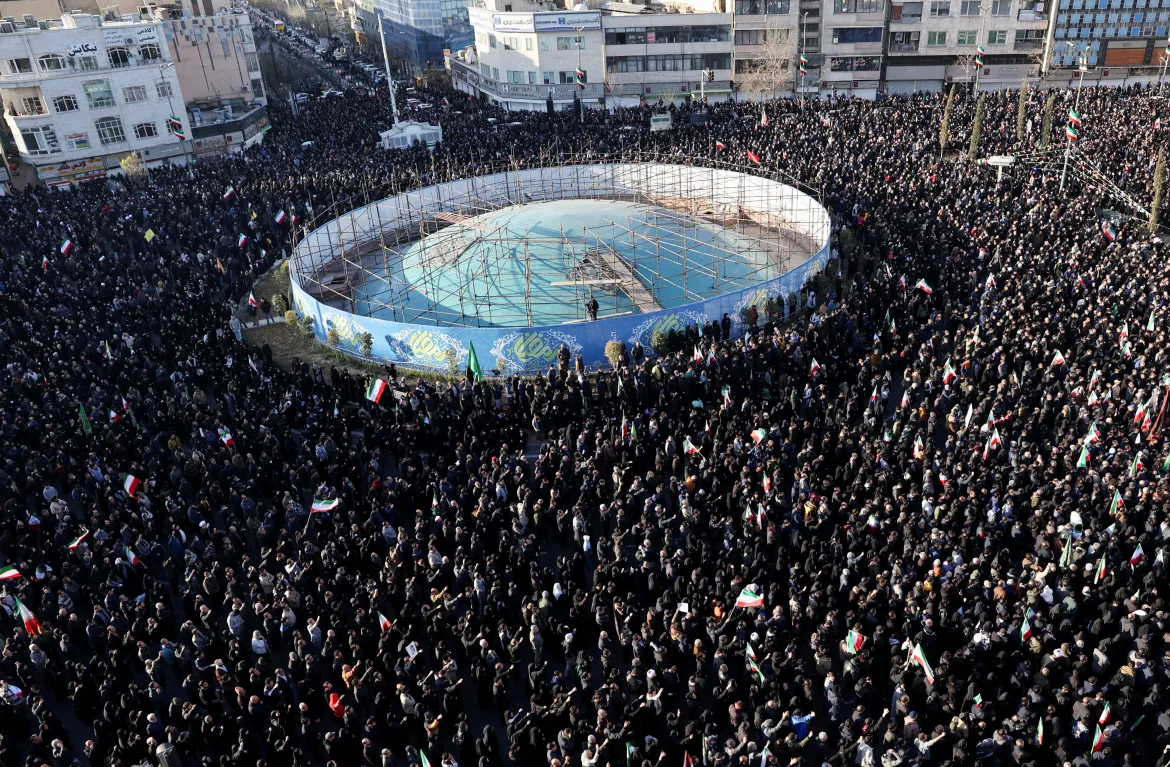
Thousands of Iranians flooded central Tehran on Sunday, converging on Enghelab (Revolution) Square to mourn the death of Supreme Leader Ali Khamenei, reportedly killed in a coordinated strike by the United States and Israel.
Iranian state television confirmed the 86-year-old cleric’s death in the early hours of Sunday, hours after US President Donald Trump announced that Khamenei had been “eliminated,” describing him as “one of the most evil people in history.”
Dressed largely in black, mourners waved Iranian flags and clutched portraits of Khamenei, who had ruled the Islamic Republic since 1989. Many wept openly as state broadcasters aired images of the crowd, capturing scenes of grief and disbelief in the heart of the capital.

The solemn gathering unfolded against the backdrop of intensifying military exchanges across the region. The Islamic Revolutionary Guard Corps (IRGC) issued a strongly worded statement condemning the killing as a “murder” and vowing “severe and decisive” retaliation.
The IRGC warned of what it described as the “most ferocious” operations in history against Israel and US military installations in the Gulf, several of which were reportedly targeted by Iranian missile strikes over the weekend.
According to reports by Al Jazeera, President Trump, speaking from the White House, cautioned Tehran against retaliatory action, warning that any response would be met with force “never seen before.”
Read also:
- Iran unleashes 6th wave of missile, drone strikes on Israel, US bases across Middle East
- Iran’s state television confirms death of Supreme Leader Ayatollah Ali Khamenei
- Trump makes case for attack on Iran in State of the Union speech
Explosions were reported in Gulf cities including Doha, Dubai and Manama, while sirens sounded across central Israel. The Israeli military confirmed it was responding to incoming Iranian missile fire, raising fears that the confrontation could spiral into a full-scale regional war.
Khamenei, Iran’s highest political and religious authority for over three decades, presided over a period marked by deep hostility with the West, expanding regional influence and recurrent flashpoints with Israel and the United States.
As night fell on Tehran, security forces tightened their presence around key installations, while state media continued round-the-clock coverage of the mourning crowds — a nation on edge as the Middle East braces for what could be its most dangerous escalation in years.