


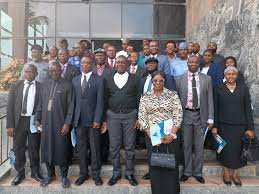
Efforts to reform and modernise the judiciary in Taraba State received a significant boost on Tuesday as the Chief Judge, Justice Joel Agya, received the final report of the Committee on the Review of Court Rules and Laws.
The development marks a critical milestone in the state’s drive to strengthen its justice system through improved legal frameworks, streamlined procedures, and enhanced access to justice.
Speaking during the presentation in Jalingo, Agya described the exercise as far more than a routine administrative task, emphasising its central role in ongoing judicial transformation.

“The administration of justice is a dynamic enterprise that must continuously evolve to meet emerging challenges,” he said. “The modernisation of court rules and relevant laws remains a cornerstone of our judicial reform agenda.”
The committee, inaugurated on Oct. 25, 2024, was tasked with undertaking a comprehensive review of existing court rules and laws guiding judicial practice in Taraba State. Its work brought together judicial officers, legal practitioners, and key stakeholders in a collaborative effort to address procedural gaps and inefficiencies.
A major highlight of the committee’s work was the submission of an interim report on Aug. 17, 2025, which led to the introduction of three landmark procedural frameworks: the Taraba State High Court (Civil Procedure) Rules, 2026, the Area Court (Civil Procedure) Rules, 2026, and the District Court Rules, 2026.
According to the chief judge, these new rules have already begun to reshape the judicial landscape by simplifying court processes, reducing technical bottlenecks, and promoting faster resolution of cases. He added that they also incorporate modern practices that reflect technological advancements and improved case management systems.
Agya expressed confidence that the final report would further consolidate these gains by strengthening the legal framework, addressing outstanding procedural issues, and enhancing the overall quality of justice delivery in the state.
He assured that the recommendations would receive careful and objective consideration, with necessary steps taken to implement reforms aimed at improving efficiency and ensuring broader access to justice for residents.
Read also:
- Taraba court to deliver judgement on neglect of Numan–Jalingo Road February 26
- Taraba Court dismisses case against Ahijo Sulaiman over prosecution lapses
- Court nullifies appointment of 3rd Class Chief in Taraba
Earlier, the chairman of the committee, Justice Nuhu Adi, said the panel reviewed no fewer than 12 laws and rules during the assignment.
He listed them to include those governing the High Court, Area Court, and District Court, as well as the Penal Code Law, Administration of Criminal Justice Law, Anti-Kidnapping Law, Hire Purchase Law, Sale of Goods Law, and the Limitation Law.
Adi noted that the exercise involved extensive consultations, research, and deliberations, reflecting a broad-based approach to reforming the judicial process in Taraba State.
Observers say the submission of the final report signals a renewed commitment by the Taraba judiciary to align its operations with global best practices, improve public confidence, and ensure that justice is delivered promptly and fairly.


