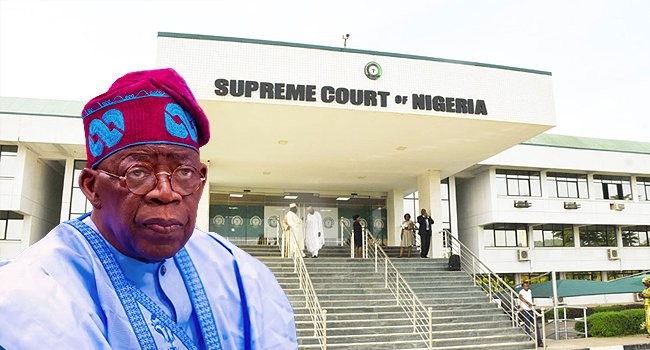
The Supreme Court has determined that the president possesses the constitutional authority to declare a state of emergency in any state to maintain law and order.
In a divided ruling of six to one on Monday, the court stated that the president can also suspend elected state officials during an emergency.
However, it emphasized that such suspensions should be temporary.

In his leading judgment, Justice Mohammed Idris clarified that Section 305 of the Constitution permits the president to take exceptional measures to restore peace and stability when an emergency is declared.
He pointed out that the constitution does not specifically outline what these extraordinary measures should entail, granting the president discretion in determining the appropriate actions to restore normalcy.
The case was instituted by Adamawa State and 10 other states led by the Peoples Democratic Party, which contested the state of emergency declared by President Bola Tinubu in Rivers State, where Governor Siminalayi Fubara and other elected officials were suspended for six months.
Read also:
- Supreme court overrules Tinubu’s pardon, reinstates death sentence for Abuja Housewife
- Ecobank to appeal Honeywell’s purported N72 billion court judgment
- Sacked Taraba APC senatorial candidate to appeal court ruling
Justice Idris also supported the preliminary objections raised by the attorney general of the federation and the National Assembly.
He stated that the PDP states did not provide a valid cause of action that would permit the Supreme Court to exercise its original jurisdiction.
As a result, he dismissed the suit due to lack of jurisdiction and further rejected it on its merits.
However, Justice Obande Ogbuinya disagreed with the majority ruling.
In his dissenting opinion, he asserted that while the president has the authority to declare a state of emergency, this power should not extend to suspending elected officials such as governors, deputy governors, or legislators.