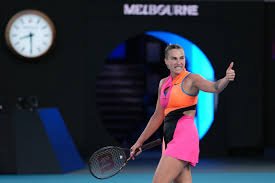
Aryna Sabalenka delivered another ruthless Melbourne performance on Thursday, overpowering Elina Svitolina to book her place in a fourth consecutive Australian Open final and underline her dominance as the world’s top-ranked player.
Sabalenka shrugged off mid-match tension and a controversial hindrance call to defeat the Ukrainian 12th seed 6-2, 6-3, extending her flawless run at Melbourne Park this year. The Belarusian has now dropped no sets in the tournament and is riding an imposing 11-match winning streak.

Svitolina arrived at the semi-final full of confidence after eliminating two top-10 opponents, but she was ultimately overwhelmed by Sabalenka’s power, precision, and growing mental control on the biggest stage.
The 27-year-old will now face either Elena Rybakina or Jessica Pegula in Saturday’s final as she chases her fifth Grand Slam singles title and a third Australian Open crown. The match also represents a chance for redemption after last year’s Melbourne final defeat to Madison Keys, a loss Sabalenka later admitted was influenced by self-doubt.
“I can’t believe it,” Sabalenka said after becoming the first woman since Martina Hingis in 2002 to reach four consecutive Australian Open finals. “It’s an incredible achievement, but the job is not finished.”
The semi-final was briefly interrupted by controversy early in the first set when chair umpire Louise Azemar Engzell issued a hindrance call against Sabalenka for an irregular grunt during a rally. The point was awarded to Svitolina, and despite Sabalenka’s request for a video review, the decision stood.
Read also:
- Fred, McTominay, won’t get United on top, says Keane
- Xhaka flourishes in new role for Arsenal
- ‘Rangers flop’ Umar Sadiq close to becoming Almeria record sale
Visibly frustrated, Sabalenka responded with a sarcastic thumbs-down gesture and a brief exchange with her box, but the moment proved to be a turning point rather than a distraction. She immediately raised her level, breaking Svitolina’s serve and winning four of the next five games to seize control of the opening set.
The second set followed a similar script. After a loose service game handed Svitolina an early break, Sabalenka glared toward her team, reset mentally, and broke back at the first opportunity. She saved a crucial break point later in the set, surged to a 5-2 lead, and sealed victory with a thunderous forehand winner.
Statistically, Sabalenka was in command throughout, firing 29 winners against just 15 unforced errors and conceding only 11 points on her serve. Beyond the numbers, her composure stood out. Once known for emotional volatility in major finals, she showed maturity and control that suggests a player peaking at exactly the right time.
Svitolina, who had lost her previous five meetings with Sabalenka, battled hard but found no answer to the relentless pressure coming from the other side of the net.
As Melbourne braces for another Sabalenka final, the message from the world number one is clear. She is not just winning. She is learning, adapting, and positioning herself to rule once again on the sport’s biggest stage.