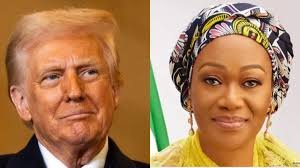
United States President Donald Trump stunned political observers after publicly commending Nigeria’s First Lady, Senator Oluremi Tinubu, at the 74th Annual National Prayer Breakfast in Washington, D.C., raising fresh questions over whether Nigeria’s reported $9 million U.S. lobbying contract played any role in the high-profile recognition.

Speaking before an audience of global leaders, lawmakers and diplomats at the annual interfaith gathering, Trump singled out Nigeria’s First Lady for special acknowledgment.
“We’re honored to be joined today by the First Lady of Nigeria, who also serves as a Christian pastor at the largest church in Nigeria, a highly respected woman. First Lady, where are you? Thank you very much. It’s a great honor. A very respected person too. Thank you,” the former U.S. president said.
The brief remark quickly gained traction across Nigerian media and political circles. Supporters of President Bola Tinubu’s administration described the moment as a diplomatic milestone, arguing that Trump’s praise of Remi Tinubu underscores Nigeria’s relevance on the global stage and strengthens bilateral ties between Abuja and Washington.
Yet critics have linked the timing of the commendation to Nigeria’s controversial $9 million lobbying contract with a Washington-based public affairs firm. The agreement, reportedly signed in late 2025, was designed to improve Nigeria’s image among U.S. policymakers and address concerns surrounding insecurity and allegations of religious persecution.
The lobbying deal followed renewed diplomatic strain after the United States designated Nigeria as a Country of Particular Concern over religious freedom issues, a classification that carries reputational weight and possible policy consequences. Nigerian authorities have repeatedly rejected claims of state-sponsored religious persecution, maintaining that the nation’s security challenges are multifaceted and not faith-driven.
Analysts say the core objective of the lobbying engagement is to reshape narratives in Washington, foster closer engagement with U.S. lawmakers and influence policy discussions affecting Nigeria’s international standing.
The sequence of events has fueled speculation. Opposition voices insist public funds should prioritize domestic reforms rather than image management abroad. They argue that celebrating praise from foreign leaders while grappling with economic and security pressures at home may create uncomfortable optics. Still, there is no verified evidence connecting the lobbying contract to Trump’s remarks at the National Prayer Breakfast.
Diplomatic experts note that public acknowledgments at such gatherings are common. The National Prayer Breakfast traditionally highlights religious identity, moral leadership and shared faith values. Trump’s reference to Remi Tinubu’s pastoral role aligns with the event’s long-standing emphasis on faith and public service, suggesting his comments may have been ceremonial rather than strategic.
Read also:
- Senate names 12-man committee to harmonise Electoral Act Amendment Bill public outcry
- Trump slams 25% tariff on countries doing business with Iran
- Trump to deploy 200 additional troops to Nigeria
In subsequent remarks during her U.S. visit, the First Lady expressed appreciation for the recognition, describing it as unexpected and humbling. Her attendance carried symbolic weight. As Nigeria’s First Lady and a pastor in the Redeemed Christian Church of God, her presence at a faith-centered global forum resonated with American evangelical communities, a key constituency within Republican political circles.
Whether President Trump’s praise of Remi Tinubu reflects simple diplomatic courtesy or signals the impact of Nigeria’s $9 million lobbying effort remains a matter of political debate. What is certain is that the moment has intensified scrutiny of Nigeria’s foreign engagement strategy and its efforts to recalibrate its image in the United States.