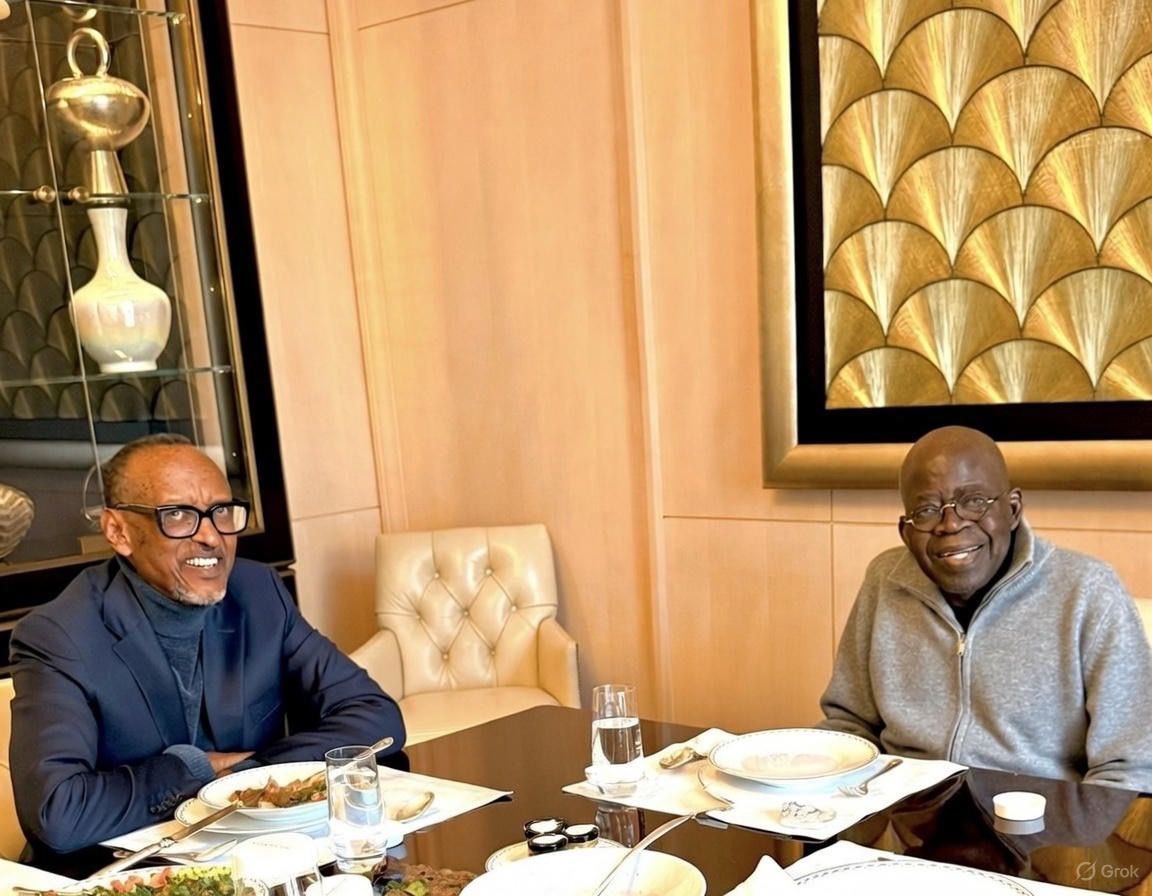
President Bola Tinubu’s recent Paris meeting with Rwandan President Paul Kagame has unexpectedly opened a broader national conversation, one that goes beyond diplomacy and into the evolving intersection of political power, technology, and public trust.

At the centre of the debate is not the substance of the meeting itself, but a photograph from the engagement that surfaced online bearing a Grok AI watermark, prompting claims that the image was artificially generated. The Presidency has since clarified that the photograph was real and only enhanced using artificial intelligence to improve its quality. Still, the episode has raised important questions about transparency, communication strategy, and the role of AI in modern governance.
AI in Villa Communication: Innovation or Risk?
The Presidency’s explanation highlights a growing reality: governments worldwide are increasingly adopting AI tools to enhance communication, streamline workflows, and improve media output. In this case, Grok AI was reportedly used not to fabricate an image, but to enhance a low-quality photograph taken on a mobile device.
While technically defensible, the move exposes a gap between technological adoption and public understanding. In an era where AI-generated misinformation is a global concern, even legitimate use of AI by state actors can easily be misinterpreted, especially when safeguards such as clear labelling and proactive explanation are absent.
The Optics Problem
Political communication is as much about perception as it is about fact. The presence of an AI watermark on an official image involving the President inevitably raised suspicion, particularly in a highly polarised digital environment.
Analysts argue that while the Presidency did nothing illegal or deceptive, the episode reflects a broader optics challenge: the failure to anticipate how AI tools, when used without context, can fuel speculation and erode confidence.
“This was not a crisis of truth, but a crisis of perception,” said a media analyst familiar with government communications. “Once AI enters the picture, the burden of explanation increases.”
More reactions from social media, particularly X (formerly known as twitter) have been lar,ely critical: @iyaganku said; “This is actually defending incompetence. You don’t use canva to edit a document and leave the watermark, not to talk of a picture of the President of Nigeria, haba! Who’s even vetting the jobs of the kitchen cabinets of the President, cos 2yrs in Power, outlook should be great.”
Read also:
- Presidency explains Grok watermark on Tinubu–Kagame Paris photograph
- Maduro appears in a US court as Trump threatens other nations after Venezuela strikes
- Jamiu Azeez responds to criticism over alleged conversion to Christianity
While @iamking_FYD took his reaction to another level, “All of you should be sacked. You have successfully brought shame to the presidency by posting an AI generated photo of our president @officialABAT. You are a disgraced media aide/team.”,
@krativity added, “This defense sounds more stupid than the cooked picture. Nothing is authentic about you people from top to bottom. Cooked Bishops, cooked tax laws and Cooked pictures. Shame.”
Trust, Transparency, and the AI Age
The Tinubu administration has positioned itself as forward-looking on digital transformation, innovation, and technology-driven governance. However, this incident underscores the need for clear AI-use protocols, especially in official state communication.
Experts say governments must now operate under a new rule: what is technologically acceptable may not always be publicly acceptable without explanation.
Transparent disclosure, such as noting when AI is used for enhancement rather than creation, could help bridge this gap and prevent misinformation before it spreads.
A Test Case for Nigeria’s Digital Future
Beyond the immediate controversy, the Grok AI episode may serve as a test case for how Nigeria navigates AI governance at the highest levels. As artificial intelligence becomes more embedded in public administration, the line between innovation and misunderstanding will continue to blur.
Although the Presidency’s swift response has helped contain the narrative, the moment offers a lesson: in the digital age, silence or delayed clarification can allow technology itself to become the story.
President Tinubu’s use of Grok AI has exposed that Nigeria’s leaders are not insulated from the disruptive impact of emerging technologies. The challenge now is not whether to use AI is good and acceptable, but how to use it responsibly, transparently, and with public trust in mind.
As governments adapt to the AI era, the Tinubu-Kagame photograph may be remembered not as a scandal but as a moment that revealed how quickly technology can reshape political narratives and how carefully power must now be communicated.