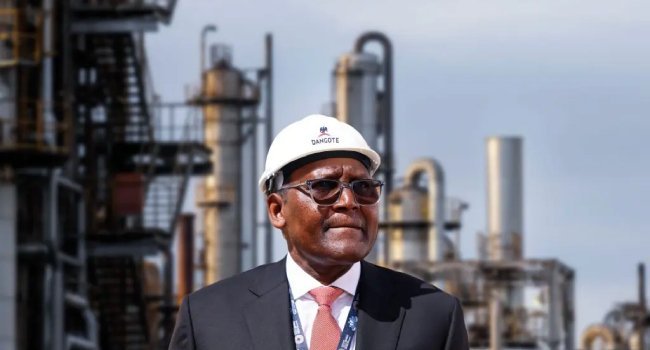
The escalating tension in Nigeria’s downstream petroleum sector took a dramatic turn on Sunday as President of the Dangote Group, Alhaji Aliko Dangote, publicly accused the Chief Executive Officer of the Nigerian Midstream and Downstream Petroleum Regulatory Authority (NMDPRA), Farouk Ahmed, of corruption and economic sabotage.
Dangote alleged that Ahmed spent about $5 million on the secondary school education of his four children in Switzerland and demanded a full-scale investigation into the source of the funds, insisting that the regulator must account for the expenditure before Nigerians.

Speaking during a press briefing at the Dangote Petroleum Refinery in Lekki, Lagos, the billionaire industrialist said Ahmed should appear before the Code of Conduct Tribunal to explain how such an amount could be afforded on a public servant’s income.
Dangote argued that the alleged spending, if true, was inconsistent with earnings from public service and raised serious questions about integrity in the regulation of Nigeria’s petroleum downstream sector.
“I’ve had people making complaints about a regulator who put his four children in secondary schools abroad, and the education of those children over six years allegedly cost about $5 million,” Dangote said. “It is difficult to understand how someone in public service could legitimately afford that.”
He maintained that such expenditure would ordinarily attract scrutiny from tax and anti-corruption authorities.
“When you look at his income, it does not match this level of spending. Even if it were me paying $5 million for school fees, the tax authorities would have to question how the money was earned and taxed,” he added.
Dangote also contrasted the alleged spending with the economic hardship facing many Nigerians, particularly in the northern part of the country.
“People in Sokoto are struggling to raise N100,000 for school fees, and many children are out of school because of that amount. Yet someone who has spent his entire career in government is alleged to have paid $5 million for four children’s secondary education,” he said.
The businessman stressed that he was not calling for Ahmed’s removal but for transparency and accountability.
Read also:
- Dangote Group’s Audacious 2030 Vision: Blueprint for $100 Billion African industrial giant
- Dangote Refinery slashes Petrol Prices again amid smuggling crackdown, rising local output
- Pipeline security: NNPCL targets 2.06mbpd production in 2026
“I am not asking for his sack. I am asking for a proper investigation. He should be required to explain himself and prove that he has not compromised his position to the detriment of Nigerians. What is happening amounts to economic sabotage,” Dangote said.
He added that if the allegation was denied, he was prepared to publish details of the tuition payments and pursue legal steps to compel the schools involved to disclose records of the payments allegedly made by Ahmed.
“Even my own children did not attend secondary schools abroad. They were educated in Nigeria,” he said.
The allegation is not new. In July, the NMDPRA dismissed similar claims after a protest group accused Ahmed of spending over $5.5 million on foreign education for his children. At the time, the authority described the allegations as false, insisting they were part of a coordinated smear campaign against its leadership.
Dangote used the occasion to criticise what he described as deep-rooted regulatory failures in the downstream petroleum sector, alleging that vested interests were frustrating domestic refining to protect fuel importation profits.
“There are powerful interests benefiting from imports. Allowing massive fuel imports when Nigeria now has refining capacity is unethical and against national interest,” he said.
He warned that the integrity of the sector would be undermined if regulators were influenced by commercial players.
“A trader should never be a regulator. Forty-seven refinery licences have been issued, yet no meaningful refining capacity is coming on stream because the environment is hostile,” he stated.
Dangote insisted that local refining would ultimately benefit Nigerians, even if fuel importers incur losses, adding that his company was working to ensure that recent reductions in gantry prices were reflected at the retail level nationwide.