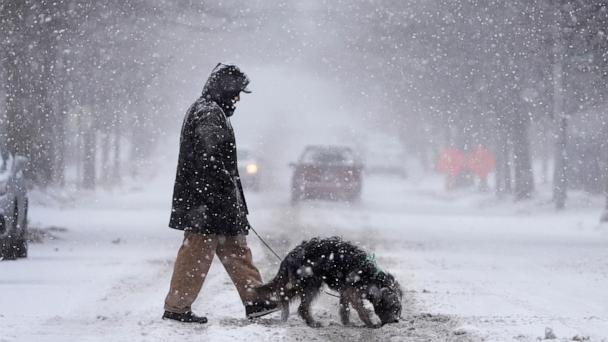
More than 160 million Americans are bracing for an unusually severe winter storm forecast to sweep across large parts of the United States beginning Friday, with forecasters warning of life-threatening cold, heavy snowfall, and widespread travel disruption.
The National Weather Service says the powerful storm system will push eastward from the High Plains and Rocky Mountains, unleashing what it describes as “extremely dangerous” winter conditions across multiple regions. Arctic air accompanying the system is expected to drive temperatures well below zero, with brutal wind chills raising the risk of hypothermia and frostbite for anyone exposed for even short periods.

Meteorologists warn that the storm’s slow movement will compound its impact, dumping heavy snow and freezing rain from the Southern Rockies and Plains through the Mid-Atlantic and into the Northeast. Major cities along its projected path include Memphis, Nashville, Washington DC, Baltimore, Philadelphia, and New York, all of which could see significant snowfall and hazardous road conditions.
Data from the NWS Probabilistic Precipitation Portal suggests that a wide swath of the country, stretching from Colorado through West Virginia and as far northeast as Boston, could receive more than a foot of snow. In the Northern Plains, the cold is expected to be especially severe, with wind chills possibly plunging below minus 50 degrees Fahrenheit, conditions that could shatter long-standing temperature records.
Read Also:
- Trump’s Housing Revolution: Banning corporate giants from single-family homes, restoring American dream
- Trump orders US withdrawal from 66 international organisations, says they no longer serve American interests
- Niger hits back at US travel ban, suspends Visas for American citizens
Transportation authorities are already sounding alarms over the weekend, warning of major delays and cancellations at airports and on highways. Officials say heavy snow, ice accumulation, and strong winds could trigger power outages and make travel treacherous, if not impossible, at the height of the storm.
Governors in several states, including Arkansas, Georgia, Texas, North Carolina, and South Carolina, have declared states of emergency, allowing emergency agencies and National Guard units to mobilize in anticipation of the storm’s impact. Some airlines have begun offering flexible rebooking options, waiving change fees as they prepare for potential flight cancellations.
NWS meteorologists Rich Otto and Tony Fracasso cautioned that road travel during the peak of the storm could become nearly impossible, urging motorists to avoid non-essential journeys and to prepare for rapidly changing conditions.
The cold snap is not limited to the United States. In Canada, freezing temperatures are already taking hold, with additional snowfall expected in eastern and Atlantic regions early next week. Meteorologist Geoff Coulson told CBC that the lingering Arctic air mass could extend the period of dangerous cold across much of the region.
Authorities across affected areas are urging residents to stay informed, limit travel, and take precautions as one of the most widespread and dangerous winter storms of the season bears down on North America.