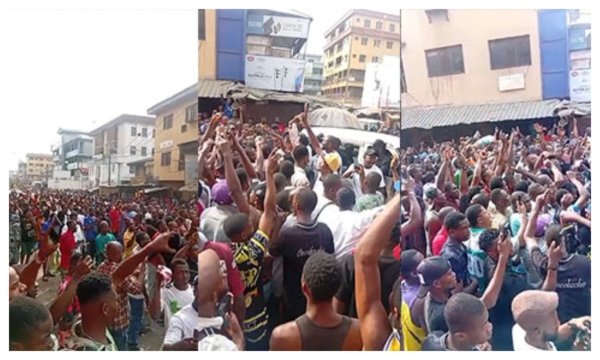
Traders protesting the continued closure of the popular Onitsha Main Market on Monday staged a dramatic shutdown of the ever-busy Niger Bridge yesterday, crippling movement between Asaba in Delta State and Anambra State, and drawing national attention to the escalating dispute over trading activities in the South-East.
The protest followed the Anambra State Government’s insistence that traders must resume business on Mondays or risk a total one-month closure of their markets. The development has triggered widespread anger among traders, many of whom say the order ignores lingering security concerns linked to the long-running sit-at-home crisis.

From early hours of the day, aggrieved traders marched through major roads in Onitsha before converging at the Niger Bridge Head, where they blocked the bridge for several hours. The action brought vehicular and pedestrian movement to a standstill, leaving thousands of commuters stranded in a massive gridlock stretching into Asaba. Some travellers reportedly turned back out of fear that the protest could degenerate into violence.
Despite the disruption, the protesters remained largely peaceful, chanting slogans such as “Soludo show us the law,” “We must trade on Mondays,” and “Stop infringing on our rights.” Others questioned what they described as selective closure of markets in Onitsha, accusing the government of inconsistency and heavy-handed enforcement.
Read Also:
- IPOB accuses Soludo of using Onitsha market closure to fuel insecurity
- Umahi expresses sadness over slow pace of work on Enugu-Onitsha Expressway
- NAFDAC reopens Onitsha drug market after 1-month closure
At the bridge head, the traders said their decision to block the Niger Bridge was meant to draw the attention of the Federal Government to what they described as injustice and economic hardship. They also linked the difficulty of returning to Monday trading to the continued detention of Nnamdi Kanu, arguing that the situation had made normal commercial activities on Mondays extremely risky.
Spokesman of the protesting traders, Mr Sunday Okoli, said that while the Indigenous People of Biafra had announced the cancellation of the Monday sit-at-home and distanced itself from those enforcing it, traders had expected the state and local governments to respond by providing strong security presence in the markets.
According to him, that support never came, and traders who attempted to open their shops on Mondays were attacked by hoodlums without adequate protection from security agencies. He said the government was now attempting to force traders back to the markets without guaranteeing the safety of their lives and goods.
The protesters openly criticised the deployment of security forces to block access to markets, saying they were disappointed that the same level of security was not provided when traders were under attack for defying the sit-at-home order.
The traders’ procession reportedly moved from New Market Road through Venn Road and Kirk Road to Niger Street before finally occupying the Niger Bridge Head, effectively sealing the major link between the South-East and South-South regions.
Meanwhile, the Igbo Community Association in Abuja has appealed to Governor Chukwuma Soludo to immediately reopen the Onitsha Main Market to prevent the protests from escalating further. In a statement signed by its President General, Ikenna Ellis-Ezenekwe, and Secretary General, Mazi Emmanuel Onah, the group warned that continued closure could lead to a breakdown of law and order in the commercial city.
The association said residents of Onitsha were already taking to the streets, stressing that prolonged tension could result in loss of lives and destruction of property. It urged the governor to respect democratic principles and the right of citizens to express grievances peacefully.
While calling for restraint, the group acknowledged Governor Soludo’s efforts to tackle economic sabotage and praised his achievements in infrastructure and policy reforms. However, it maintained that markets remain the backbone of the local economy and social life of the people and should not be shut indefinitely.
The controversy comes amid the state government’s announcement that Monday sit-at-home has been abolished in several additional markets across Anambra, including Ochanja Central Market, Bridgehead Market, Ogbaru Main Market, and major auto spare parts and building materials markets in Nnewi, Nkpor, Ogidi, and Obosi.
As tension continues to mount, the Niger Bridge protest has heightened the depth of frustration among traders and raised fresh questions about security, economic survival, and the balance between enforcement and dialogue in Anambra State.