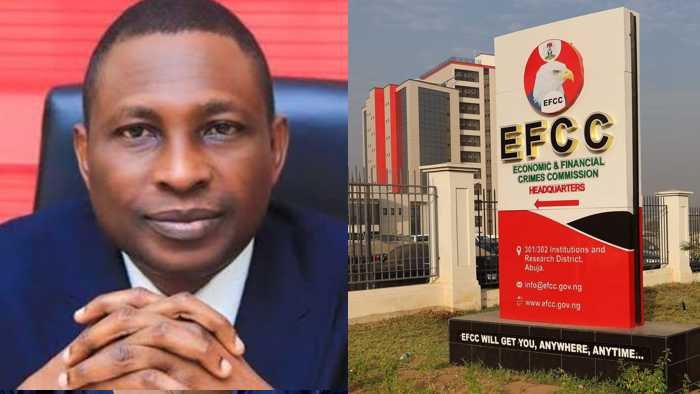
The Executive Chairman of the Economic and Financial Crimes Commission, (EFCC) ,Mr Ola Olukoyede, on Thursday reiterated the need for proactive measures in the fight against corruption, stressing that anti-graft efforts must extend beyond investigation and prosecution to include early risk detection and institutional safeguards.
Olukoyede spoke at the commission’s corporate headquarters in Jabi, Abuja, during the signing of a memorandum of understanding between the EFCC and BudgIT Foundation.

He recalled that during his Senate confirmation, he pledged to strengthen preventive mechanisms in the anti-corruption drive.
“Coming to this office, I told the Senate during my confirmation that we can do things better. We do not necessarily have to wait for money to be stolen before we act,” he said.
The EFCC boss disclosed that he had presented lawmakers with an analysis of funds lost to procurement fraud in a particular year and the potential impact such resources could have had if properly utilised.
“I gave them an analysis of the monies that were lost to the country through procurement fraud in a particular year and what that money could deliver. I posed a question to them that we need to do more on prevention,” he said.
According to him, this resolve led to the establishment of a Directorate of Fraud Risk Assessment and Control within the commission, headed by a director and mandated to focus on preventive mechanisms.
“From the inception of my office, I set up a directorate called fraud risk assessment and control. We have since started our prevention activities. It is not enough to track stolen funds; we must stop them from being stolen in the first place,” Olukoyede stated.
He emphasised the importance of scrutinising budget implementation processes, noting that questions must be asked once funds are appropriated for projects.
“If money is budgeted for a project, we must ask questions. What is happening to it? We should not wait until the project fails before we move. That is why that department was set up,” he said.
Olukoyede revealed that the directorate had already recorded notable successes.
“They have been working and were able to prevent tens of thousands, if not hundreds of millions of naira that would have been stolen in one of their operations,” he added.
Earlier, the Deputy Country Director of BudgIT, Mr. Vahyala Kwaga, described the MoU as both symbolic and strategic, noting that partnership remained a critical tool in combating corruption.
“For me, the MoU is symbolic in several ways of partnership and one way to fight corruption in Nigeria. Sometimes it is not about pointing fingers but about creating relationships,” he said.
Kwaga noted that building relationships enables exchange of ideas and perspectives capable of driving reforms.
“In creating relationships, we exchange ideas and perspectives, and that makes us look at issues differently. We can then direct change without pressing a button, driving a car or showing a weapon,” he said.
He added that civil society organisations play a complementary role in supporting government efforts.
“We believe the work we do as a civil society organisation is critical to the success of the government itself, and one of such partnerships is with the EFCC. The EFCC is not just the foremost anti-corruption agency in Nigeria but also a partner in purpose,” he stated.
Also speaking, Emmanuel Uche, Project Manager, Anti-Corruption, RoLAC, commended Olukoyede’s leadership, describing it as transformative.
“We recognise the leadership of my brother, Olukoyede, who is giving new direction not only to the EFCC but to Nigeria, the impact of which we are all enjoying,” he said.
Uche noted that recent reforms had begun to improve Nigeria’s standing in the global financial system.
“Just recently, every one of us has a new lease of life as we can now, incrementally, be accepted back into the global financial community. We are even enjoying the use of our local debit cards for international transactions,” he added.
He maintained that while the EFCC had previously been led by capable individuals, the current leadership had ushered in renewed optimism.
“The EFCC has been lucky with leaders, but it has never been as lucky as in this administration. A lot of things are changing and everybody is happy about it,” Uche said.