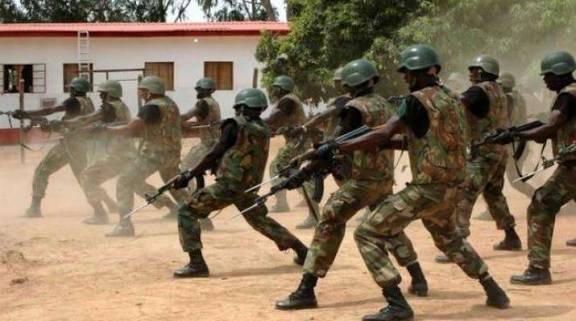
The Nigerian military has been ranked 33rd globally and third in Africa in the 2026 Global Firepower Index, reaffirming the country’s status as a major military force despite persistent internal security challenges.
The latest Global Firepower Index, released on Friday, places Nigeria among the world’s notable military powers, highlighting its continued relevance within a complex and evolving security environment. The ranking highlights Nigeria’s growing influence in regional security coordination across West Africa, even as the country grapples with terrorism, banditry, and separatist violence at home.

According to the report, Nigeria recorded a Power Index score of 0.6097 in the 2026 assessment. The index evaluates the military strength of more than 145 countries using multiple indicators, including manpower, land, air and naval assets, defense spending, logistics, and strategic positioning.
Within Africa, Nigeria ranks behind Egypt and Algeria. Egypt is placed 19th globally, maintaining its lead on the continent with strong ground forces, a modern air force, and an expanding navy protecting its Mediterranean and Red Sea interests. Algeria follows in 27th position worldwide, buoyed by a substantial defense budget, sustained arms procurement, and extensive international military partnerships.
Nigeria’s third-place ranking in Africa is supported by its large active-duty personnel, sizable reserve forces, and an expanding arsenal. The country’s position places it ahead of several regional rivals within ECOWAS and the Gulf of Guinea, reinforcing its role as a dominant military actor in sub-Saharan Africa.
Read also:
- Tantita constructs 13 offices for 3 Brigade Nigerian Army at Effurun
- Minnesota elections signal growing Democratic surge ahead of 2026 midterms
- Police detain officers over alleged murder of motorcyclist in Ebonyi
Globally, the United States, Russia, and China retain their positions as the world’s top three military powers, with Power Index scores of 0.074, 0.079, and 0.0919 respectively, reflecting their overwhelming superiority in technology, manpower, and global force projection.
Recent military equipment deliveries from the United States have further strengthened Nigeria’s counterterrorism and internal security operations. In addition, Nigeria’s leadership role in regional security was underscored by its involvement in deploying ECOWAS standby forces to the Republic of Benin following a failed coup attempt, highlighting its commitment to stability beyond its borders.
Nigeria’s proposed 2026 budget also reflects a renewed focus on security. The federal government has earmarked N5.41 trillion for defense and security, up from N4.91 trillion in 2025. The increased allocation is aimed at improving troop welfare, acquiring modern military hardware, enhancing intelligence capabilities, and intensifying counterinsurgency operations across the country.
Ongoing bilateral defense cooperation with key partners, including the United States, continues to bolster Nigeria’s military capacity. Together, these factors position Nigeria as a critical security pillar in West Africa, capable of shaping regional stability while confronting its domestic security challenges.