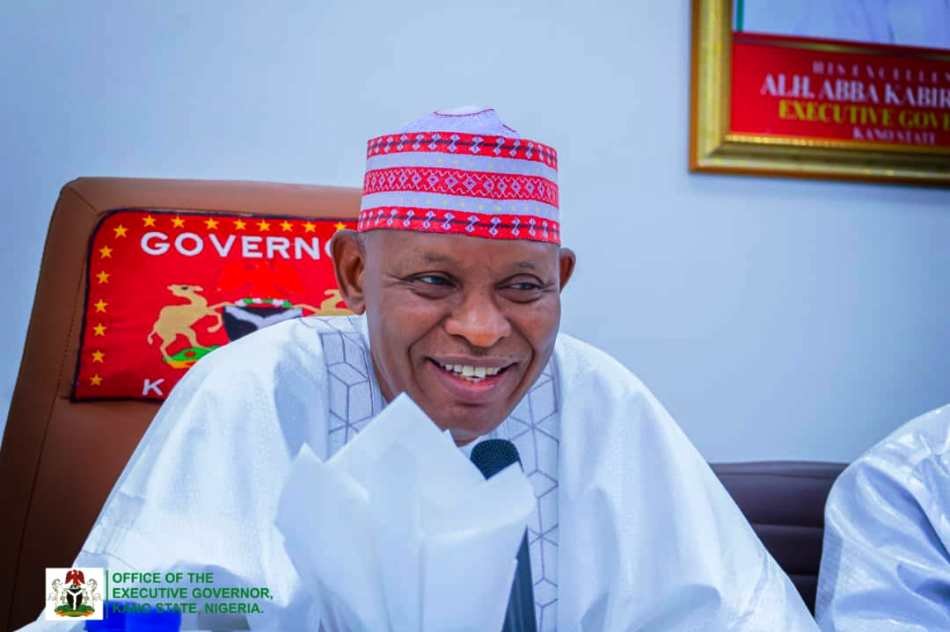
Governor Abba Yusuf of Kano State has urged Nigerians to translate noble ideas into action as the country marks its 65th independence anniversary, warning that nation-building cannot be left to government alone.
Speaking at the 65th Independence and Valedictory Lecture held at the Coronation Hall, Kano state Government House, the governor described the event as a reminder of the “urgency of our time and the responsibility that history has placed on our shoulders.”
Represented by his Chief of Staff, Dr. Suleiman Sani, the governor emphasized that security is strongest when communities take ownership, commending the Kano’s Safe Corridor Initiative for its rehabilitation and reintegration of repentant youths.

“No life is beyond redemption if society chooses to guide rather than abandon,” he said.
The governor also stressed civic participation as the bedrock of democracy, noting that the power of the vote must be harnessed for peaceful change; adding that, the Nigerian youths are the country’s “greatest wealth,” capable of uniting the nation if properly guided.
“Security is not just the absence of crime; it is the presence of justice, opportunity, and unity,” Gov. Yusuf declared.
The governor, while acknowledging Nigeria’s challenges of poverty, insecurity, and mistrust, called for renewed determination among leaders and citizens alike.
Read also:
- Gov. Yusuf reshuffles cabinet, redeploys senior staff in ministries
- Gov. Yusuf distributes appointment letters to 4,315 teachers
- Kano flays media campaign against Gov. Yusuf’s administration
“Nigeria at 65 is still far from the nation of our dreams, but this is not a reason to lose hope. It is a call to action,” he said.
He urged Nigerians to unite and ensure that the country’s vast resources are harnessed for progress.
“If we do this, then Nigeria 65 will not just be a number, but a milestone on the road to greatness,” the governor concluded.
The Commissioner for Information and Internal Affairs, Ibrahim Waiya, explained that the Safe Corridor Initiative targets voluntarily repentant political thugs and drug users through de-radicalization, psychosocial support, rehabilitation, and skills acquisition.
Waiya revealed that the police in Kano arrest between 50 to 70 youths weekly for drug-related offenses, while the NDLEA recorded 1,345 suspects in 2024 alone.
Many beneficiaries of the programme, he noted, have returned to school or started small-scale businesses after rehabilitation.