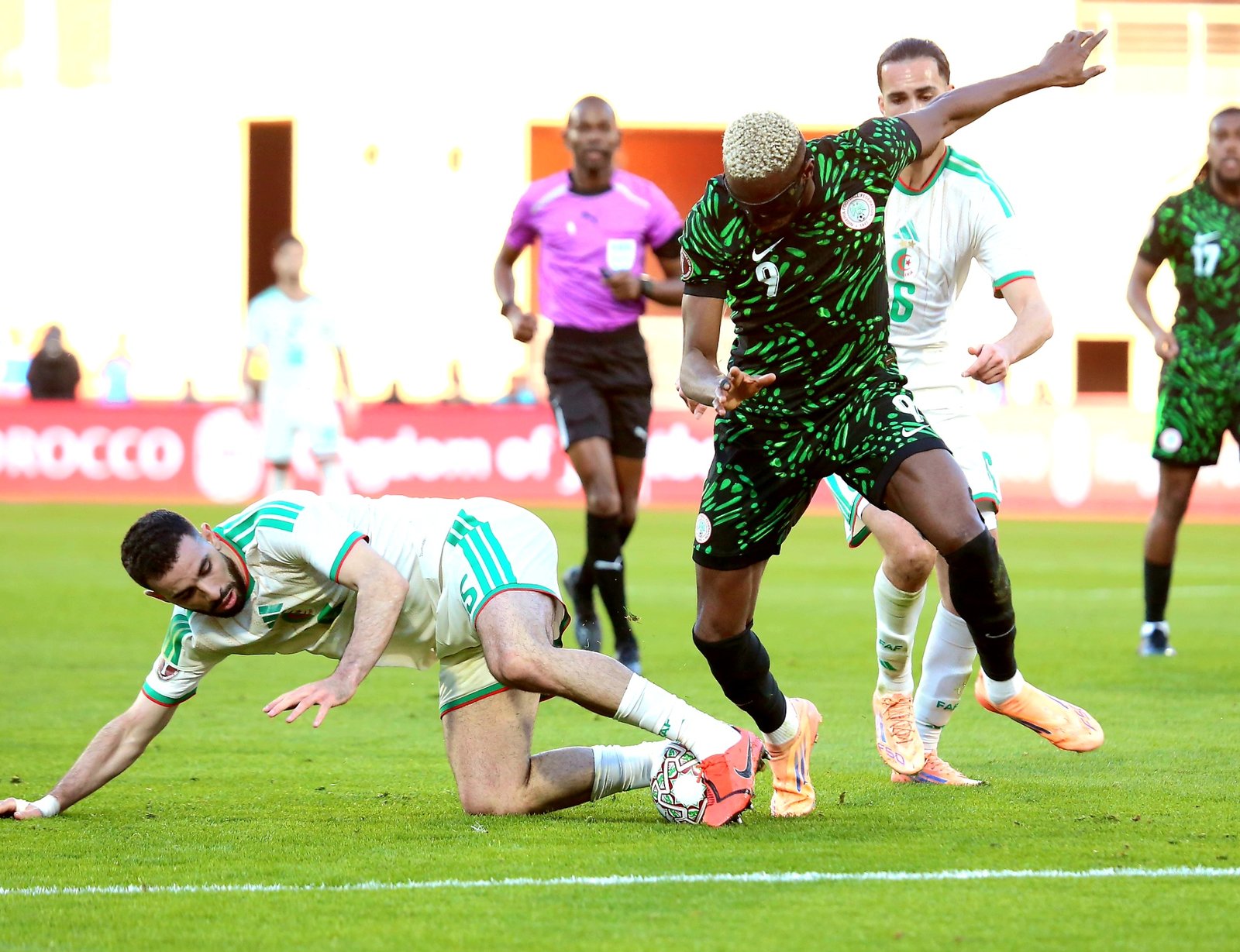
The Atlas Lions of Morocco have every reason to be on the brink as they prepare to face the formidable Nigerian super Eagles in the semi-finals of the ongoing 35th Africa Cup of Nations.
Three-time champions Nigeria have made it clear through their performances that they are not in the North African Kingdom for a leisurely visit.

They have displayed skill, determination, and charisma, with over half of their 16 goals scored in five matches reflecting a strong team effort.
Victor Osimhen, with four goals and two assists (35 goals in 51 matches, just two shy of the Nigerian international scoring record), Ademola Lookman with three goals and five assists, Akor Adams with two goals and one assist, Raphael Onyedika with two goals, Samuel Chukwueze with two assists, and the playmaker Alex Iwobi (who has provided 36 passes in the knockout phase) have all contributed to the Super Eagles’ impressive performance.
Their defense has been solid, with Calvin Bassey and Bruno Onyemaechi supporting the attack, and wing-back Bright Osayi-Samuel excelling in both defense and offense against Algeria. Semi Ajayi scored Nigeria’s opening goal of the tournament against Tanzania.
Captain Wilfred Ndidi will be absent for Wednesday’s match due to suspension, but Raphael Onyedika and Frank Onyeka are expected to maintain a strong presence in midfield while Iwobi creates opportunities with his insightful passes.
All signs suggest that Wednesday’s match at the 70,000-seat Prince Moulay Abdellah Stadium will be the toughest challenge the Atlas Lions have faced since their semi-final run in the 2022 FIFA World Cup.
They will be up against a Nigerian team that is highly motivated to win this year’s AFCON, especially after failing to qualify for the FIFA World Cup.
Both teams are poised to deliver an unforgettable match for football fans.
Read also:
- Osimhen more suited for Arsenal than M’United
- Ronaldo honours late son with ‘100th United goal’ against Arsenal
- Aubameyang trains alone after being excluded from selection at Arsenal
Morocco boasts Brahim Diaz, the tournament’s top scorer with five goals, along with three-goal Ayoub El Kaabi, captain Achraf Hakimi, Sofyan Amrabat, Ismael Saibari, and Azzedine Ounahi.
In AFCON history, Nigeria has scored 158 goals in 109 matches and has lost only four of their last 23 games in the tournament, including last season’s final against host nation Côte d’Ivoire in Abidjan.
However, the Super Eagles have not faced North African teams back-to-back in the knockout stages since they defeated Morocco and Algeria to win their first title at home 46 years ago.
The Atlas Lions previously triumphed over the Eagles on their way to winning their only AFCON title in Ethiopia 50 years ago.
Backhanded compliments have been exchanged in the same tournament this millennium, with Nigeria defeating Morocco 2-0 in Lagos in 2000 and Morocco winning 1-0 in Tunisia in 2004.
After both teams drew in the two-legged qualifying series (Nigeria won 3-0 in Lagos, while Morocco won 4-1 in Casablanca), FIFA mandated a one-leg playoff to decide the winner.
This was before the away-goals rule was implemented. Asuquo Ekpe scored twice, and ‘wonderboy’ Paul Hamilton contributed to Nigeria’s victory over Morocco in Lagos.
Hamilton also netted Nigeria’s only goal in the return match in Casablanca. However, Morocco ultimately prevailed in Dakar and secured the qualification.
A young, talented, and energetic Nigerian team had shocked the reigning champions Zaire (now DR Congo) with a 4-2 victory in their opening match at the continental finals in Ethiopia.
Nevertheless, they lost 1-3 to Morocco in their third game after previously winning 1-0 against Sudan.
The victories over Zaire and Sudan allowed the Eagles to advance to the final round of a tournament that remains unique for being played in a league format.
In that final round, they faced Morocco again.
Baba Otu Mohammed scored just before the hour mark, but late goals from Ahmed Faras and Redouane El Guezzar secured the win for Morocco, who became champions, while the Eagles, who defeated Egypt 3-2 in their last match, took home the bronze medal.
Just three weeks after the disappointment in Addis Ababa, the Eagles had a chance to seek revenge against the Atlas Lions.
In a qualifying match for the Montreal Olympics at the National Stadium in Lagos, Nigeria achieved a convincing 3-1 victory, with Thompson Usiyen scoring twice and Kelechi ‘Caterpillar’ Emeteole adding another goal.
Nigeria lost the return match by a single goal but still qualified for Montreal. However, the Nigerian government led an African boycott of the Games due to Canada’s ties with New Zealand, which had connections to apartheid South Africa.
The Green Eagles were performing well in the first AFCON hosted by Nigeria, and the Atlas Lions couldn’t stop them.
Felix Owolabi scored the only goal early in the semi-final at the National Stadium in Lagos, paving the way for a final against Algeria, which the Eagles won to claim their first AFCON title.
After a goalless draw in Benin City, Nigeria and Morocco again ended in a 0-0 tie in the return match in Rabat, leading to a penalty shootout that Nigeria won 4-3, qualifying them for the 1984 tournament in Côte d’Ivoire.
Both teams again finished the first leg in Lagos with a 0-0 scoreline, and the same result occurred in Casablanca during the race for the Los Angeles 1984 Olympics. In the subsequent penalty shootout, Morocco triumphed 4-3 and advanced to the next round.
Goals from Finidi George and Julius Aghahowa secured Nigeria’s victory and qualification for the quarter-finals of the AFCON finals they co-hosted with Ghana, setting up a match against Senegal’s Teranga Lions.
Morocco seized control of the match right from the opening whistle, quickly establishing a 3-0 lead within the first 45 minutes at the Cape Town Stadium.
However, Nigeria, under the guidance of the late Stephen Keshi, came back from halftime as a transformed team, equalizing the score before ultimately winning in extra time to advance to the semifinals.