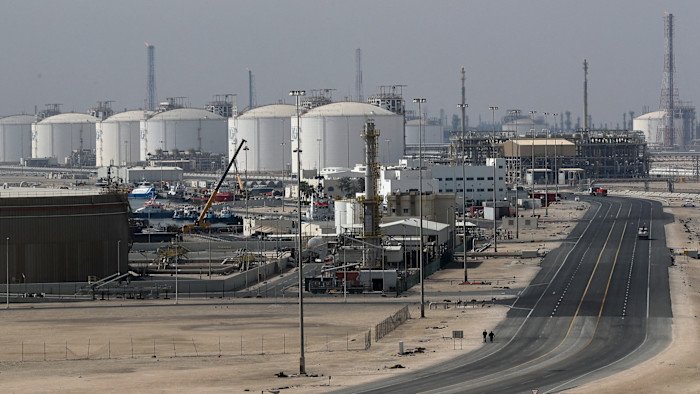
Global energy markets were jolted on Monday as natural gas prices spiked by nearly 50 percent,as Brent crude climbs above $82 following a decision by QatarEnergy to suspend liquefied natural gas production after reported military attacks on its facilities.
The surge comes amid escalating tensions in the Middle East after US and Israeli strikes in Iran triggered retaliatory action from Tehran across the region. The renewed hostilities have unsettled oil and gas markets and raised fears of prolonged disruption to global supply chains.

Brent crude, the international benchmark, jumped by 10 percent to trade above 82 dollars per barrel in early dealings. The spike followed reports that at least three vessels were attacked near the Strait of Hormuz over the weekend. The narrow waterway, located south of Iran, handles roughly 20 percent of the world’s oil and gas shipments.
Iran has warned vessels against passing through the route, heightening concerns of supply bottlenecks. Shipping activity at the entrance to the strait has slowed sharply, with analysts cautioning that any prolonged closure could drive energy prices higher.
In financial markets, London’s FTSE 100 fell by 1 percent. Airline stocks were among the hardest hit as Middle East airspace disruptions intensified. Major banks, including Barclays, Standard Chartered and HSBC, also recorded losses amid fears that sustained high energy prices could fuel inflation and limit central banks’ scope for interest rate cuts.
Across Europe, the downturn was more pronounced. France’s CAC 40 declined by 1.8 per cent, while Germany’s DAX dropped 2.1 per cent in afternoon trading.
Read Also:
- Iran unleashes 6th wave of missile, drone strikes on Israel, US bases across Middle East
- UK withdraws embassy staff in Tehran over US-Iran crisis
- Tinubu, Siemens push for Extra 4,000MW deal to end Nigeria’s power crisis
Gold, often seen as a safe haven in times of geopolitical uncertainty, rose by 2 percent to 5,388 dollars per ounce.
Qatar’s Ministry of Defence said a drone launched from Iran targeted a facility in Ras Laffan Industrial City, prompting QatarEnergy to halt LNG production. Another drone reportedly struck a water tank linked to a power plant in Mesaieed, south of Doha.
In neighbouring Saudi Arabia, Saudi Aramco temporarily shut its Ras Tanura refinery after it was hit by a drone.
The UK Maritime Trade Operations confirmed that two vessels were struck near the Strait of Hormuz, while an unidentified projectile exploded close to a third.
Despite the sharp initial surge, Brent crude later eased to around 79 dollars per barrel, while US-traded oil remained up by 7.6 percent at 72.20 dollars.
Energy analysts noted that markets are closely watching whether oil transport and production infrastructure become sustained targets. For now, traders appear to be weighing the scale of the disruption against the possibility of diplomatic de-escalation.
The unfolding crisis has renewed concerns about global energy security, inflationary pressure and the stability of international shipping routes at a time when markets remain sensitive to geopolitical shocks.