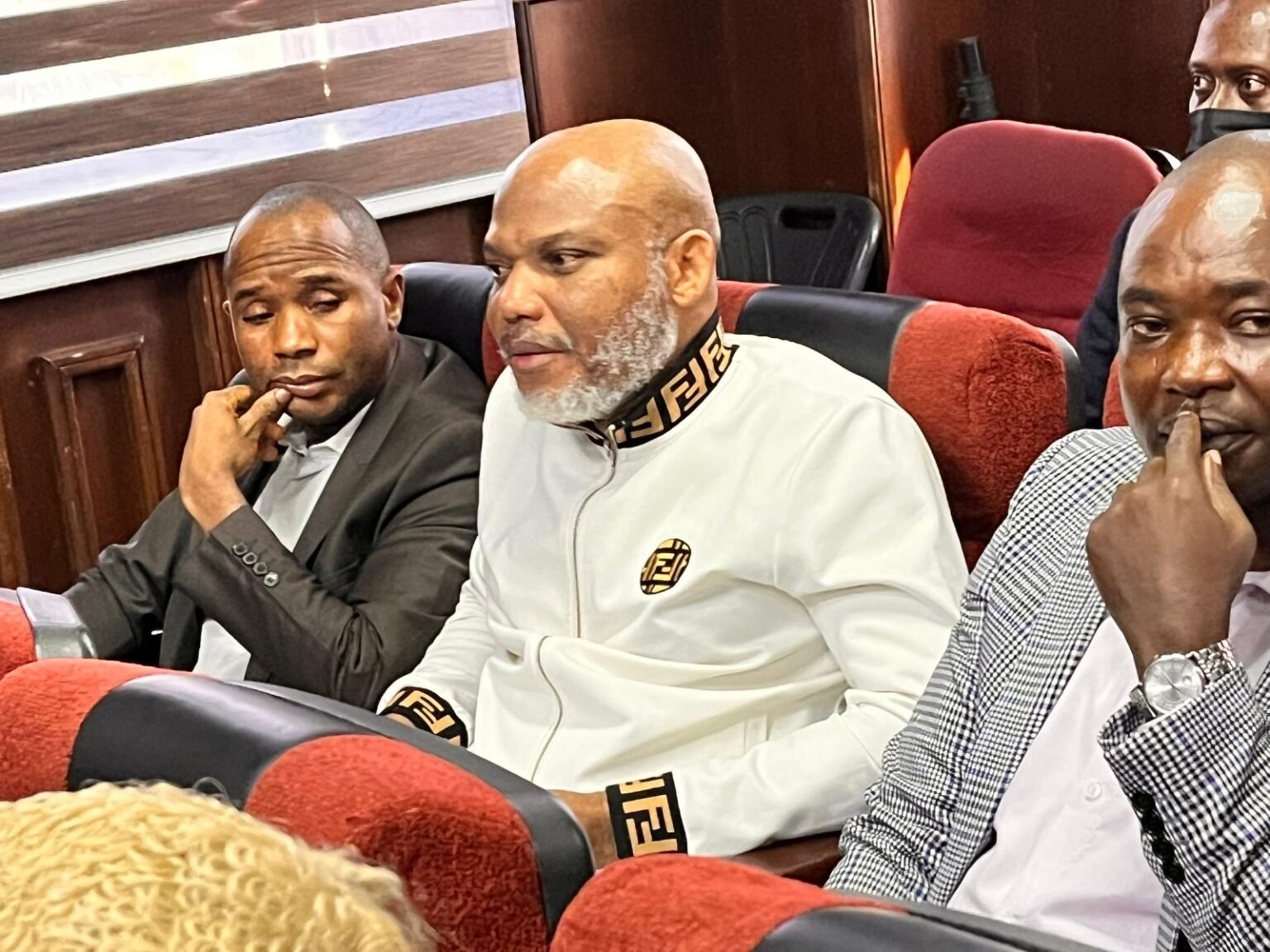
The Nnamdi Kanu Global Defence Consortium has declared that the Abuja Federal High Court ruling that sentenced the leader of the banned Indigenous People of Biafra (IPOB), Nnamdi Kanu, to life imprisonment cannot stand appeal.
It is expected that Kanu’s lawyers will file an appeal to challenge the judgment passed by Justice James Omotosho.

Kanu was scheduled to be moved by the management of Sokoto Prison, where he is serving the sentence, to the Abuja Federal High Court for an appeal records settlement on November 28, but the court did not issue a warrant for his movement.
However, in a statement on Monday ahead of the formal filing of the appeal, Kanu’s defence team explained why the judgment will not survive an appeal.
Speaking on behalf of the Nnamdi Kanu Global Defence Consortium, Christopher Chidera, described Justice Omotosho’s reliance on a repealed law in the conviction as “legally impossible”.
The defence team cited previous Supreme Court cases to sustain the argument that the judgment cannot stand.
“To understand how indefensible Justice Omotosho’s approach is, one must look at what the Supreme Court has consistently held for over four decades: once a law is repealed, it becomes dead, extinct, and of no legal effect.
“It cannot be the foundation of a charge, trial, or conviction. This principle is not controversial. It’s not ambiguous.
“It’s not subject to judicial assumption without conceding. It is black-letter law, affirmed repeatedly by the Supreme Court,” he asserted.
Read Also:
- Nnamdi Kanu declared “Prison President” by Sokoto Inmates after life sentence
- Nnamdi Kanu’s life sentence, was justice served?
- Kanu’s conviction, a corruption of law, travesty of justice – APC chieftain
Listing Supreme Court rulings that vaporize Justice Omotosho’s judgment, the statement pointed to attorney-general Lagos State vs Dosunmu (1989), noting that a repealed law ceases to exist in the eyes of the law.
Further citing Uwaifo vs attorney-general of the defunct Bendel State, the defence team held that a court that applies a repealed law acts without jurisdiction.
It added: “In Uwaifo vs AG Bendel State, the Supreme Court held that a repealed statute cannot confer jurisdiction.
“Any proceeding conducted under a repealed law is a nullity. A judge must take judicial notice of the current state of the law.
“This is exactly the scenario in Justice Omotosho’s courtroom. The 2022 TPPA was the extant law. The 2013 TPAA was extinct. Failure to take judicial notice of the repeal is a jurisdictional defect.
“Again, this is precisely why Kanu repeatedly said my lord, show me the law. Because the law Omotosho was applying no longer existed.”
Further faulting the conviction, the defence team noted that no Nigerian court today applies the 1979 Constitution to decide a modern case, or relies on military era decrees as if they were still operative, or conducts a criminal trial under the Criminal Procedure Act because those instruments have been expressly replaced by newer ones.
“If no judge can resurrect the 1979 Constitution, if no judge can revive military decrees, if no judge can use the CPA today to run a criminal trial, then no judge can use TPAA 2013 to try or convict anybody after TPPA 2022 came into force.
“By refusing to apply TPPA 2022, Justice Omotosho acted without a legal foundation, ignored mandatory statutory transition clauses, violated Section 122 of the Evidence Act (judicial notice), contradicted binding Supreme Court authority, and operated ultra vires, without jurisdiction.
“This is why every authority, including Dosunmu and Uwaifo, makes Omotosho’s approach insupportable. The unavoidable outcome is that the trial collapses automatically.
“Once a trial is shown to have been conducted under a repealed statute, the foundation is gone, jurisdiction evaporates, the entire trial becomes a nullity, the conviction cannot stand,
and appellate courts have no choice but to set it aside. And that is why the entire trial cannot stand,” the defence team submitted.