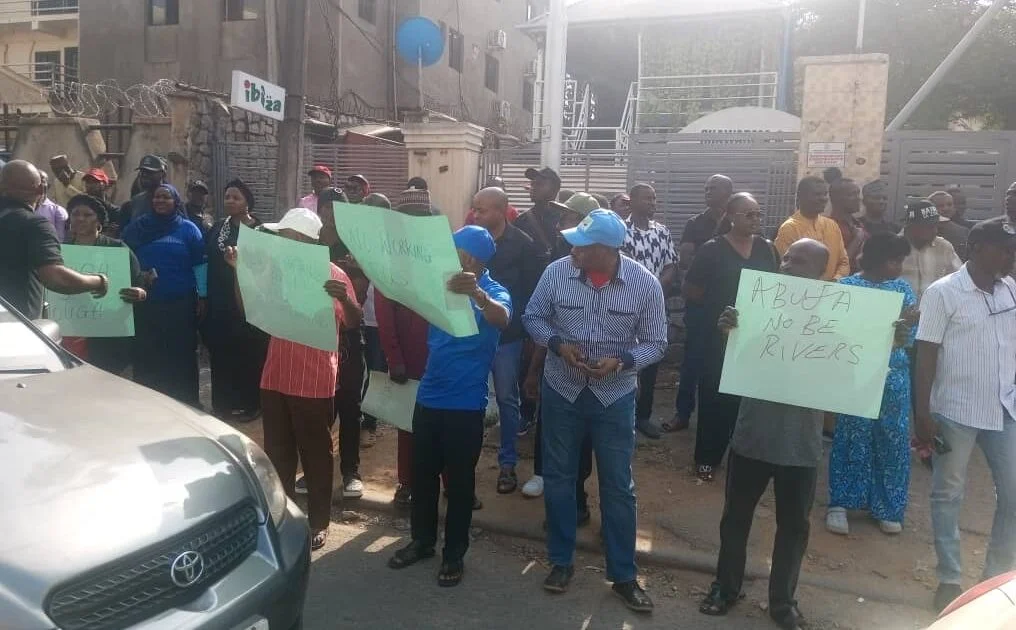
The National Industrial Court of Nigeria (NICN) in Abuja has directed workers operating under the Joint Union Action Committee (JUAC) to immediately halt their ongoing strike that has disrupted public services across the Federal Capital Territory.
The order followed the granting of an interlocutory injunction in favour of the Minister of the FCT, Nyesom Wike, and the Federal Capital Territory Administration (FCTA) in a suit marked NICN/ABJ/17/2026.

Delivering his ruling on Tuesday, Justice E.D. Subilim restrained JUAC, its officials, and agents from continuing the strike or engaging in related activities such as picketing and lockouts, pending the resolution of the substantive suit before the court.
The FCT minister and the FCTA had approached the court, naming JUAC Chairman Rifkatu Iortyer and Secretary Abdullahi Umar Saleh as defendants, contending that the industrial action was unlawful and had severely affected governance and essential services in the nation’s capital.
In his decision, Justice Subilim acknowledged that the dispute qualified as a trade dispute but emphasized that the right to strike is not absolute. He ruled that once a matter has been formally referred to the National Industrial Court, workers are legally barred from continuing any strike action related to the dispute.
“An order of interlocutory injunction is hereby granted restraining the defendants, their officers and representatives from embarking on any form of industrial action against the claimants, pending the determination of this suit,” the judge ruled.
The case was adjourned to March 23, 2026, for hearing of the substantive matter.
Read Also:
- NUT orders FCT primary, secondary school teachers to join strike
- ADC seeks postponement of FCT area council elections
- Wike plays the Ostrich as FCT grinds to a halt: The human cost of governance failure
The industrial action, which commenced last Monday following the expiration of a seven-day ultimatum issued by labour unions, resulted in the closure of several government offices and disruption of services across Abuja.
While the FCTA maintained that it had resolved the majority of the workers’ demands, JUAC insisted that critical issues, including outstanding entitlements and welfare-related concerns, were yet to be addressed.
During the proceedings, counsel to the workers, Maxwell Opara, urged the court to dismiss the application, arguing that granting the injunction would amount to pre-judging the substantive case. However, counsel to the FCT minister and the FCTA, James Onoja (SAN), argued that JUAC lacked legal standing, stating that it was not registered under the Trade Union Act and therefore had no authority to declare a strike.