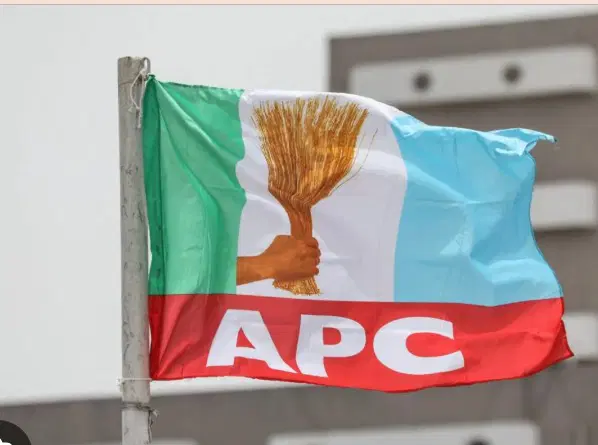
When the All Progressives Congress (APC) in Taraba State announced on Monday its endorsement of Governor Agbu Kefas for another term in office, it was more than a routine political declaration.
For many observers, it marked the consolidation of a dramatic political shift that has redefined the balance of power in the state.

The endorsement, delivered by the outgoing State Working Committee through its Chairman, Ibrahim Tukur El-Sudi, came as the party’s current leadership prepares to hand over following the expiration of its tenure.
Party leaders described the moment as historic — a symbolic close to a chapter that saw the APC move from opposition status to firmly occupying the driver’s seat in Taraba politics.
Governor Kefas’ recent defection to the APC sent ripples through the state’s political landscape. In a state long accustomed to a different power configuration, his move altered alliances, recalibrated loyalties and set off a chain reaction within party structures at both state and grassroots levels.
According to party officials, what could have turned into a fractious transition instead became a carefully managed realignment. They credited the governor with demonstrating “maturity and statesmanship,” ensuring that the process avoided the internal crises that have accompanied similar defections in other states.
Read also:
- Exclusive: Why Nigeria’s 2030 N1 Trillion economy target remains a mirage
- MPAC condemns US–Israel strikes, calls for international accountability
- Gov. Nwifuru warns Ebonyi varsity students to shun cultism, exam malpractices
The relatively smooth integration strengthened internal cohesion within the APC and, in the view of analysts, gave the party the stability it needed at a critical time.
Beyond the symbolism of defection and endorsement lies the mechanics of party consolidation. The APC leadership highlighted the successful conduct of congresses in all 168 wards and the 16 local government areas of the state — exercises they described as peaceful and inclusive.
Stakeholders at ward and local government levels were consulted, party officials said, reinforcing a sense of ownership and participation among grassroots members.
The committee also revealed that Taraba ranked among the top-performing states in the party’s electronic membership registration and revalidation exercise. The process, according to El-Sudi, received financial backing from governor Kefas and has since driven steady growth in membership across council wards.
Political analysts suggest that such grassroots expansion could prove decisive in future electoral contests, providing the APC with a strengthened base and improved mobilization capacity.
In its formal resolution, the State Working Committee unanimously endorsed Governor Kefas for another term, citing his leadership style and commitment to development.
“With these milestones, Taraba State is now fully integrated and firmly established as an APC state,” the committee declared.
The endorsement is widely interpreted as both a vote of confidence and a strategic signal. By rallying early around a single candidate, the party appears intent on minimizing internal fractures while projecting unity ahead of the next political cycle.
Party officials argue that continuity would allow the governor to consolidate ongoing projects and initiate new development programmes aimed at advancing the state’s economic and social progress.
The APC leadership also called on residents to align with the broader national agenda by supporting President Bola Ahmed Tinubu alongside Governor Kefas.
The appeal underscores a broader strategy of harmonizing state and federal political interests — a move party insiders believe could translate into greater political leverage and development opportunities for Taraba.
As the outgoing State Working Committee bows out, it leaves behind a party structure markedly different from the one it inherited. Whether the endorsement of Governor Kefas ultimately secures long-term dominance for the APC will depend on performance, public perception, and the evolving dynamics of Taraba politics.