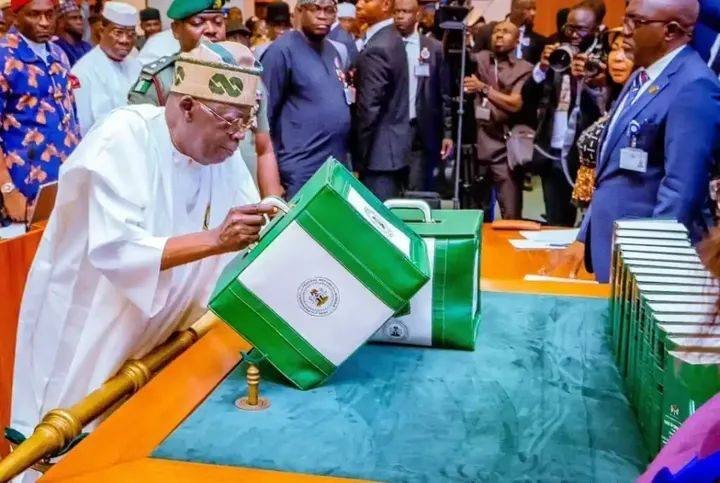
President Bola Ahmed Tinubu’s presentation of Nigeria’s 2026 federal budget to the National Assembly has ignited a national debate, blending cautious optimism with deep skepticism as the government simultaneously pushed for the continued implementation of the 2025 Appropriation Act into 2026. The proposal, unveiled on December 19, 2025 and themed “Budget of Consolidation, Renewed Resilience and Shared Prosperity,” arrives at a moment of fragile economic recovery and mounting public scrutiny over fiscal discipline.
Key Highlights:

- Tinubu proposed a record ₦58.18 trillion expenditure for 2026, the largest budget in Nigeria’s history, alongside a request to extend the lifespan of the 2025 budget to March 31, 2026 to complete ongoing projects and end overlapping fiscal cycles.
- The administration projects revenues of ₦34.33 trillion, leaving a deficit of ₦23.85 trillion to be financed largely through borrowing.
- The government insists the plan will consolidate recent economic gains, including slowing inflation, rising foreign reserves and modest GDP growth.
The president described the proposal as a turning point under his Renewed Hope Agenda, arguing that Nigeria is emerging from economic turbulence and must now focus on execution, discipline and shared prosperity. Yet critics warn that unresolved failures from the 2025 budget threaten to undermine the credibility of the new proposal.
Under the 2026 Appropriation Bill, debt servicing is allocated ₦15.52 trillion, underscoring Nigeria’s heavy fiscal burden, while recurrent non-debt expenditure stands at ₦15.25 trillion. Capital spending receives a major boost, with ₦26.08 trillion earmarked for infrastructure and development projects, reflecting the administration’s push to stimulate growth through construction, power and transport.
Budget assumptions remain conservative, with crude oil benchmarked at $64.85 per barrel, daily production set at 1.84 million barrels, and the exchange rate pegged at ₦1,400 to the dollar. Tinubu told lawmakers that inflation had eased to 14.45 percent in November 2025 from over 24 percent earlier in the year, GDP growth reached 3.98 percent in the third quarter, and external reserves climbed to a seven-year high of $47 billion.
Security dominates sectoral allocations, with ₦5.41 trillion assigned to defence and internal security as the government vows to intensify the fight against banditry, terrorism and violent crime. Infrastructure follows with ₦3.56 trillion, education receives ₦3.52 trillion, and health is allocated ₦2.48 trillion, signaling continued emphasis on human capital and social stability.
Read also:
- Edo 2026 Budget: Okpebholo targets infrastructure, jobs to redefine public spending — Okoebor
- Gov. Okpebholo presents ₦939bn budget of hope, growth to assembly
- Igbo-Etiti council chairman proposes ₦7.74bn budget for 2026
However, the shadow of the 2025 budget looms large. Implementation has been slow, with barely 17.7 percent of capital expenditure released by the third quarter of 2025. Analysts say weak revenues, cash flow challenges and overlapping budgets have stalled projects, distorted fiscal planning and weakened public confidence. Tinubu’s request to extend the 2025 budget and re-enact earlier appropriation laws is framed as a reform move, but critics argue it reflects deeper planning failures.
Reactions have been sharply divided. Supporters within the ruling APC and some economists praise the budget’s focus on security, infrastructure and macroeconomic stability, describing it as a consolidation of hard-won gains. The opposition PDP, however, dismissed it as a budget that entrenched hardship, while figures such as Peter Obi questioned the wisdom of presenting a new budget amid unresolved spending from the previous year. Lawmakers have also warned that persistent budget overlaps signal fiscal disorder.
As deliberations continue in the National Assembly, the 2026 budget stands at the center of Nigeria’s economic crossroads. Whether it becomes a tool for genuine consolidation or another chapter in fiscal controversy will depend not on projections, but on execution. For millions of Nigerians grappling with high living costs and uncertain incomes, the coming months will test whether renewed hope can translate into real relief.