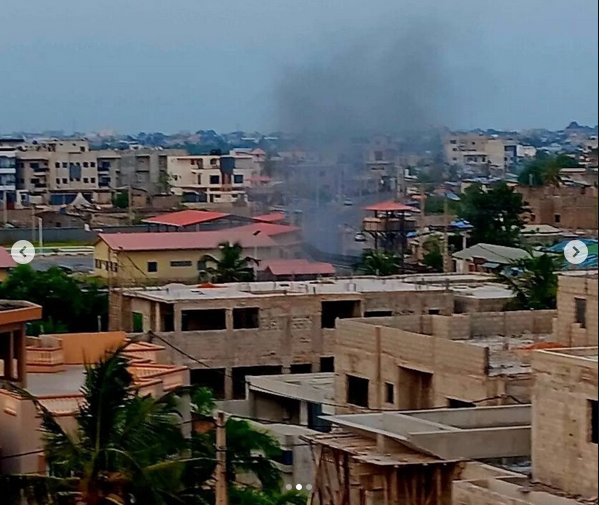
Explosions rocked the Tignon Barracks in Cotonou on Sunday as loyalist forces pushed to dislodge a small group of rebel soldiers linked to the failed coup attempt against President Patrice Talon. The blasts, which thundered across the capital shortly after midday, signaled a sharp turn in the confrontation that began before dawn when mutineers seized the state broadcaster and claimed to have toppled the government.
Residents near the barracks described a frightening scene as heavy smoke rose over the district and security vehicles raced toward the base. Many who had begun to resume normal routines after a morning of gunfire retreated indoors once again. One resident, Aïcha Kouassi, said the shock of the explosions left her neighborhood in panic as helicopters hovered above the city.
The uprising was led by Lieutenant Colonel Pascal Tigri, a mid-level officer who has been openly critical of the government’s efforts to contain extremist violence along the country’s northern frontier. The mutineers, believed to number slightly more than a dozen, briefly hijacked the national broadcaster, ORTB, using its signal to announce the creation of a “Military Committee for Refoundation.” Their broadcast claimed to suspend the constitution and dissolve all governing institutions.

Tigri has since disappeared. Security officials say he escaped after the failed strike on the presidential residence at Camp Guézo and is now the target of an intensive manhunt. Remaining members of his group retreated to the Tignon Barracks, where some are reported to be attempting to disguise themselves as civilians as loyalist forces close in.
Interior Minister Alassane Seïdou spoke at midday to calm public concern. He said the armed forces had contained the mutiny and secured key institutions across the city. According to him, the president is safe and has been moved to a protected location.
The coup attempt has shaken Benin’s reputation as one of West Africa’s most stable democracies. President Talon has faced rising criticism in recent years over constitutional reforms, restrictions on opposition activity, and security challenges in the northern provinces where attacks linked to jihadist groups have displaced thousands.
Read also:
- Nigeria condemns failed Coup in Benin Republic, backs Talon as Army restores order
- Hanga rejects State Police plan, warns it could worsen Nigeria’s security troubles
- Umahi says Lagos–Calabar Coastal Highway to get relief stations, solar lighting, CCTV for faster emergency response
By late afternoon, ORTB returned to regular programming with messages asserting that order had been restored. Armoured vehicles continued to patrol central Cotonou, and checkpoints remained in place across several districts. Finance Minister Romuald Wadagni said loyalist forces had cornered the remaining rebels but were still working to stabilise the area.
There have been injuries among soldiers on both sides, although full casualty figures remain uncertain. No civilian deaths have been confirmed, yet the impact on daily life has been profound. Schools, markets and public offices were closed throughout the day, and the streets of Cotonou reflected a city still anxious after hours of unrest.
As evening settled over the city, the government projected confidence, though analysts warned that the grievances driving the mutiny will require careful attention. The unresolved challenges of insecurity, economic pressure and political discontent have left many wondering how long the calm will last. The search for Tigri and the surrender or capture of his remaining supporters will determine the immediate next steps as Benin works to reassert stability after one of the most dramatic days in its recent history.