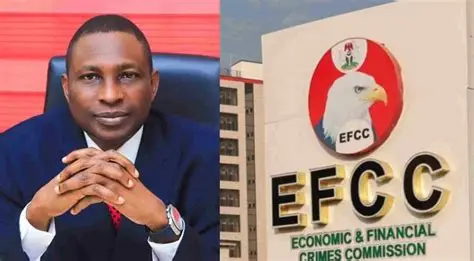
The Executive Chairman of the Economic and Financial Crimes Commission (EFCC), Mr. Ola Olukoyede has urged the public to adopt greater accountability in the fight against corruption to facilitate a swift return to order and stability in Nigeria.

According to a post on its official X handle on Monday 22 December 2025, Olukoyede made this statement on Friday, December 19, 2025, while delivering a presentation on Corruption, National Security, and Economic Prosperity at the Annual Lecture Series of the Nigeria Air Force Officers Mess Honourary Members’ Forum in Lagos.
Speaking through the EFCC’s Director of Public Affairs, Commander CE Wilson Uwujaren, the EFCC Chairman noted that inadequate accountability in managing resources in both public and private sectors is exacerbating corruption throughout the country.
He acknowledged that issues such as religious extremism, ethnic conflicts, and demands for self-determination, often stemming from perceived or actual marginalization, are commonly cited as causes of widespread insecurity in various regions. However, he emphasized that “the real elephant in the room is corruption.”
Corruption, he explained, contributes to insecurity when funds intended for state security are misappropriated or when resources that could alleviate poverty among the majority are diverted into the hands of the ruling elite.
Read also:
- EFCC nabs suspected internet fraudsters
- EFCC arrests member of syndicate for duping Kwara Monarch N33.39m
- EFCC’s committed to fight against money laundering, terrorism financing – Bawa
He condemned the misuse of security votes, labeling them as an unaccountable means of misappropriating public funds, and referenced a former governor currently facing prosecution for allegedly embezzling over N4 billion in security votes.
The EFCC Chairman stated that the Commission is committed to combating terrorism and violent extremism by employing non-kinetic strategies to hinder the flow of illicit funds to criminal groups in conflict areas. Additionally, the EFCC monitors the activities of designated non-financial institutions and Bureau De Change operators to prevent their use in money laundering and illicit financial transactions.
Other measures include overseeing the operations of international and local NGOs in the Northeast to ensure they are not exploited for subversive purposes, and collaborating with anti-corruption agencies in West Africa through the Network of Anti-corruption Institutions in West Africa (NACIWA) to enhance anti-money laundering frameworks and enforcement in the region.
He also highlighted the Commission’s asset recovery efforts, which have resulted in the retrieval of significant sums and properties, aiding the nation’s economic recovery. He noted that investing part of the recovered funds in social programs, such as student loan schemes and consumer credit initiatives, has the potential to lift many individuals out of poverty.
“Other deliberate interventions by the Commission to stimulate the economy include measures to support the Central Bank of Nigeria’s monetary policy through fighting currency racketeering and mutilation as well as the dollarization of the economy. The enforcement action targeted at illegal forex dealers in major cities across the country helped to ease the pressure on the value of the naira and by extension ensured the prevailing stability.
“In addition, the Commission took a deliberate decision on the assumption of office of the Executive Chairman, Ola Olukoyede, not to shut down concerns that are subject of investigation to preserve jobs and livelihood. While the impact of this decision is difficult to measure, it has made a difference in the lives of hundreds of households over the last two years of unprecedented economic turbulence.