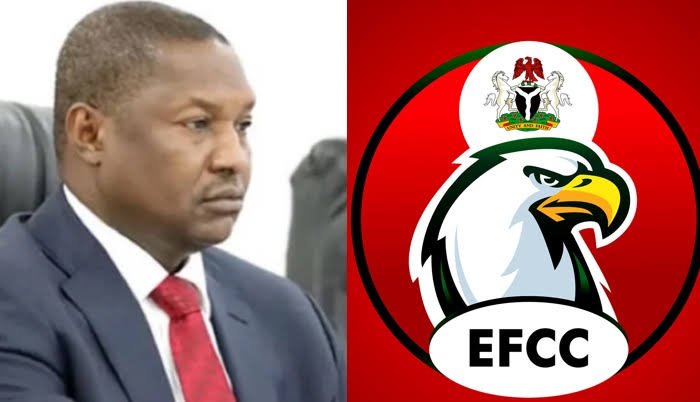
The arrest of former Attorney-General of the Federation Abubakar Malami has stirred intense public attention after the Economic and Financial Crimes Commission took him into custody on allegations of terrorism financing and money laundering. He is also being questioned over suspicious accounts, a reported N10 billion investment trail in Kebbi State, and the whereabouts of the $322 million Abacha loot repatriated from Switzerland along with another $22 million recovered from Jersey.
Key Highlights
The EFCC kept Malami in custody late into Tuesday night, as he had yet to meet the bail conditions set for his release.

A senior official said investigators are examining a long list of allegations, suggesting the exercise may last several days.
The official stated that the probe covers suspected terror-financing links, questions over the repatriated Abacha funds, and the sudden growth of Malami’s private investments.
The EFCC is also expected to question one of his wives over an alleged connection to N4 billion from the Anchor Borrowers Programme.
Malami has pushed back forcefully at the accusations. He said his record as Minister of Justice contradicts any claim of involvement in terror financing. He insisted he has never been interrogated or charged by any local or foreign agency over such offences.
Read also:
- Court orders ministries to pay journalist N2 million for denial of information
- HURIWA deplores court’s ruling on pregnant single cops
- Suspicion Trails Kyari’s Extradition Moves and Trial by NDLEA
In a statement released on X, he argued that the allegations arose from political mischief and misinterpretations of a retired military officer’s claims. He stressed that terrorism financing is a serious crime and should not be tied to anyone without clear evidence.
He went on to outline his role in national reforms, pointing to the establishment of the Nigerian Financial Intelligence Unit as an autonomous body, the enactment of the Money Laundering (Prevention and Prohibition) Act of 2022, and the strengthening of Nigeria’s counter-terrorism laws. He said his office consistently worked with relevant institutions to improve coordination and compliance across the country’s anti-money-laundering and counter-terrorism-financing systems.
As of Tuesday night, the EFCC indicated that Malami would remain in custody until he satisfied his bail terms, with investigators continuing to examine the full scope of allegations linked to his tenure and private dealings.